Symbolic Quantum-Trajectory Method for Multichannel Dicke Superradiance
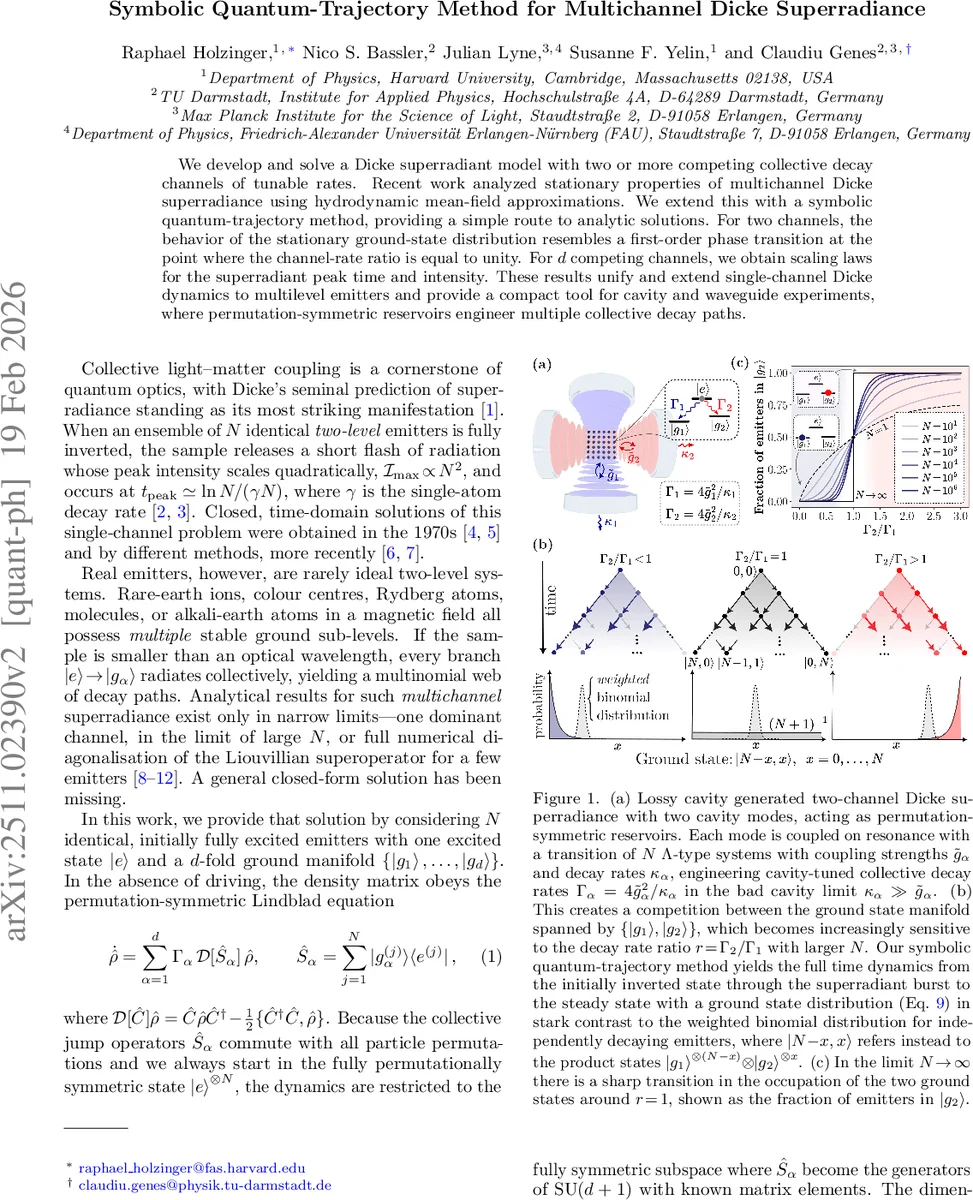
We develop and solve a Dicke superradiant model with two or more competing collective decay channels of tunable rates. Recent work analyzed stationary properties of multichannel Dicke superradiance using hydrodynamic mean-field approximations as shown by Mok et al. [Phys. Rev. Res. 7, L022015 (2025)]. We extend this with a symbolic quantum-trajectory method, providing a simple route to analytic solutions. For two channels, the behavior of the stationary ground-state distribution resembles a first-order phase transition at the point where the channel-rate ratio is equal to unity. For $d$ competing channels, we obtain scaling laws for the superradiant peak time and intensity. These results unify and extend single-channel Dicke dynamics to multilevel emitters and provide a compact tool for cavity and waveguide experiments, where permutation-symmetric reservoirs engineer multiple collective decay paths.
💡 Research Summary
In this work the authors present a fully analytical treatment of Dicke superradiance when several collective decay channels compete, using a symbolic quantum‑trajectory (quantum‑jump) construction. The model consists of N identical emitters, each with one excited state |e⟩ and a d‑fold ground‑state manifold {|g₁⟩,…,|g_d⟩}. Because the emitters are confined to a volume much smaller than the optical wavelength, all transitions couple to the same radiation mode and the dynamics are permutation‑symmetric. Consequently the master equation reduces to a Lindblad form with collective jump operators Ŝ_α = Σ_j |g_α⟩_j⟨e|_j and decay rates Γ_α. The Hilbert space therefore collapses to the symmetric subspace of dimension (N+d choose d).
The authors first revisit the single‑channel case (d=1). By unraveling the Lindblad equation into pure‑state trajectories, each trajectory consists of a sequence of non‑Hermitian evolutions under Ĥ_eff = −i(Γ/2)Ŝ†Ŝ punctuated by instantaneous jumps Ŝ. The probability to be in the symmetric Dicke state with m excitations after q = N−m jumps is obtained as a product of binomial coefficients and a chain of exponential decays with rates Λ_k = Γ·k(N+1−k). This chain can be written as a nested convolution of exponentials, or equivalently as a Laplace transform ˜p_m(s)=C_m/∏_{k=m}^N (s+Λ_k). The emitted intensity follows directly as I(t)=Γ Σ_m m(N+1−m) p_m(t).
For two competing channels (d=2) the situation becomes richer. Each jump can occur via channel 1 (rate Γ₁) or channel 2 (rate Γ₂). The authors introduce two counters u₁ and u₂ that record how many photons have been emitted into each channel. A trajectory is encoded by a binary string α = (α_N,…,α_{m+1}) where α_k=1 denotes a jump of type 1 and α_k=0 a jump of type 2. The total number of distinct paths leading to a final ground‑state configuration |n₁,n₂⟩ (with n₁+n₂ = N−m) is the multinomial coefficient (n₁+n₂)!/(n₁! n₂!). Along a given path j the non‑Hermitian evolution acquires a time‑dependent decay rate Λ^{(j)}_k = k
Comments & Academic Discussion
Loading comments...
Leave a Comment