Precision of an autonomous demon exploiting nonthermal resources and information
Quantum-dot systems serve as nanoscale heat engines exploiting thermal fluctuations to perform a useful task. Here, we investigate a multi-terminal triple-dot system, operating as a refrigerator that extracts heat from a cold electronic contact. In contrast to standard heat engines, this system exploits a nonthermal resource. This has the intriguing consequence that cooling can occur without extracting energy from the resource on average – a seemingly demonic action – while, however, requiring the resource to fluctuate. Using full counting statistics and stochastic trajectories, we analyze the performance of the device in terms of the cooling-power precision, employing performance quantifiers motivated by the thermodynamic and kinetic uncertainty relations. We focus on two regimes with large output power, which are based on two operational principles: exploiting information on one hand and the nonthermal properties of the resource on the other. We show that these regimes significantly differ in precision. In particular, the regime exploiting the nonthermal properties of the resource can have cooling-power fluctuations that are suppressed with respect to the input fluctuations by an order of magnitude. We also substantiate the interpretation of the two different working principles by analyzing cross-correlations between input and output heat currents and information flow.
💡 Research Summary
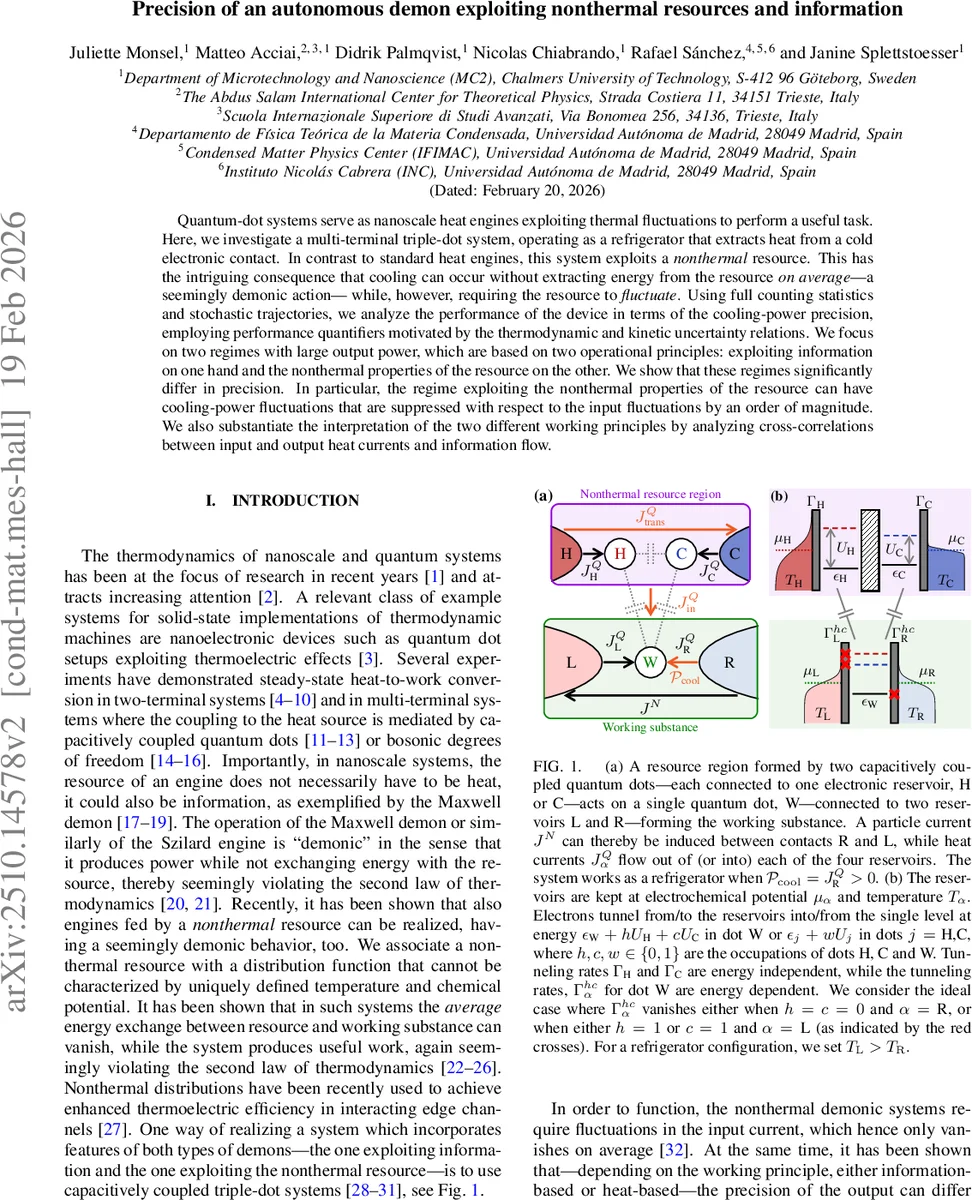
The paper investigates a three‑quantum‑dot (QD) device that operates autonomously as a refrigerator. The upper part of the device consists of two capacitively coupled QDs (labeled H and C), each attached to its own electronic reservoir at different temperatures (T_H > T_C) but the same chemical potential (set to zero). Strong inter‑dot Coulomb repulsion (U → ∞) forbids simultaneous occupation of H and C, so the pair constitutes a non‑thermal resource: its occupation probabilities fluctuate but its average energy exchange with the lower part can be tuned to zero. The lower part contains a single QD (W) coupled to two reservoirs L and R (with temperatures T_L > T_R) that serve as the working substance. Because the energy of an electron tunneling into or out of W depends on the occupations h and c of H and C (through capacitive shifts U_H and U_C), the tunneling rates Γ_{hc}^{L,R} become state‑dependent, effectively acting as an energy filter.
Two distinct operating principles are explored. In the “information‑driven” regime the device extracts heat from the cold reservoir R while absorbing a finite amount of heat from the resource (J_Q^{in}>0). The demon‑like behavior relies on the resource acquiring information about the state of W, quantified by an information current J_I. In the “non‑thermal‑resource” regime the average heat injected from the resource vanishes (J_Q^{in}=0); nevertheless, fluctuations of the resource occupations drive a net cooling current P_cool = J_Q^{R}>0. This is the genuinely demonic situation: no average energy is taken from the resource, yet cooling occurs because the resource’s stochastic fluctuations are rectified by the energy‑filtering action of W.
The authors employ steady‑state full counting statistics (FCS) based on an extended master equation to obtain first‑ and second‑order cumulants of particle number, transferred energy, and information. From these cumulants they extract average heat currents J_Q^{α}, their variances S_{J_Q^{α}J_Q^{β}}, the activity K (total number of tunneling events per unit time), and the information current J_I. The cooling power is defined as P_cool = J_Q^{R} (positive when heat is extracted from reservoir R). The resource’s contribution is split into an injected heat current J_Q^{in}=J_Q^{C}+J_Q^{H} and a “transport” current J_Q^{trans}=(J_Q^{H}−J_Q^{C})/2, the latter measuring the non‑thermal character of the resource.
To assess precision, the paper adopts three uncertainty‑relation‑based performance quantifiers. The thermodynamic uncertainty relation (TUR) yields X_TUR = 2 P_cool² S_{P_cool} / (P_cool · Σ̇) ≤ 1, where Σ̇ is the total entropy production rate Σ̇ = −∑α J_Q^{α}/T_α. The kinetic uncertainty relation (KUR) gives X_KUR = P_cool² S{P_cool} / (P_cool · K) ≤ 1. A local version, X_locKUR = P_cool² S_{P_cool} / (P_cool · S_{J_NJ_N}), replaces the global activity by the particle‑current noise, a quantity directly measurable in experiments. All three bounds are guaranteed for classical Markovian dynamics, but the authors find regimes where X_locKUR exceeds unity because the capacitive coupling introduces correlations not captured by simple particle‑noise activity.
Numerical results reveal stark differences between the two regimes. In the information‑driven case, the cooling power is modest and its relative fluctuations are large; consequently X_TUR and X_KUR are well below their maximal values, indicating limited precision. In contrast, when the device exploits the non‑thermal resource, the cooling power can approach its theoretical maximum while the variance of the cooling power is suppressed by roughly an order of magnitude relative to the variance of the input heat current. This leads to X_TUR and X_KUR values close to unity, i.e. near‑optimal trade‑offs between power, efficiency, and precision. The authors also compute Pearson correlation coefficients ρ_{J_Q^{in}, J_Q^{trans}} and ρ_{J_Q^{in}, P_cool}. In the non‑thermal regime these correlations are weak, reflecting the decoupling of input and output fluctuations, whereas in the information‑driven regime strong positive or negative correlations appear, explaining why fluctuations are amplified.
A comparative analysis with a conventional absorption refrigerator, where energy is transferred via particle exchange rather than capacitive coupling, shows that the latter can achieve higher precision because the energy‑filtering mechanism directly shapes the statistics of the output heat current. The paper discusses experimental feasibility: charge detectors (quantum point contacts or single‑electron transistors) can resolve individual tunneling events, and because each tunneling event carries a well‑defined energy in the Coulomb‑blockade regime, heat‑counting statistics are in principle accessible.
In summary, the work demonstrates that a triple‑dot autonomous demon can operate with vanishing average energy intake from its non‑thermal resource while delivering sizable cooling power. The precision of this operation, quantified through TUR and KUR, is dramatically better when the device relies on the non‑thermal nature of the resource rather than on information flow. These findings broaden the understanding of how stochastic fluctuations and non‑thermal distributions can be harnessed for nanoscale thermodynamic tasks, and they provide concrete design principles for future quantum‑dot based refrigerators and information‑to‑heat converters.
Comments & Academic Discussion
Loading comments...
Leave a Comment