Semi-orthogonal decompositions via t-stabilities
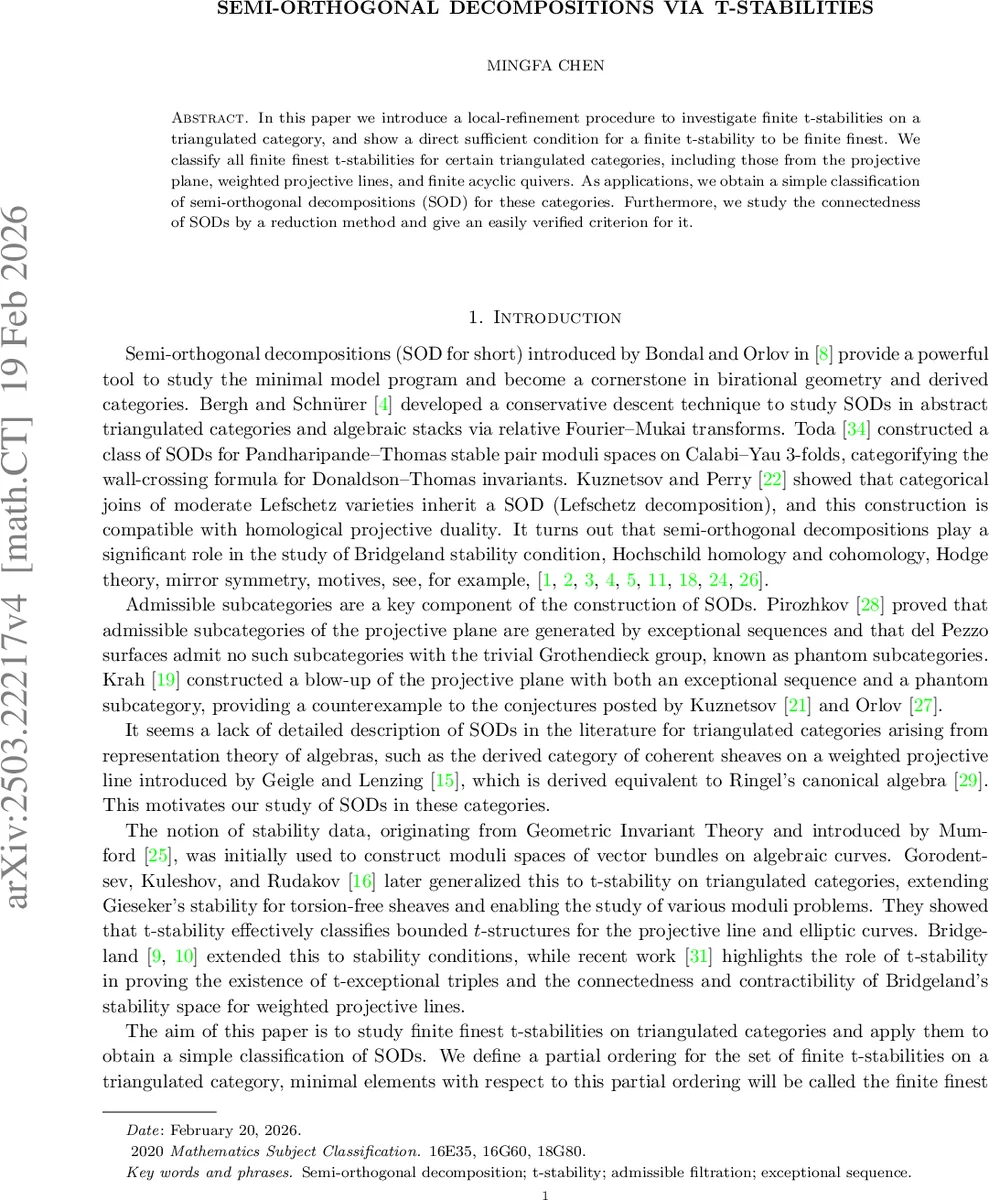
In this paper we introduce a local-refinement procedure to investigate finite t-stabilities on a triangulated category, and show a direct sufficient condition for a finite t-stability to be finite finest. We classify all finite finest t-stabilities for certain triangulated categories, including those from the projective plane, weighted projective lines, and finite acyclic quivers. As applications, we obtain a simple classification of semi-orthogonal decompositions (SOD) for these categories. Furthermore, we study the connectedness of SODs by a reduction method and give an easily verified criterion for it.
💡 Research Summary
The paper develops a systematic framework for classifying semi‑orthogonal decompositions (SODs) of triangulated categories by exploiting finite t‑stabilities. After recalling the basic notions of SODs, admissible subcategories and admissible filtrations, the authors establish a bijection between admissible SODs and strongly admissible filtrations (Proposition 2.4). They then introduce finite t‑stabilities, defined by a linearly ordered set Φ together with full extension‑closed subcategories Πφ satisfying a shift compatibility and a Hom‑vanishing condition. When Φ is finite, τΦ must be the identity, and each Πi becomes a full triangulated subcategory.
A central result (Proposition 3.5) shows that equivalence classes of finite t‑stabilities are in one‑to‑one correspondence with SODs via the map η, sending (Φ,{Πi}) to the ordered collection (Πi). This bridges the language of stability data and semi‑orthogonal decompositions. The authors then introduce a partial order ⪯ on finite t‑stabilities: (Φ,{Πi}) is finer than (Ψ,{Pψ}) if there exists a surjective order‑preserving map r:Φ→Ψ compatible with the shift and such that each Pψ is generated by the Πi lying over ψ. Minimal elements with respect to ⪯ are called finite finest t‑stabilities, and the corresponding SODs are the finest SODs.
To refine a given t‑stability, the paper proposes a local‑refinement procedure (Proposition 3.7). For each component Πi one chooses a finer finite t‑stability on Πi, and then assembles these into a new global t‑stability on D that is strictly finer than the original. This process preserves finiteness and the identity shift, providing an iterative method to reach the finest possible stability.
Assuming the existence of a Serre functor and certain admissibility conditions, the authors prove that every finite finest t‑stability arises from a complete exceptional sequence (Theorem 5.2). Consequently, the classification of finest SODs reduces to the classification of exceptional sequences. Applying this, they completely enumerate the finest SODs for several important categories: the derived category of the projective plane ℙ², derived categories of weighted projective lines ℙ(a,b,c), and derived categories of finite acyclic quivers. In each case the SODs are shown to be generated by exceptional objects, and no phantom subcategories appear.
The paper also addresses the connectivity of the mutation graph of SODs. Using a reduction method, the authors prove that if every pair of adjacent SODs shares a common admissible filtration, then the mutation graph is connected (Theorem 6.4). This provides an easily verifiable criterion for connectedness, which the authors demonstrate on the examples above.
Section 7 presents detailed examples illustrating the theory: explicit finest t‑stabilities and SODs for ℙ², for weighted projective lines such as ℙ(1,2,3), and for Aₙ‑type quivers, together with the corresponding mutation graphs. The examples confirm that the theoretical criteria work in practice and that the classification is exhaustive.
Overall, the work offers a powerful new perspective: by studying finite t‑stabilities and their local refinements, one obtains a complete classification of semi‑orthogonal decompositions for a broad class of triangulated categories and a practical tool for analyzing the structure of their mutation graphs. This bridges stability theory, exceptional collections, and the geometry of derived categories, opening avenues for further applications in birational geometry, representation theory, and homological mirror symmetry.
Comments & Academic Discussion
Loading comments...
Leave a Comment