On the Limit of the Tridiagonal Model for $β$-Dyson Brownian Motion
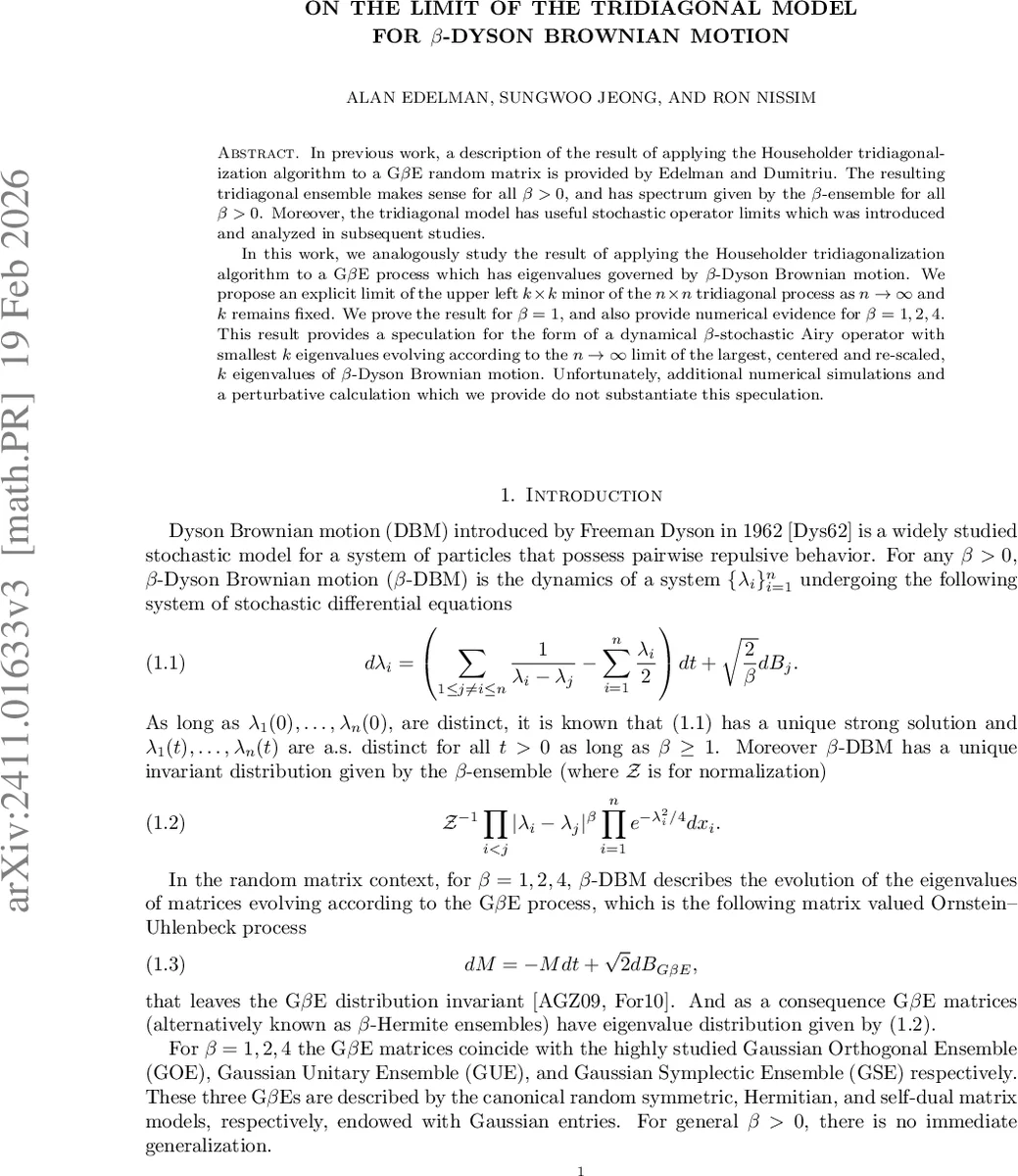
In previous work, a description of the result of applying the Householder tridiagonalization algorithm to a G$β$E random matrix is provided by Edelman and Dumitriu. The resulting tridiagonal ensemble makes sense for all $β>0$, and has spectrum given by the $β$-ensemble for all $β>0$. Moreover, the tridiagonal model has useful stochastic operator limits which was introduced and analyzed in subsequent studies. In this work, we analogously study the result of applying the Householder tridiagonalization algorithm to a G$β$E process which has eigenvalues governed by $β$-Dyson Brownian motion. We propose an explicit limit of the upper left $k \times k$ minor of the $n \times n$ tridiagonal process as $n \to \infty$ and $k$ remains fixed. We prove the result for $β=1$, and also provide numerical evidence for $β=1,2,4$. This leads us to conjecture the form of a dynamical $β$-stochastic Airy operator with smallest $k$ eigenvalues evolving according to the $n \to \infty$ limit of the largest, centered and re-scaled, $k$ eigenvalues of $β$-Dyson Brownian motion.
💡 Research Summary
The paper investigates the dynamical analogue of the well‑known tridiagonal β‑ensemble obtained by applying the Householder tridiagonalization to a static GβE matrix. Instead of a fixed matrix, the authors consider the GβE matrix process M(t) that satisfies the matrix Ornstein–Uhlenbeck stochastic differential equation dM = –M dt + √2 dB_{GβE}. At each time t the matrix is tridiagonalized, producing a symmetric tridiagonal process T(t) whose eigenvalues evolve according to β‑Dyson Brownian motion (β‑DBM). The central question is: as the matrix size n tends to infinity while keeping a finite top‑left k×k block (k fixed), what stochastic processes describe the entries of this block?
The main result, Theorem 3.1, is proved for β = 1. For each fixed index j ≤ k the diagonal entry a_j(t) converges in distribution (as n→∞) to √2 OU(2j−1)(t), where OU(m) denotes a stationary Ornstein–Uhlenbeck process with drift parameter m and diffusion coefficient √(2m). Simultaneously, the off‑diagonal entry b_j(t) satisfies \
Comments & Academic Discussion
Loading comments...
Leave a Comment