Slitherlink on Triangular Grids
Let $G$ be a plane graph and let $C$ be a cycle in $G$. For each finite face of $G$, count the number of edges of $C$ the face contains. We call this the Slitherlink signature of $C$. The symmetric difference $A$ of two cycles with the same signature is totally even, meaning every vertex is incident to an even number of edges in $A$ and every face contains an even number of edges in $A$. In this paper, we completely characterize totally even subsets in the triangular grid, and count the number of edges in any totally even subset of the triangular grid. We also show that the size of the symmetric difference of two cycles with the same signature in the triangular grid is divisible by $12$; this is best possible since 12 is the greatest common divisor of all the sizes of the symmetric difference between two cycles with the same signature in a triangular grid.
💡 Research Summary
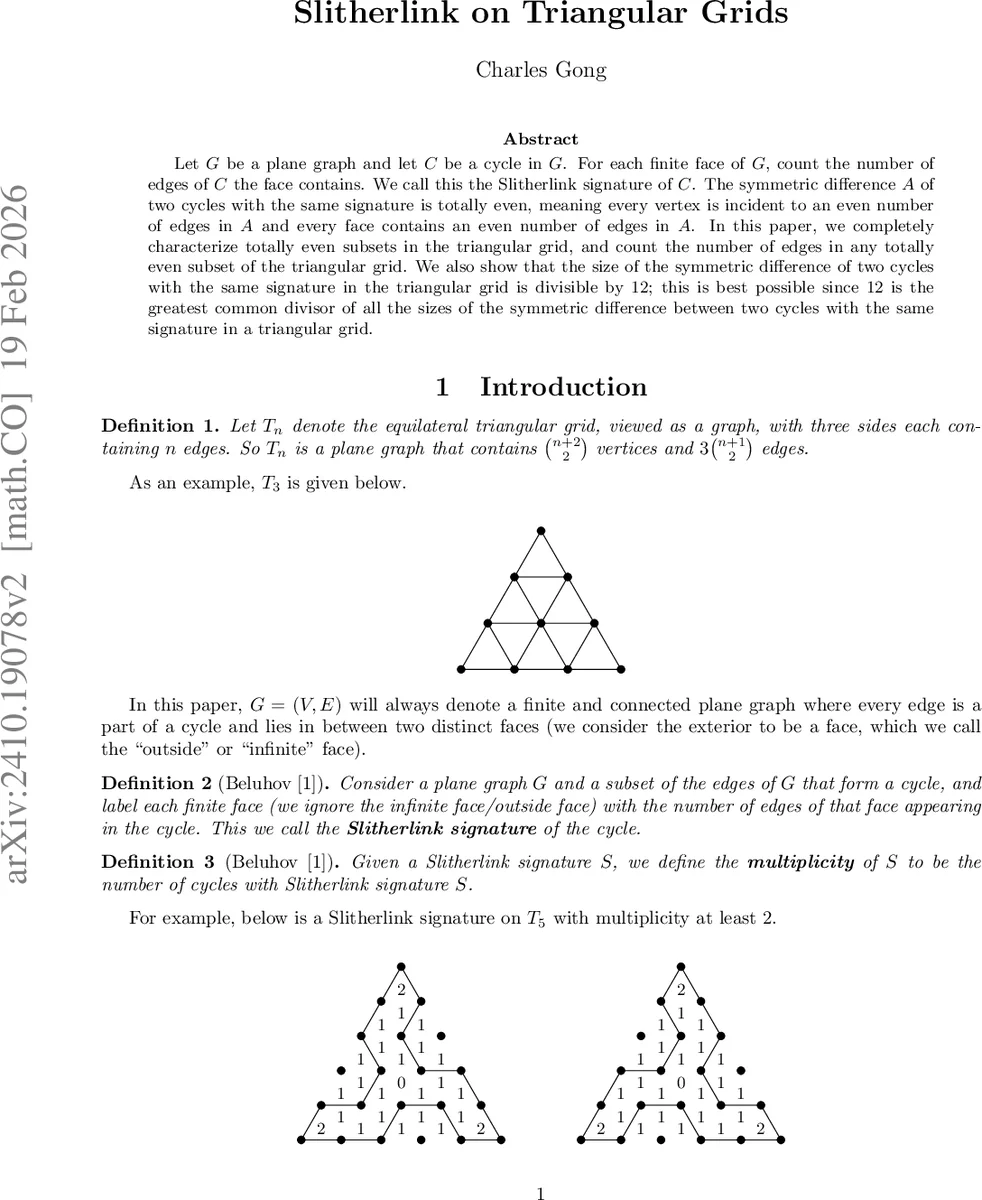
The paper studies Slitherlink puzzles on the equilateral triangular grid (T_n). A Slitherlink signature of a cycle (C) in a plane graph (G) records, for each finite face, how many edges of (C) lie on that face. If two cycles (C_1) and (C_2) share the same signature, their symmetric difference (A=C_1\triangle C_2) has the property that every vertex and every face is incident to an even number of edges of (A). Such a set is called “totally even”.
The authors first recall Beluhov’s work on rectangular (square) grids, where totally even subsets enjoy a four‑fold diagonal symmetry and are completely characterized. They then transfer these ideas to the triangular grid, which possesses a six‑fold symmetry. The main contributions are:
-
Symmetry Theorem – Every totally even subset of (T_n) is symmetric with respect to the “middle line”, the line joining the vertices ((1,n+1)) and ((n+1,1)). The proof proceeds by induction from the topmost edges downward, using the even‑degree condition at vertices and the even‑edge condition on faces to force paired edges to appear together. As a corollary, no edge lying on the middle line can belong to a totally even subset.
-
Basis and Count – For (T_6) the authors exhibit three elementary totally even subsets (Figure 4) and show they form a basis of the vector space over (\mathbb{F}_2) of all totally even subsets. Generalising, they prove that the dimension of this space is (\lfloor n/2\rfloor); consequently the total number of totally even subsets of (T_n) is (2^{\lfloor n/2\rfloor}).
-
Uniqueness from the Bottom Edge Pattern – If two totally even subsets agree on the bottom side (the set of horizontal edges ({(i,1),(i+1,1)}) for (i=1,\dots,n)), then they are identical. The authors give a constructive algorithm: starting from the bottom layer and moving upward, at each step there is always a vertex or face with exactly one undecided incident edge; the even‑parity condition forces the status of that edge, and the process uniquely determines the whole subset.
-
Divisibility of Symmetric Differences – Because any symmetric difference of two cycles with the same signature is a totally even subset, its size must be a multiple of 12. The authors prove that 12 is the greatest common divisor of all possible sizes of such differences on the triangular grid, and they provide explicit constructions achieving size 12, showing the bound is tight. This contrasts with the rectangular case where the corresponding gcd is 8.
The paper also discusses the six axes of symmetry (three lines through vertices and three through edges) that generate the full dihedral‑(D_6) symmetry group of the triangular grid, and shows how these symmetries imply the six‑fold rotational symmetry of totally even subsets.
Overall, the work delivers a complete algebraic and combinatorial description of totally even edge sets on triangular grids, quantifies their degrees of freedom, and establishes a sharp divisibility condition for the size of symmetric differences of cycles sharing a Slitherlink signature. These results deepen the theoretical understanding of Slitherlink puzzles on non‑rectangular lattices and open avenues for further exploration of puzzle‑generation algorithms, enumeration of admissible signatures, and extensions to other regular tilings.
Comments & Academic Discussion
Loading comments...
Leave a Comment