Linton Stereo Illusion
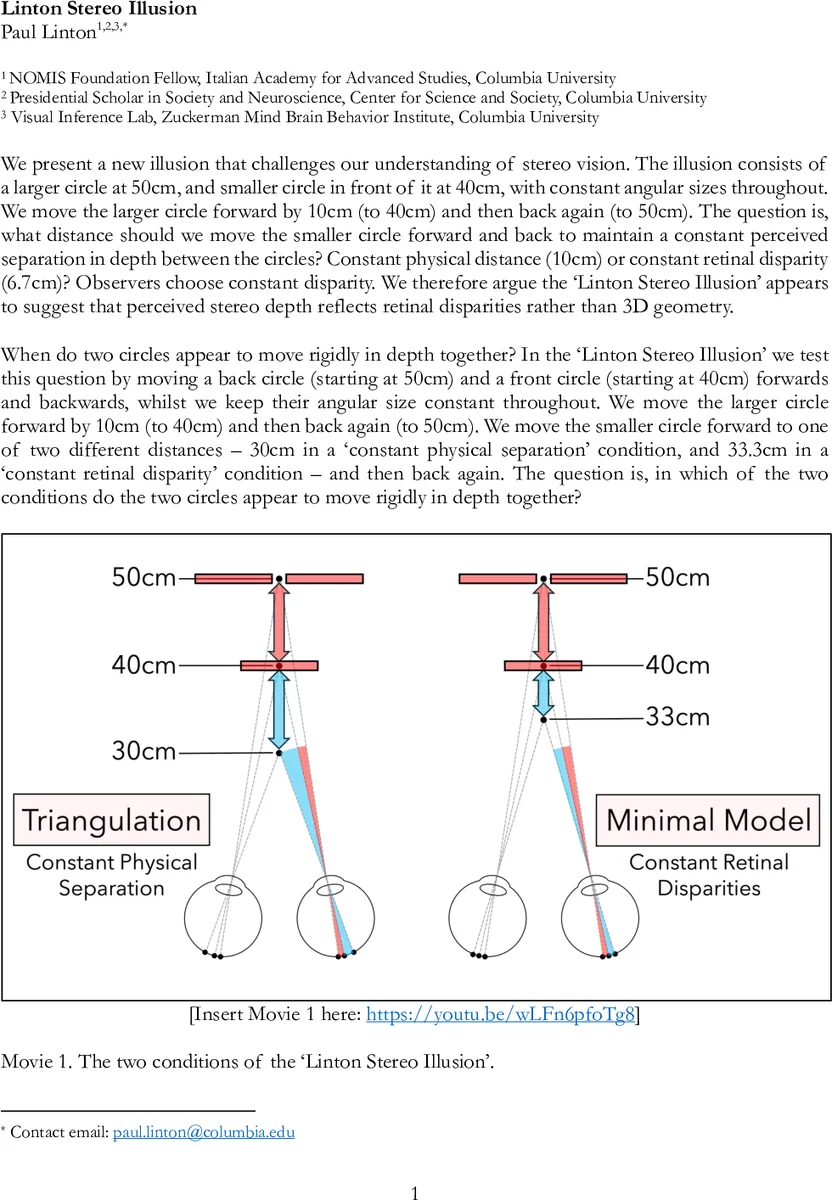
We present a new illusion that challenges our understanding of stereo vision. The illusion consists of a larger circle at 50cm, and smaller circle in front of it at 40cm, with constant angular sizes throughout. We move the larger circle forward by 10cm (to 40cm) and then back again (to 50cm). The question is, what distance should we move the smaller circle forward and back to maintain a constant perceived separation in depth between the circles? Constant physical distance (10cm) or constant retinal disparity (6.7cm)? Observers choose constant disparity. We therefore argue the ‘Linton Stereo Illusion’ appears to suggest that perceived stereo depth reflects retinal disparities rather than 3D geometry.
💡 Research Summary
The paper introduces the “Linton Stereo Illusion,” a novel binocular stimulus designed to test whether perceived stereo depth is governed by physical geometry (triangulation) or by retinal disparity alone. The stimulus consists of two circles: a larger “back” circle initially at 50 cm and a smaller “front” circle at 40 cm, both presented with constant angular size. The back circle is moved forward by 10 cm (to 40 cm) and then back to its original position. The front circle is moved under two alternative conditions. In the “constant physical separation” condition it is placed at 30 cm, preserving a 10 cm physical gap between the circles throughout the motion. In the “constant retinal disparity” condition it is placed at 33.3 cm, so that the binocular disparity between the circles remains the same as the back circle moves. Observers (≈210 participants across VSS and ECVP conferences) were asked which condition made the two circles appear to move rigidly in depth. Over 90 % reported the constant‑disparity condition as the rigid one, while the constant‑physical‑separation condition produced a “concertina” effect where the front circle appeared to move more than the back circle.
These results directly contradict classic triangulation models that predict rigidity when the physical inter‑object distance is constant, and instead support the author’s “Minimal Model” (Linton, 2023) that posits perceived depth is a direct function of retinal disparity. The illusion also demonstrates that doubling disparity roughly doubles perceived depth, consistent with a linear disparity‑depth relationship. Moreover, the authors note that changes in vergence have little impact on the perceived rigidity, challenging claims that vergence cues can dominate depth perception even when disparity is unchanged.
Two alternative explanations are examined. First, the well‑known failure of depth constancy (Johnston, 1991) suggests that the visual system scales disparity using an inaccurate estimate of viewing distance derived from vergence. The paper argues that Johnston’s model predicts opposite patterns (compression at near distances, expansion at far distances) to those observed in the illusion. Second, the possibility that keeping angular size constant alone could generate the effect is considered, but the fact that only the disparity‑constant condition yields a rigid perception undermines this account.
The authors provide open‑source implementations of the stimulus in ThreeJS (WebGL) and Psychtoolbox, allowing manipulation of interpupillary distance, viewing distance, separation, and motion speed. They suggest further experiments varying these parameters, as well as systematic psychophysical measurements of disparity‑depth scaling, to more rigorously discriminate between disparity‑only and depth‑constancy frameworks.
In conclusion, the Linton Stereo Illusion offers compelling empirical evidence that human stereo vision relies primarily on retinal disparity rather than on a triangulation process that restores physical 3‑D geometry. This challenges long‑standing assumptions about depth constancy in binocular vision and invites a re‑evaluation of models that treat disparity as a cue that must be scaled by vergence‑derived distance estimates. The paper calls for broader discussion and experimental validation, positioning the illusion as a modern addition to classic binocular phenomena such as Wheatstone’s stereoscope, Helmholtz’s depth constancy failures, and Adelson’s checkerboard stereograms.
Comments & Academic Discussion
Loading comments...
Leave a Comment