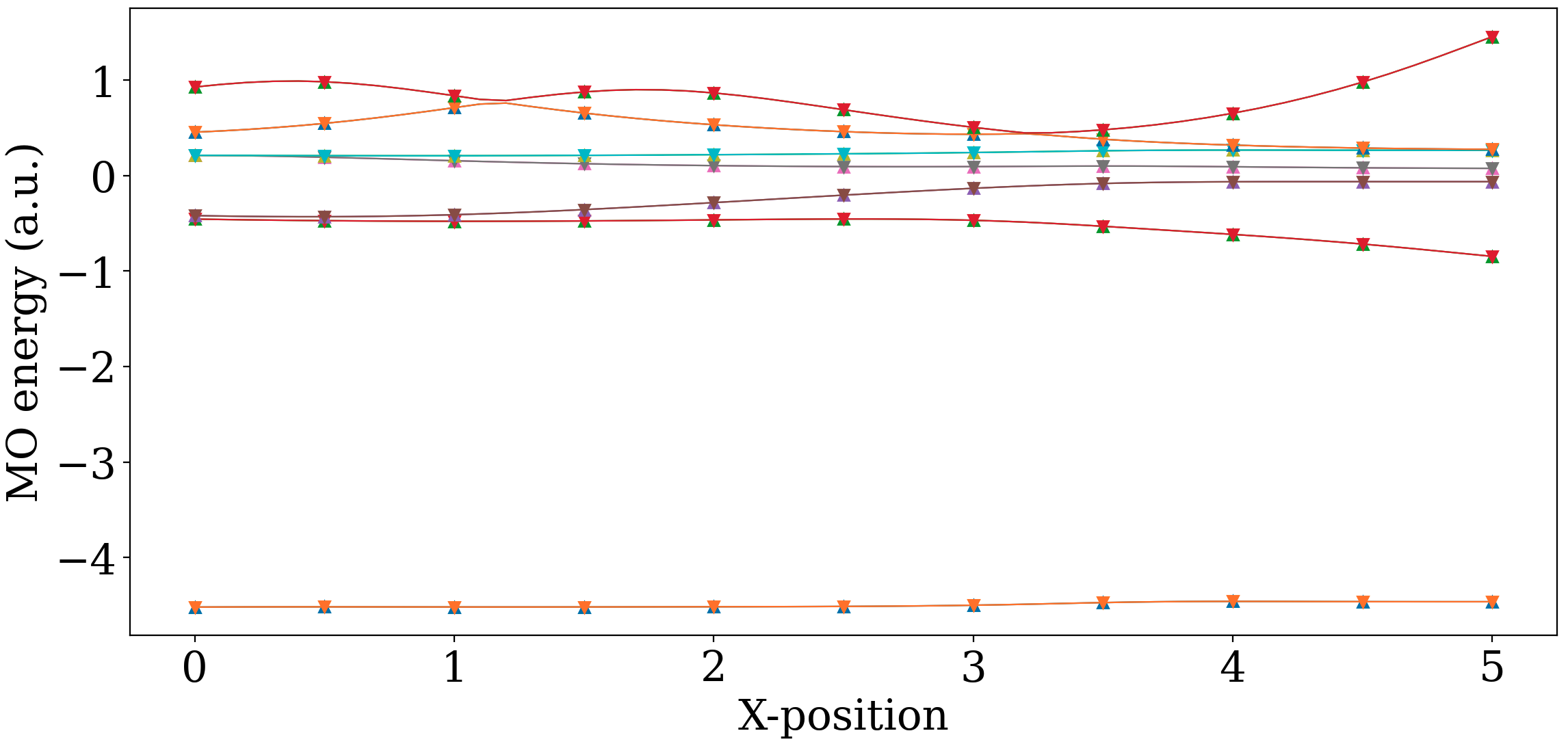
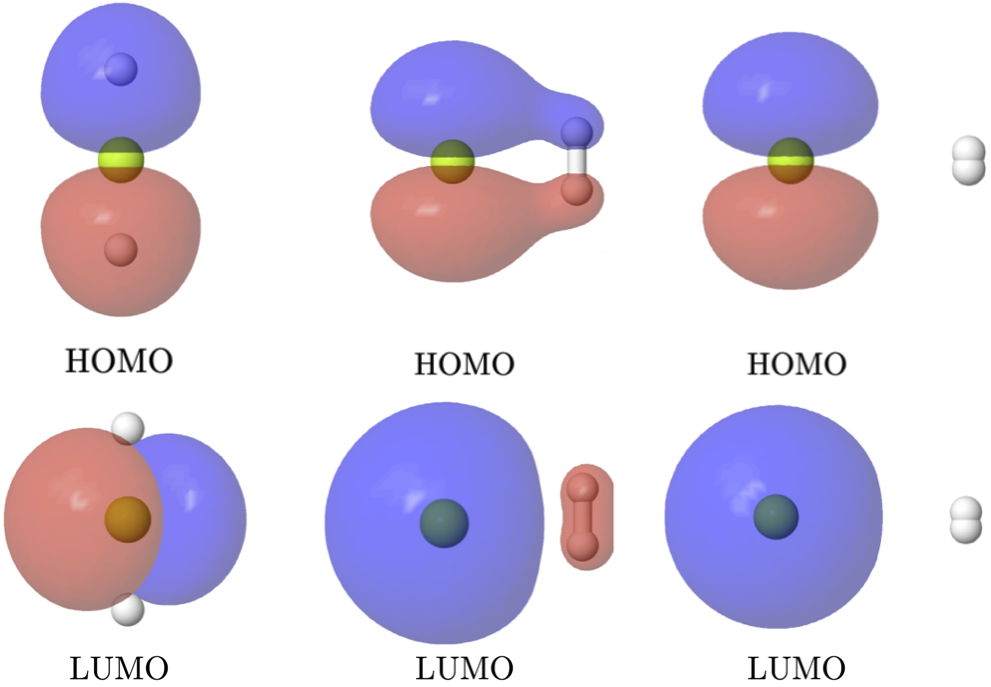
We extend recent algebro-geometric results for coupled cluster theory of quantum many-body systems to the truncation varieties arising from the doubles approximation (CCD), focusing on the first genuinely nonlinear doubles regime of four electrons. Since this doubles truncation variety does not coincide with previously studied varieties, we initiate a systematic investigation of its basic algebro-geometric invariants. Combining theoretical and numerical results, we show that for $4$ electrons on $n\leq 12$ orbitals, the CCD truncation variety is a complete intersection of degree $2^{\binom{n-4}{4}}$. Using representation-theoretic arguments, we uncover a Pfaffian structure governing the quadratic relations that define the truncation variety for any $n$, and show that an exact tensor product factorization holds in a distinguished limit of disconnected doubles. We connect these structural results to the computation of the beryllium insertion into molecular hydrogen ({Be$\cdots$H$_2$ $\to$ H--Be--H}), a small but challenging bond formation process where multiconfigurational effects become pronounced.
Deep Dive into On the Coupled Cluster Doubles Truncation Variety of Four Electrons.
We extend recent algebro-geometric results for coupled cluster theory of quantum many-body systems to the truncation varieties arising from the doubles approximation (CCD), focusing on the first genuinely nonlinear doubles regime of four electrons. Since this doubles truncation variety does not coincide with previously studied varieties, we initiate a systematic investigation of its basic algebro-geometric invariants. Combining theoretical and numerical results, we show that for $4$ electrons on $n\leq 12$ orbitals, the CCD truncation variety is a complete intersection of degree $2^{\binom{n-4}{4}}$. Using representation-theoretic arguments, we uncover a Pfaffian structure governing the quadratic relations that define the truncation variety for any $n$, and show that an exact tensor product factorization holds in a distinguished limit of disconnected doubles. We connect these structural results to the computation of the beryllium insertion into molecular hydrogen ({Be$\cdots$H$_2$ $\to
Computational (quantum) chemistry provides a quantitative link between quantum mechanics and chemical observables by translating microscopic models into algorithms for energies, forces, and derived properties. A central component is electronic structure simulation, which turns the many-electron problem into a sequence of large-scale numerical tasks and thereby exposes deep questions in approximation theory, numerical linear and nonlinear algebra [26].
The fundamental mathematical model is the quantum many-body problem for electrons moving in an external potential generated by the nuclei. The central quantity is a many-electron wave function, i.e., a function of 3d spatial variables (and spin) for d electrons, constrained by fermionic antisymmetry. Even before numerical approximation enters, this combination of high dimensionality and antisymmetry makes the electronic structure problem a prototypically difficult computational task. The high fidelity requirements of electronic structure simulations demand an accurate representation of the nontrivial coupling created by electron-electron interactions in a very high dimensional antisymmetric space, whereas numerical tractability requires advanced techniques that exploit problem-specific structures.
In practice, one introduces a finite representation, which turns the electronic Schrödinger equation into a large eigenvalue problem on an antisymmetric tensor space. The dimension of this space grows combinatorially with the number of orbitals; hence, the direct application of “standard” numerical approaches quickly becomes infeasible. This scaling barrier motivates working with reduced model classes for the wave function, but these classes are typically nonlinear. The reason is that electron-electron interactions mix a large number of basis configurations, so that achieving a given accuracy with a linear approximation space generally forces the dimension of that space to grow rapidly. Nonlinear parametrizations offer an alternative reduction mechanism by representing the relevant states as a low-dimensional manifold or variety inside the full antisymmetric space, thereby reducing the effective dimension of the problem. From this viewpoint, much of electronic structure theory can be seen as the design and analysis of computationally accessible model classes that capture the essential physics.
One instance of such a nonlinear reduction strategy is provided by coupled cluster theory, which is highly successful and widely regarded in the computational chemistry community as a benchmark for high-accuracy electronic structure calculations. In this approach, one does not solve the discretized eigenvalue problem directly in the full antisymmetric space. Instead, one introduces a parametrized family of trial states obtained from a fixed reference vector by applying an exponential map to a structured operator, and one determines the parameters by enforcing the eigenvalue equation through a set of projected residual conditions. Practical variants arise by restricting the parametrizing operator to a prescribed subset of degrees of freedom, which yields a smaller but nonlinear system. These restrictions make large scale computations feasible, but they also raise mathematical questions about the solution set of the nonlinear system, such as the presence of multiple solutions, singular points, and the geometry of the feasible set.
An exterior algebra and algebraic geometry viewpoint on coupled cluster theory was recently initiated in [14] and developed further in [17]. A key outcome is the notion of coupled cluster truncation varieties, which model the feasible set determined by truncating the exponential parametrization (1.7) and the associated unlinked coupled cluster equations (1.8). A first focused algebraic investigation of truncation varieties was carried out in [3], building on the observation that the coupled cluster singles truncation variety (only one-electron excitations are included in the cluster operator) recovers the Grassmannian, a classical and well-understood variety. The present manuscript continues this line of research with an emphasis on the coupled cluster doubles (CCD) truncation variety, where only two-electron excitations are included in the cluster operator. Unlike the singles case, the doubles truncation varieties do not appear to coincide with specifically studied varieties, and their geometry must therefore be analyzed directly.
In Section 2, we describe the defining quadrics P J in (2.2) and the linear equations of the affine CCD truncation variety V A {2} for four electrons, expressed in coordinates of 6 n-4 2 quantum states (1.2). Constructing the defining ideal of the projective CCD variety V {2} requires saturating an ideal generated by n-4 4 homogenized quadrics Q J (2.3), a process that becomes computationally prohibitive for n > 10 spin orbitals (see Example 2.2). This motivates our algebro-geometric study of the varieties V P and V Q de
…(Full text truncated)…
This content is AI-processed based on ArXiv data.