Clever Materials: When Models Identify Good Materials for the Wrong Reasons
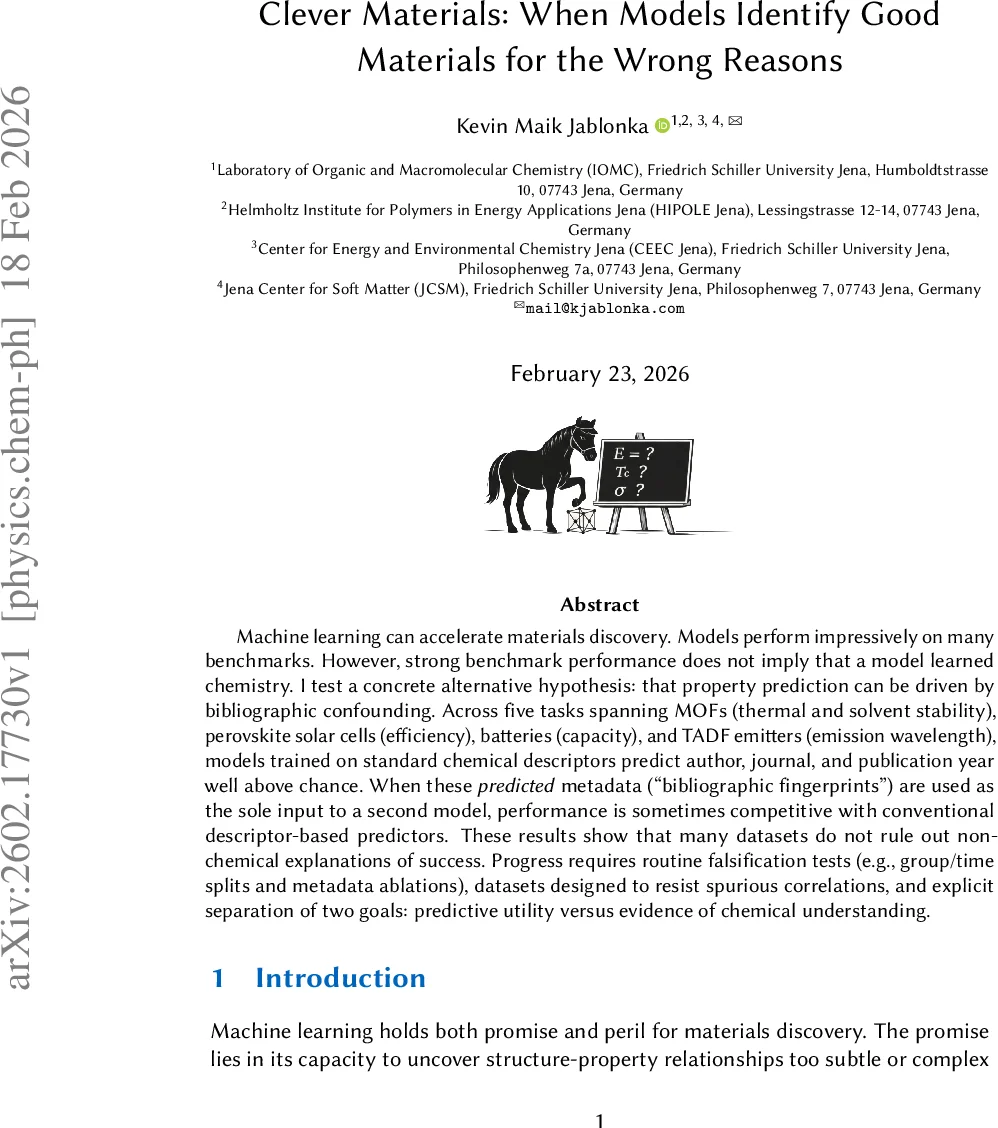
Machine learning can accelerate materials discovery. Models perform impressively on many benchmarks. However, strong benchmark performance does not imply that a model learned chemistry. I test a concrete alternative hypothesis: that property prediction can be driven by bibliographic confounding. Across five tasks spanning MOFs (thermal and solvent stability), perovskite solar cells (efficiency), batteries (capacity), and TADF emitters (emission wavelength), models trained on standard chemical descriptors predict author, journal, and publication year well above chance. When these predicted metadata (“bibliographic fingerprints”) are used as the sole input to a second model, performance is sometimes competitive with conventional descriptor-based predictors. These results show that many datasets do not rule out non-chemical explanations of success. Progress requires routine falsification tests (e.g., group/time splits and metadata ablations), datasets designed to resist spurious correlations, and explicit separation of two goals: predictive utility versus evidence of chemical understanding.
💡 Research Summary
The paper “Clever Materials: When Models Identify Good Materials for the Wrong Reasons” investigates a subtle but critical failure mode in machine‑learning‑driven materials discovery: models may achieve high benchmark performance by exploiting bibliographic shortcuts rather than learning genuine chemistry. The author formulates a concrete alternative hypothesis—property prediction can be driven solely by metadata such as author identity, journal venue, and publication year—and tests it across five widely used materials datasets: (1) thermal stability of metal‑organic frameworks (MOFs), (2) solvent‑removal stability of MOFs, (3) power‑conversion efficiency (PCE) of perovskite solar cells, (4) capacity of battery electrode materials, and (5) maximum emission wavelength of thermally activated delayed fluorescence (TADF) emitters.
For each task, three model families are trained on identical cross‑validation splits: (i) a “direct” model that maps standard chemical descriptors (structural features, molecular fingerprints, etc.) to the target property, (ii) a “metadata” model that maps the same descriptors to bibliographic variables (author, journal, year), and (iii) a “proxy” model that uses only the predicted bibliographic variables as inputs to predict the target property. The key finding is that the metadata model can predict bibliographic information far above random baselines (author F1‑scores 0.55–0.76, journal prediction accuracies 0.58–0.85, year MAE ≈1–2 years). When these predicted metadata are fed into the proxy model, performance sometimes rivals or even matches the direct model. Notably, for MOF thermal‑stability classification (top‑10 % stable) the proxy reaches 0.901 accuracy versus 0.923 for the direct model; for perovskite PCE classification (top‑10 % efficient) the proxy attains 0.900 versus 0.899 for the direct model. In contrast, battery capacity prediction shows no benefit from the proxy (performance indistinguishable from a naive mean predictor), and TADF wavelength prediction shows only modest improvement (MAE between proxy and direct models).
These results demonstrate that the degree of “Clever Hans” effect varies across domains and depends heavily on how strongly bibliographic variables correlate with the target property. The paper also highlights that evaluation metrics and baseline choices critically shape the perceived impact of spurious correlations; accuracy alone can overstate proxy performance, while metrics such as MAE or F1‑score provide a more nuanced view.
To mitigate such pitfalls, the author recommends systematic falsification tests: (1) group‑ or time‑based splits that force the model to extrapolate beyond the bibliographic patterns present in the training set, (2) explicit ablation of metadata features, and (3) inclusion of robust baselines (e.g., stratified random sampling, mean‑value predictors). Moreover, the paper advocates for “dataset nutrition labels” that quantify author, group, and temporal distributions, and for adversarial dataset construction that deliberately reduces spurious correlations.
Beyond methodological safeguards, the discussion calls for a cultural shift in the materials community toward building diversified, low‑cost, high‑throughput data infrastructures that prioritize robustness over convenience. Potential mechanisms include coordinated data‑generation consortia, “bug‑bounty” programs for datasets and models, and the use of large‑language‑model agents as automated “devil’s advocates” to generate and test alternative hypotheses at scale.
In conclusion, strong benchmark scores do not guarantee that a model has learned meaningful structure‑property relationships. Without explicit testing of competing explanations, models may simply be leveraging bibliographic shortcuts—a modern incarnation of the Clever Hans effect. The paper urges researchers to adopt rigorous validation protocols, design datasets that resist proxy learning, and clearly separate the goals of predictive utility from evidence of chemical understanding.
Comments & Academic Discussion
Loading comments...
Leave a Comment