Closing Africa's Early Warning Gap: AI Weather Forecasting for Disaster Prevention
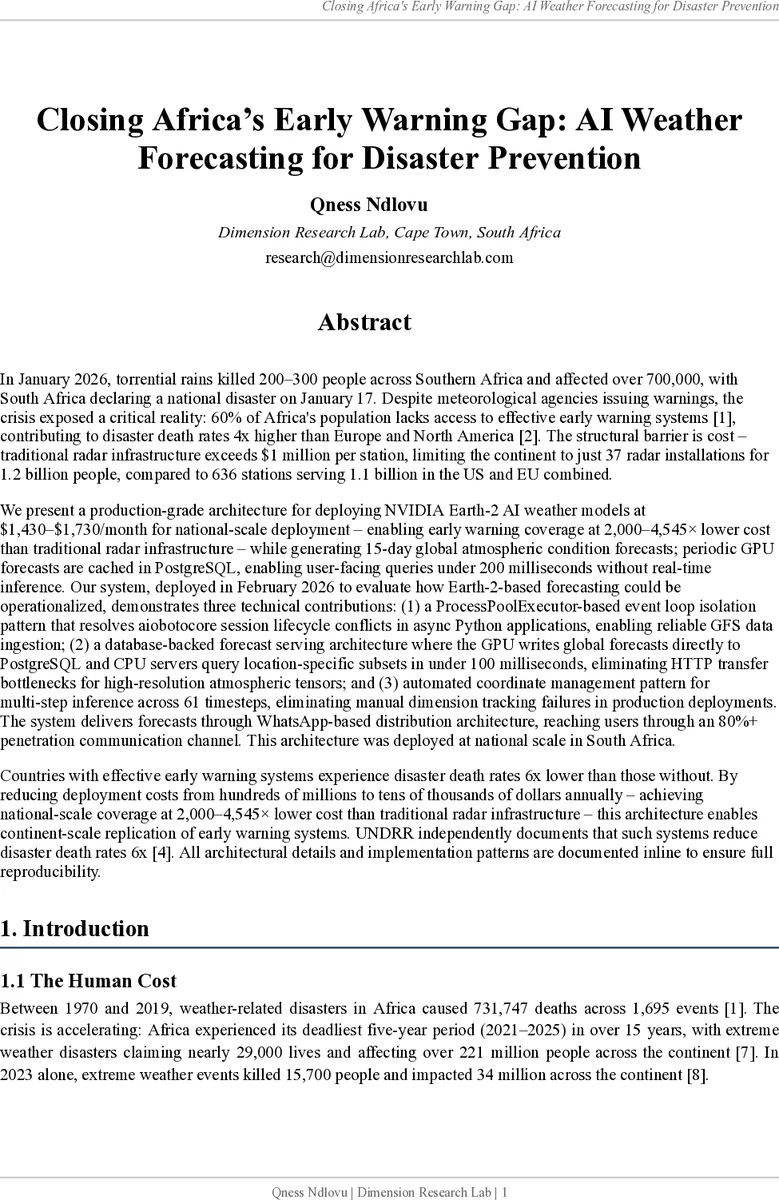
In January 2026, torrential rains killed 200-300 people across Southern Africa, exposing a critical reality: 60% of the continent lacks effective early warning systems due to infrastructure costs. Traditional radar stations exceed USD 1 million each, leaving Africa with an 18x coverage deficit compared to the US and EU. We present a production-grade architecture for deploying NVIDIA Earth-2 AI weather models at USD 1,430-1,730/month for national-scale deployment - enabling coverage at 2,000-4,545x lower cost than radar. The system generates 15-day global atmospheric forecasts, cached in PostgreSQL to enable user queries under 200 milliseconds without real-time inference. Deployed in South Africa in February 2026, our system demonstrates three technical contributions: (1) a ProcessPoolExecutor-based event loop isolation pattern that resolves aiobotocore session lifecycle conflicts in async Python applications; (2) a database-backed serving architecture where the GPU writes global forecasts directly to PostgreSQL, eliminating HTTP transfer bottlenecks for high-resolution tensors; and (3) an automated coordinate management pattern for multi-step inference across 61 timesteps. Forecasts are delivered via WhatsApp, leveraging 80%+ market penetration. This architecture makes continent-scale early warning systems economically viable, supporting UNDRR findings that such systems reduce disaster death rates by 6x. All architectural details are documented inline for full reproducibility.
💡 Research Summary
The paper addresses the stark lack of early‑warning infrastructure across Africa, where 60 % of the population is unprotected and traditional weather radars cost between US $2 million and US $8 million per installation. This results in an 18‑fold coverage deficit compared with the United States and the European Union. To bridge this gap, the authors design, implement, and evaluate a production‑grade system that leverages NVIDIA’s Earth‑2 AI weather models to generate 15‑day global forecasts at a monthly operating cost of US $1,430–$1,730. The architecture is split into two tiers.
The control plane runs on a modest Azure VM fleet using FastAPI and AsyncIO. It asynchronously ingests Global Forecast System (GFS) data from NOAA’s S3 bucket via the aiobotocore library. Because Earth‑2’s internal use of aiobotocore conflicts with FastAPI’s event loop, the authors isolate the data‑fetching step in a separate process using Python’s ProcessPoolExecutor. This guarantees a clean event‑loop and session lifecycle, allowing the fetch of 75 atmospheric variables at 0.25° resolution in roughly three seconds.
The inference plane runs on a Lambda Labs GH200 GPU. After performing synchronous Atlas model inference, the GPU writes the full forecast directly into an Azure PostgreSQL Flexible Server. The forecast consists of 61 time steps, 75 variables, and a 721 × 1440 grid, amounting to over 4.7 billion floating‑point values. Instead of transmitting this massive tensor over HTTP, the system inserts approximately 1,038,240 rows (one per grid point) into the database in 30–40 seconds. The GPU then returns only a tiny JSON payload containing metadata. CPU servers query location‑specific subsets from PostgreSQL, delivering results in under 100 ms, thereby eliminating network bottlenecks and enabling high‑throughput user access.
A third contribution is an automated coordinate‑management pattern that handles the multi‑step, multi‑variable inference across 61 timesteps without manual dimension tracking, reducing operational errors in production.
The system was deployed in February 2026 for national‑scale operation in South Africa. Forecasts are disseminated through the WhatsApp Business API, exploiting the platform’s 80 %+ penetration among African smartphone users. This last‑mile delivery approach ensures that warnings reach the majority of the population, addressing the communication gap highlighted by the January 2026 floods.
Cost analysis shows that the AI‑driven solution is 2,000–4,500 times cheaper than building and maintaining a comparable radar network, turning a multi‑hundred‑million‑dollar capital expense into a ten‑thousand‑dollar annual operating budget. The authors cite UNDRR findings that countries with effective early‑warning systems experience disaster‑related mortality rates six times lower than those without, underscoring the life‑saving potential of the proposed architecture.
In the broader context, the paper situates its work among recent AI weather models such as GraphCast, FourCastNet, and Pangu‑Weather, noting that while these models have demonstrated superior accuracy to traditional numerical weather prediction, few have tackled the end‑to‑end deployment challenges in resource‑constrained settings. By providing a reproducible, open‑source‑style implementation that covers data ingestion, inference, storage, and user delivery, the study fills a critical gap between model performance and real‑world impact.
The authors conclude that the combination of low‑cost GPU inference, database‑backed forecast serving, and high‑penetration communication channels offers a scalable, replicable pathway to eliminate Africa’s early‑warning gap, with the potential for rapid expansion to other nations using the same shared infrastructure.
Comments & Academic Discussion
Loading comments...
Leave a Comment