Poisson-MNL Bandit: Nearly Optimal Dynamic Joint Assortment and Pricing with Decision-Dependent Customer Arrivals
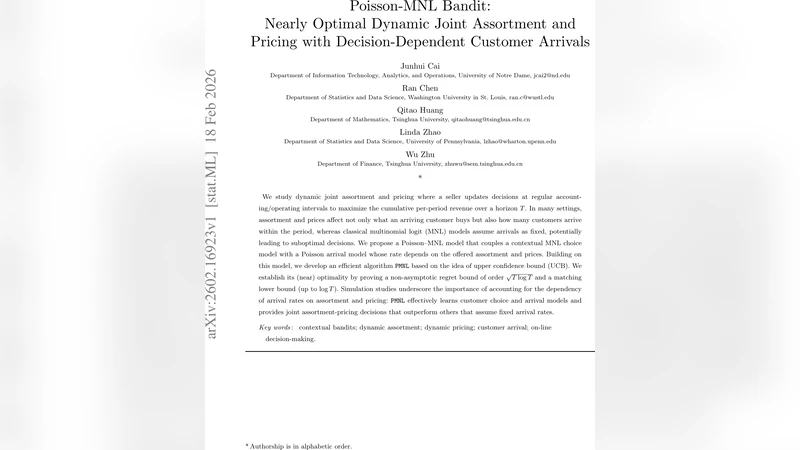
We study dynamic joint assortment and pricing where a seller updates decisions at regular accounting/operating intervals to maximize the cumulative per-period revenue over a horizon $T$. In many settings, assortment and prices affect not only what an arriving customer buys but also how many customers arrive within the period, whereas classical multinomial logit (MNL) models assume arrivals as fixed, potentially leading to suboptimal decisions. We propose a Poisson-MNL model that couples a contextual MNL choice model with a Poisson arrival model whose rate depends on the offered assortment and prices. Building on this model, we develop an efficient algorithm PMNL based on the idea of upper confidence bound (UCB). We establish its (near) optimality by proving a non-asymptotic regret bound of order $\sqrt{T\log{T}}$ and a matching lower bound (up to $\log T$). Simulation studies underscore the importance of accounting for the dependency of arrival rates on assortment and pricing: PMNL effectively learns customer choice and arrival models and provides joint assortment-pricing decisions that outperform others that assume fixed arrival rates.
💡 Research Summary
The paper addresses the problem of jointly deciding which products to offer (assortment) and at what prices in a dynamic, period‑by‑period setting. Classical approaches typically model customer choice with a multinomial logit (MNL) model while assuming that the number of customers arriving in each period is fixed or exogenous. In many real‑world retail and platform contexts, however, the attractiveness of the offered assortment and the competitiveness of prices influence the traffic volume: a richer assortment or lower prices can draw more customers, while a sparse or expensive offering may suppress arrivals. Ignoring this decision‑dependent arrival effect can lead to sub‑optimal revenue policies.
Model.
The authors introduce the Poisson‑MNL model, which couples a contextual MNL choice model with a Poisson arrival process whose rate λ(S,p) depends on the assortment S and the price vector p. The arrival rate is modeled as log‑linear in a set of basis functions φ_k(S,p):
\
Comments & Academic Discussion
Loading comments...
Leave a Comment