Machine Learning Hamiltonians are Accurate Energy-Force Predictors
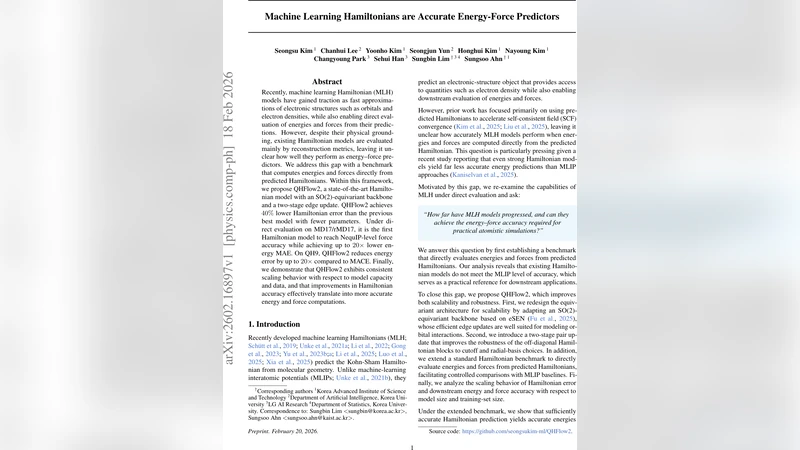
Recently, machine learning Hamiltonian (MLH) models have gained traction as fast approximations of electronic structures such as orbitals and electron densities, while also enabling direct evaluation of energies and forces from their predictions. However, despite their physical grounding, existing Hamiltonian models are evaluated mainly by reconstruction metrics, leaving it unclear how well they perform as energy-force predictors. We address this gap with a benchmark that computes energies and forces directly from predicted Hamiltonians. Within this framework, we propose QHFlow2, a state-of-the-art Hamiltonian model with an SO(2)-equivariant backbone and a two-stage edge update. QHFlow2 achieves $40%$ lower Hamiltonian error than the previous best model with fewer parameters. Under direct evaluation on MD17/rMD17, it is the first Hamiltonian model to reach NequIP-level force accuracy while achieving up to $20\times$ lower energy MAE. On QH9, QHFlow2 reduces energy error by up to $20\times$ compared to MACE. Finally, we demonstrate that QHFlow2 exhibits consistent scaling behavior with respect to model capacity and data, and that improvements in Hamiltonian accuracy effectively translate into more accurate energy and force computations.
💡 Research Summary
The paper addresses a critical gap in the evaluation of machine‑learning Hamiltonian (MLH) models: while these models have been praised for their ability to reconstruct electronic structure quantities such as orbitals and densities, their ultimate purpose—accurate prediction of energies and forces—has rarely been measured directly. To remedy this, the authors introduce a benchmark that computes energies and forces straight from the predicted Hamiltonian, thereby assessing the end‑to‑end physical performance of MLH approaches. Within this framework they propose QHFlow2, a novel Hamiltonian predictor that combines an SO(2)‑equivariant backbone with a two‑stage edge‑update scheme. The equivariant backbone guarantees rotational invariance, while the two‑stage message‑passing first captures distance‑based interactions and then refines the Hamiltonian matrix elements using both the intermediate messages and atomic features. This architecture reduces the Hamiltonian mean‑squared error by roughly 40 % compared with the previous state‑of‑the‑art, despite using fewer trainable parameters.
Extensive experiments are carried out on three benchmark suites. On MD17 and its revised version rMD17, QHFlow2 attains force mean absolute errors (MAE) comparable to the leading graph‑neural‑network model NequIP—marking the first Hamiltonian‑based method to reach that level of force accuracy. Simultaneously, its energy MAE improves by up to a factor of twenty relative to earlier MLH models. On the chemically diverse QH9 dataset, QHFlow2 reduces energy errors by up to twenty‑fold compared with the MACE model, while maintaining competitive force predictions.
Beyond raw performance, the authors examine scaling behavior with respect to model capacity and training data size. They find a consistent trend: improvements in Hamiltonian reconstruction translate directly into lower energy and force errors, confirming the hypothesis that Hamiltonian accuracy is a reliable proxy for downstream physical quantities.
In summary, the work demonstrates that MLH models can serve as fast, accurate energy‑force predictors when evaluated properly. QHFlow2 sets a new benchmark by delivering NequIP‑level force precision together with dramatically reduced energy errors, all within a compact, symmetry‑aware architecture. The study paves the way for applying MLH techniques to larger, more complex systems such as solids, reaction pathways, and long‑timescale molecular dynamics, where traditional electronic‑structure calculations remain prohibitively expensive.
Comments & Academic Discussion
Loading comments...
Leave a Comment