Construction of a classification model for dementia among Brazilian adults aged 50 and over
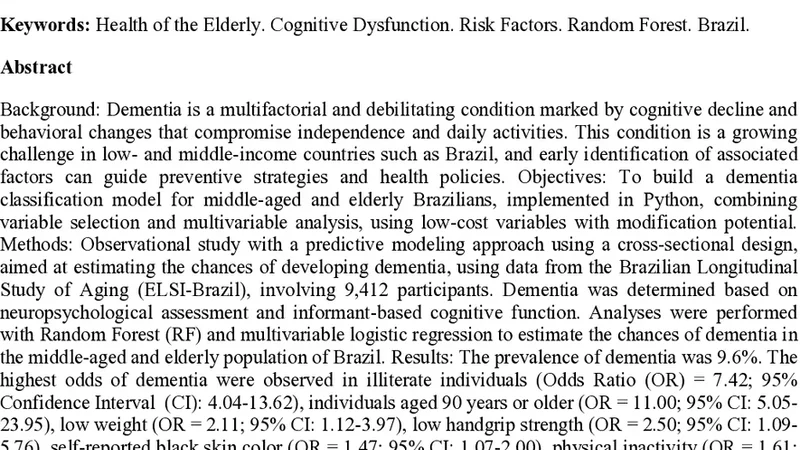
To build a dementia classification model for middle-aged and elderly Brazilians, implemented in Python, combining variable selection and multivariable analysis, using low-cost variables with modification potential. Observational study with a predictive modeling approach using a cross-sectional design, aimed at estimating the chances of developing dementia, using data from the Brazilian Longitudinal Study of Aging (ELSI-Brazil), involving 9,412 participants. Dementia was determined based on neuropsychological assessment and informant-based cognitive function. Analyses were performed using Random Forest (RF) and multivariable logistic regression to estimate the risk of dementia in the middle-aged and elderly populations of Brazil. The prevalence of dementia was 9.6%. The highest odds of dementia were observed in illiterate individuals (Odds Ratio (OR) = 7.42), individuals aged 90 years or older (OR = 11.00), low weight (OR = 2.11), low handgrip strength (OR = 2.50), self-reported black skin color (OR = 1.47), physical inactivity (OR = 1.61), self-reported hearing loss (OR = 1.65), and presence of depressive symptoms (OR = 1.72). Higher education (OR=0.44), greater life satisfaction (OR=0.72), and being employed (OR=0.78) were protective factors. The RF model outperformed logistic regression, achieving an area under the ROC curve of 0.776, with a sensitivity of 0.708, a specificity of 0.702, an F1-score of 0.311, a G-means of 0.705, and an accuracy of 0.703. Conclusion: The findings reinforce the multidimensional nature of dementia and the importance of accessible factors for identifying vulnerable individuals. Strengthening public policies focused on promoting brain health can contribute significantly to the efficient allocation of resources in primary care and dementia prevention in Brazil
💡 Research Summary
The present study aimed to develop and evaluate a predictive classification model for dementia among Brazilian adults aged 50 years and older, using readily available, low‑cost variables that could be modified through public health interventions. Data were drawn from the Brazilian Longitudinal Study of Aging (ELSI‑Brazil), a nationally representative cohort that included 9,412 participants. Dementia status was ascertained by combining a comprehensive neuropsychological battery with informant‑based cognitive assessments, resulting in an overall prevalence of 9.6 % within the sample.
A two‑stage analytical strategy was employed. First, a multivariable logistic regression was performed to quantify the independent association of each candidate predictor with dementia, expressed as odds ratios (OR). The regression identified several strong risk factors: illiteracy (OR = 7.42), age ≥ 90 years (OR = 11.00), low body weight (OR = 2.11), reduced hand‑grip strength (OR = 2.50), self‑identified Black skin colour (OR = 1.47), physical inactivity (OR = 1.61), self‑reported hearing loss (OR = 1.65), and depressive symptoms (OR = 1.72). Conversely, protective factors included higher education (OR = 0.44), greater life satisfaction (OR = 0.72), and current employment (OR = 0.78).
Second, a machine‑learning approach based on Random Forest (RF) was implemented to capture potential non‑linear relationships and interactions among predictors. The dataset was randomly split into 70 % training and 30 % testing subsets, and five‑fold cross‑validation was applied to mitigate over‑fitting. The RF model achieved an area under the receiver‑operating‑characteristic curve (AUC) of 0.776, a sensitivity of 0.708, a specificity of 0.702, an overall accuracy of 0.703, an F1‑score of 0.311, and a geometric mean (G‑means) of 0.705. These performance metrics consistently outperformed the traditional logistic regression model, indicating that the ensemble learning technique provides superior discrimination while maintaining a balanced trade‑off between true‑positive and true‑negative rates.
The findings underscore the multidimensional nature of dementia risk in Brazil. Socio‑demographic factors (education, employment, race/colour), physical health indicators (weight, hand‑grip strength, hearing), lifestyle behaviours (physical activity), and mental health status (depression) all contributed substantially to the probability of dementia. Importantly, all of these variables are inexpensive to assess in primary‑care settings and are amenable to policy‑driven interventions. For instance, programmes that promote adult literacy, encourage regular physical activity, improve nutritional status, provide hearing‑aid services, and integrate mental‑health screening could collectively reduce the burden of dementia.
Nevertheless, the study has several limitations. Its cross‑sectional design precludes causal inference, and reliance on self‑reported measures may introduce recall or social desirability bias. Moreover, the predictive model was internally validated only within the same cohort; external validation using independent Brazilian or Latin‑American samples is required to confirm generalizability. Future research should exploit longitudinal waves of ELSI‑Brazil to examine temporal dynamics of risk, assess the impact of interventions on model performance, and refine the algorithm for region‑specific calibration.
In conclusion, this work demonstrates that a low‑cost, easily obtainable set of variables can be combined in a robust Random Forest classifier to predict dementia risk among middle‑aged and older Brazilians with acceptable accuracy. The model outperforms conventional logistic regression and offers a practical tool for health‑policy makers aiming to allocate resources efficiently, prioritize high‑risk individuals, and implement preventive strategies that support brain health across the lifespan in Brazil.
Comments & Academic Discussion
Loading comments...
Leave a Comment