Controlling energy spectra and skin effect via boundary conditions in non-Hermitian lattices
Non-Hermitian systems exhibit unique spectral properties, including the non-Hermitian skin effect and exceptional points, often influenced by boundary conditions. The modulation of these phenomena by generalized boundary conditions remains unexplored and not understood. Here, we analyze the Hatano-Nelson model with generalized boundary conditions induced by complex hopping amplitudes at the boundary. Using similarity transformations, we determine the conditions yielding real energy spectra and skin effect, and identify the emergence of exceptional points where spectra transition from real to complex. We demonstrate that tuning the boundary hopping amplitudes precisely controls the non-Hermitian skin effect, i.e., the localization of eigenmodes at the lattice edges. These findings reveal the sensitivity of spectral and localization properties to boundary conditions, providing a framework for engineering quantum lattice models with tailored spectral and localization features, with potential applications in quantum devices.
💡 Research Summary
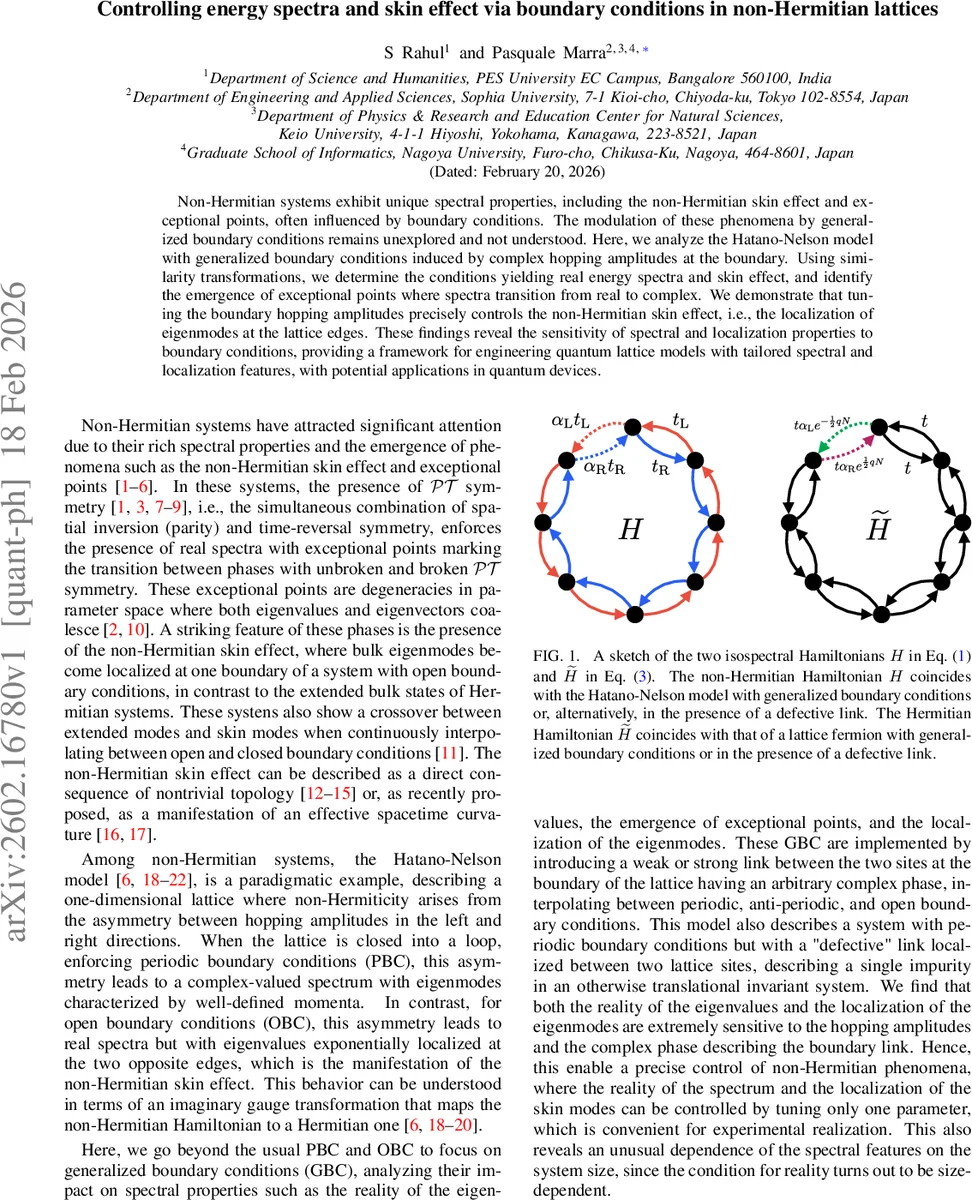
The paper investigates how generalized boundary conditions (GBC) affect the spectral properties and non‑Hermitian skin effect in the Hatano‑Nelson (HN) model, a paradigmatic one‑dimensional lattice with asymmetric left‑right hopping. By introducing complex hopping amplitudes αL and αR on the link connecting the two ends of the chain, the authors continuously interpolate between open, periodic, anti‑periodic, and a whole family of intermediate boundary conditions. Using the similarity transformation c_n → e^{q n/2} \tilde c_n (with t_R/t_L = e^{q}), the non‑Hermitian Hamiltonian H is mapped to an isospectral Hamiltonian \tilde H that is Hermitian only for a specific relation between αL, αR, the asymmetry parameter q, and a phase ϕ: αL = 1/αR = e^{iϕ} e^{qN/2}. When this condition holds, \tilde H becomes fully Hermitian, guaranteeing a real energy spectrum even though the original system has open‑type boundaries. Conversely, setting αL = αR = ±1 yields a non‑Hermitian \tilde H with complex bands, and the spectrum undergoes a transition from real to complex at exceptional points (EPs) defined by a discriminant Δ = 0. The authors analytically locate these EPs for finite chain lengths (e.g., N = 4, 10) and show that the EPs are controlled solely by the boundary hopping amplitudes.
The eigenstates are expressed analytically in terms of a real parameter ρ that encodes the magnitude of the boundary hoppings: αL = e^{ρqN}, αR = e^{(2−ρ)qN}. The momentum quantization condition becomes k_m = (ϕ+2πm)/N + i 2(1−ρ)q, leading to energies E_k = 2 cos k. For ρ = 1 the momentum is purely real, the spectrum is entirely real, and the skin effect disappears. For ρ < 1 the right eigenvectors of H are exponentially localized at one edge (the left edge for Re q > 0) while the left eigenvectors localize at the opposite edge; for ρ > 1 the localization reverses. In the transformed Hamiltonian \tilde H the situation is inverted: the skin effect appears for ρ ≠ 1 and vanishes at ρ = 1. Thus, by tuning a single complex hopping amplitude at the boundary, one can switch the presence of the skin effect on or off and even reverse its direction.
A striking result is the strong size dependence of these phenomena. The condition for a real spectrum (αL = 1/αR = e^{iϕ} e^{qN/2}) becomes trivial in the thermodynamic limit (N → ∞) because αL,R → 0, so the effect is only observable in finite‑size lattices. This sensitivity to system size suggests that experimental platforms with a modest number of sites—such as photonic resonator arrays, microwave circuits, or cold‑atom synthetic lattices—could directly test the predictions.
In summary, the work provides (i) an exact analytical criterion for real spectra under generalized boundary conditions, (ii) a clear identification of boundary‑driven exceptional points, (iii) a complete description of how boundary hopping controls the non‑Hermitian skin effect, and (iv) insight into the finite‑size scaling of these effects. These findings broaden the understanding of boundary‑dependent non‑Hermitian physics and open new routes for engineering tailored spectral and localization properties in quantum devices.
Comments & Academic Discussion
Loading comments...
Leave a Comment