Finite-Temperature Dynamical Phase Diagram of the $2+1$D Quantum Ising Model
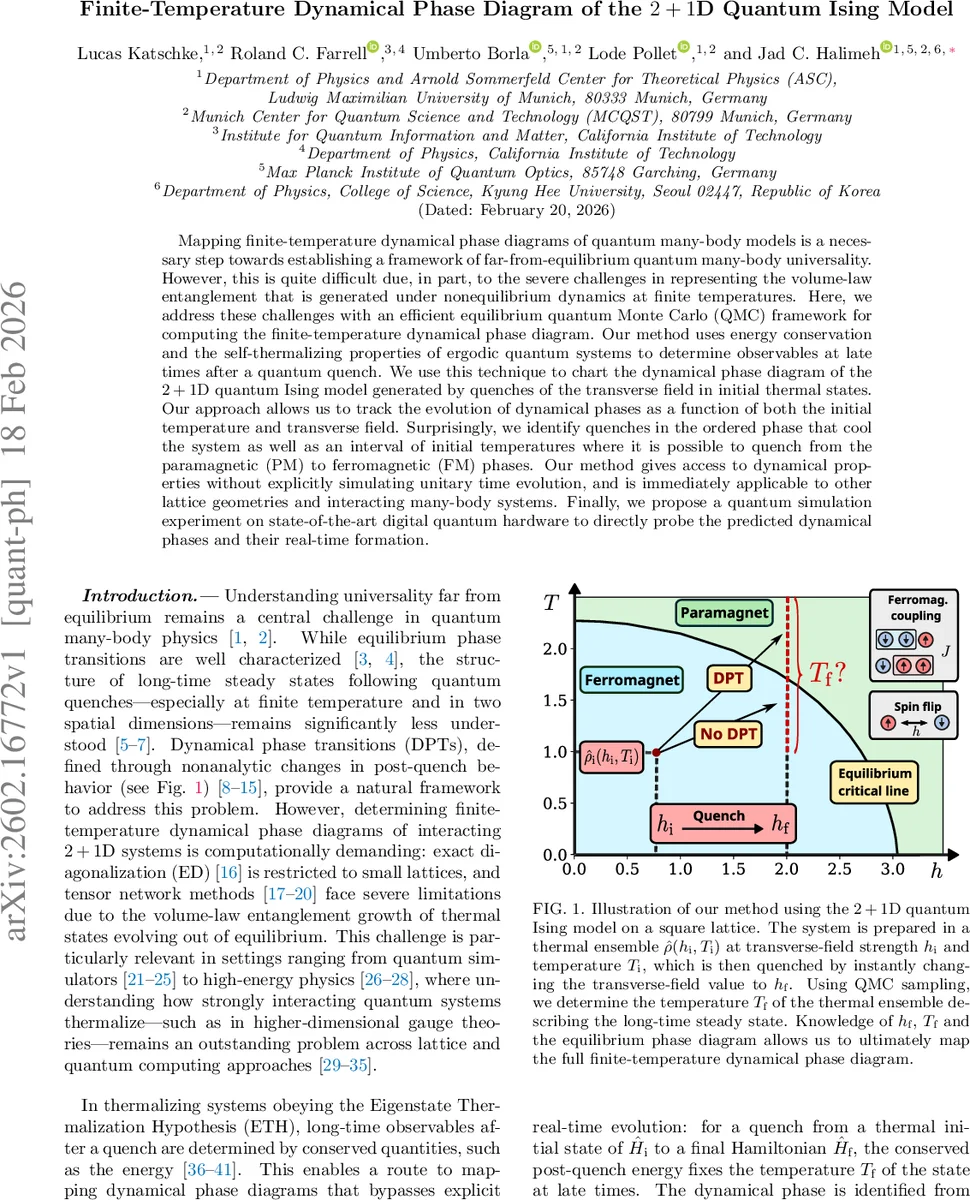
Mapping finite-temperature dynamical phase diagrams of quantum many-body models is a necessary step towards establishing a framework of far-from-equilibrium quantum many-body universality. However, this is quite difficult due, in part, to the severe challenges in representing the volume-law entanglement that is generated under nonequilibrium dynamics at finite temperatures. Here, we address these challenges with an efficient equilibrium quantum Monte Carlo (QMC) framework for computing the finite-temperature dynamical phase diagram. Our method uses energy conservation and the self-thermalizing properties of ergodic quantum systems to determine observables at late times after a quantum quench. We use this technique to chart the dynamical phase diagram of the $2+1$D quantum Ising model generated by quenches of the transverse field in initial thermal states. Our approach allows us to track the evolution of dynamical phases as a function of both the initial temperature and transverse field. Surprisingly, we identify quenches in the ordered phase that cool the system as well as an interval of initial temperatures where it is possible to quench from the paramagnetic (PM) to ferromagnetic (FM) phases. Our method gives access to dynamical properties without explicitly simulating unitary time evolution, and is immediately applicable to other lattice geometries and interacting many-body systems. Finally, we propose a quantum simulation experiment on state-of-the-art digital quantum hardware to directly probe the predicted dynamical phases and their real-time formation.
💡 Research Summary
The authors address the long‑standing challenge of constructing finite‑temperature dynamical phase diagrams for interacting quantum many‑body systems in two spatial dimensions. Traditional approaches—exact diagonalization, tensor‑network time evolution—are crippled by the rapid growth of volume‑law entanglement in out‑of‑equilibrium dynamics, especially at non‑zero temperature. To bypass explicit real‑time simulation, the paper exploits two well‑established principles: (i) energy conservation during a quantum quench, and (ii) the Eigenstate Thermalization Hypothesis (ETH), which guarantees that an ergodic system’s long‑time steady state is locally indistinguishable from a thermal ensemble with the same conserved energy.
The method proceeds as follows. An initial thermal density matrix ρ̂_i = e^{−Ĥ_i/T_i}/Z_i is prepared for the transverse‑field Ising model (TFIM) on a square L×L lattice (J=1). At time t=0 the transverse field is abruptly changed from h_i to h_f, defining a new Hamiltonian Ĥ_f. The post‑quench energy E_q = Tr
Comments & Academic Discussion
Loading comments...
Leave a Comment