Behavioral change models for infectious disease transmission: a systematic review (2020-2025)
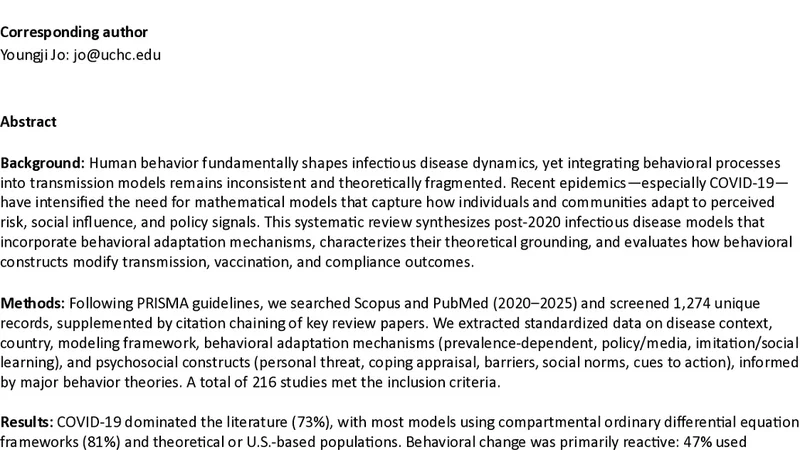
Background: Human behavior shapes infectious disease dynamics, yet its integration into transmission models remains fragmented. Recent epidemics, particularly COVID-19, highlight the need for models capturing adaptation to perceived risk, social influence, and policy signals. This review synthesizes post-2020 models incorporating behavioral adaptation, examines their theoretical grounding, and evaluates how behavioral constructs modify transmission, vaccination, and compliance. Methods: Following PRISMA guidelines, we searched Scopus and PubMed (2020-2025), screening 1,274 records with citation chaining. We extracted data on disease context, country, modeling framework, behavioral mechanisms (prevalence-dependent, policy/media, imitation/social learning), and psychosocial constructs (personal threat, coping appraisal, barriers, social norms, cues to action). A total of 216 studies met inclusion criteria. Results: COVID-19 accounted for 73% of studies. Most used compartmental ODE models (81%) and focused on theoretical or U.S. settings. Behavioral change was mainly reactive: 47% applied prevalence-dependent feedback, 25% included awareness/media dynamics, and 19% relied on exogenous policy triggers. Game-theoretic or social learning approaches were rare (less or equal than 5%). Behavioral effects primarily modified contact or transmission rates (91%). Psychosocial constructs were unevenly represented: cues to action (n=159) and personal threat (n=145) dominated, whereas coping appraisal (n=82), barriers (n=36), and social norms (n=25) were less common. Conclusions: We propose a taxonomy structured by behavioral drivers, social scale, and memory to clarify dominant paradigms and their empirical basis. Mapping models to psychosocial constructs provides guidance for more theory-informed and data grounded-integration of behavioral processes in epidemiological modeling.
💡 Research Summary
This systematic review examines how recent infectious‑disease transmission models (2020‑2025) have incorporated human behavioral change. Following PRISMA guidelines, the authors searched Scopus and PubMed, screened 1,274 records, and ultimately included 216 studies that explicitly model behavioral adaptation. The overwhelming majority (73 %) of the papers focus on COVID‑19, reflecting the pandemic’s role as a catalyst for integrating risk perception, policy signals, and social influence into epidemiological frameworks.
Methodologically, each study was coded for disease context, geographic setting, modeling framework (compartmental ODE, agent‑based, network), type of behavioral mechanism, and the psychosocial constructs drawn from health‑behavior theories (e.g., perceived threat, coping appraisal, barriers, social norms, cues to action). The review finds that 81 % of the models are traditional compartmental ODE systems, with only modest use of agent‑based (≈9 %) or network approaches (≈5 %). Behavioral mechanisms cluster into four categories: (1) prevalence‑dependent feedback (47 % of studies), where rising case numbers trigger reduced contact rates; (2) exogenous policy or media cues (25 %), where government mandates or news coverage act as triggers; (3) imitation or social‑learning processes (19 %); and (4) game‑theoretic strategic decision‑making (≤5 %). Consequently, most models are reactive rather than proactive, adjusting transmission parameters after the fact instead of simulating forward‑looking behavioral strategies.
In terms of psychosocial constructs, “cues to action” (n = 159) and “personal threat perception” (n = 145) dominate the literature, while coping appraisal (n = 82), perceived barriers (n = 36), and social norms (n = 25) appear far less frequently. This imbalance suggests that modelers preferentially adopt easily quantifiable variables (e.g., media intensity, case counts) while neglecting richer, theory‑driven constructs that could capture motivation, self‑efficacy, and normative pressures.
To bring order to a fragmented field, the authors propose a taxonomy organized along three dimensions: (i) behavioral drivers (risk perception, policy signals, social norms), (ii) social scale (individual, household, community), and (iii) memory (short‑term prevalence feedback versus long‑term experiential learning). By mapping each model onto this framework, researchers can more transparently report which psychological mechanisms are represented, how they are operationalized, and what data sources support them.
The discussion highlights several critical gaps. First, the scarcity of game‑theoretic and social‑learning models limits our ability to explore strategic compliance, free‑riding, or collective action problems that are central to public‑health policy. Second, parameterization of behavioral effects often relies on ad‑hoc assumptions, expert opinion, or single‑source surveys, leading to high uncertainty and limited validation. Third, most studies are U.S.-centric and theoretical, with few empirical calibrations to real‑world behavioral data such as mobile‑phone mobility, social‑media sentiment, or longitudinal surveys. The authors advocate for multi‑source data integration—combining mobility traces, digital epidemiology, and psychometric surveys—within Bayesian hierarchical or machine‑learning frameworks to improve parameter estimates and quantify uncertainty.
Limitations of the review include a language bias toward English publications, under‑representation of non‑COVID diseases, and the inability to quantitatively assess the fidelity of each model to underlying health‑behavior theories.
In conclusion, the paper argues that a more systematic, theory‑grounded incorporation of behavioral processes is essential for realistic transmission forecasting and for designing effective non‑pharmaceutical interventions. The proposed taxonomy offers a practical roadmap for aligning epidemiological models with established psychosocial constructs, encouraging the development of proactive, strategy‑aware behavioral modules, and promoting cross‑disciplinary collaborations that can harness real‑time behavioral data to refine model predictions. Future research directions emphasized are (1) real‑time measurement and modeling of behavioral variables, (2) quantitative treatment of social learning and network effects, and (3) cross‑cultural validation to ensure the generalizability of behavioral‑epidemiological models.
Comments & Academic Discussion
Loading comments...
Leave a Comment