Understanding the influence of yttrium on the dominant twinning mode and local mechanical field evolution in extruded Mg-Y alloys
Twinning is a primary deformation mechanism in Mg alloys. This study focuses on tension twins during uniaxial compression of Mg-Y alloys, with three key aspects: the orientation specificity of twin gr
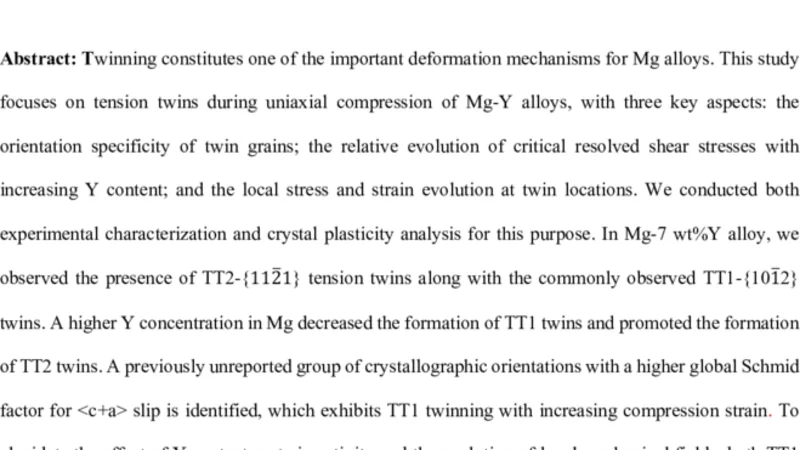
Twinning is a primary deformation mechanism in Mg alloys. This study focuses on tension twins during uniaxial compression of Mg-Y alloys, with three key aspects: the orientation specificity of twin grains, the relative evolution of CRSS with increasing Y content, and the local stress and strain evolution at twin sites. Experimental characterization and crystal plasticity modeling were performed. In Mg-7wt.%Y, TT2-{112-1} tension twins were observed in addition to the common TT1-{101-2} twins. Increasing Y suppressed TT1 formation while promoting TT2 activity. A previously unreported group of crystallographic orientations with a higher global Schmid factor for <c+a> slip was identified, which exhibited TT1 twinning with increasing compression strain. To elucidate Y effects on twin activity and local mechanical fields, both TT1 and TT2 tension twin modes were incorporated into PRISMS-Plasticity, an open-source, finite element-based crystal plasticity solver. Four binary Mg-Y alloys were modeled under compression, and statistical analysis was conducted to correlate initial orientations, stress-strain distributions, and twin activities as functions of Y concentration. The plasticity analysis revealed that increasing Y decreases the CRSS ratio of prismatic and pyramidal slip relative to TT1 twinning, while the slip-to-twin CRSS ratio for TT2 increases, thereby serving as a potential indicator of differential twin activity with Y addition in Mg alloys. Additionally, despite their small volume fraction, TT2 twin sites were predicted higher local strain accumulation locally, relative to the representative volume element and TT1 twins, suggesting their potential influence on localized phenomena such as recrystallization or twin nucleation. These findings provide insight into local mechanical behavior in Mg alloys and support alloy design for advanced engineering applications.
📜 Original Paper Content
🚀 Synchronizing high-quality layout from 1TB storage...