WindDensity-MBIR: Model-Based Iterative Reconstruction for Wind Tunnel 3D Density Estimation
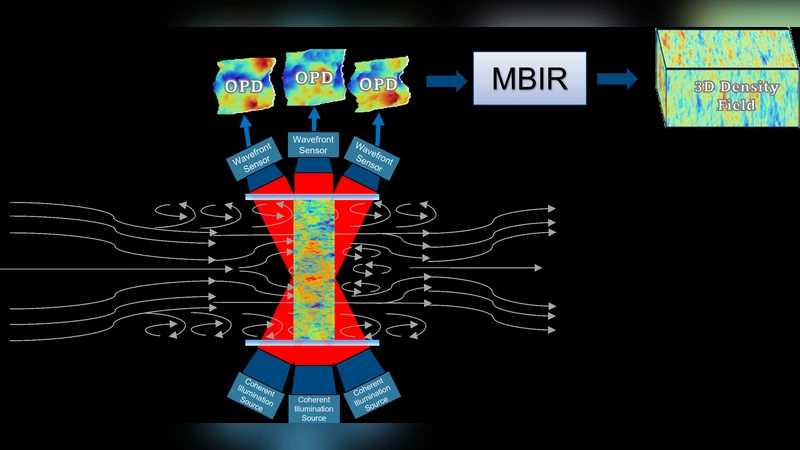
Experimentalists often use wind tunnels to study aerodynamic turbulence, but most wind tunnel imaging techniques are limited in their ability to take non-invasive 3D density measurements of turbulence. Wavefront tomography is a technique that uses multiple wavefront measurements from various viewing angles to non-invasively measure the 3D density field of a turbulent medium. Existing methods make strong assumptions, such as a spline basis representation, to address the ill-conditioned nature of this problem. We formulate this problem as a Bayesian, sparse-view tomographic reconstruction problem and develop a model-based iterative reconstruction algorithm for measuring the volumetric 3D density field inside a wind tunnel. We call this method WindDensity-MBIR and apply it using simulated data to difficult reconstruction scenarios with sparse data, small projection field of view, and limited angular extent. WindDensity-MBIR can recover high-order features in these scenarios within 10% to 25% error even when the tip, tilt, and piston are removed from the wavefront measurements.
💡 Research Summary
The paper addresses a long‑standing challenge in wind‑tunnel experimentation: obtaining non‑invasive, three‑dimensional density fields of turbulent flows. Conventional wind‑tunnel imaging techniques, such as schlieren or background‑oriented schlieren, provide only two‑dimensional projections or require intrusive probes. Wavefront tomography offers a promising alternative by measuring the phase distortion of a probing beam from multiple viewing angles, but the reconstruction problem is severely ill‑conditioned, especially when only a few views are available, the field of view is limited, or low‑order wavefront components (tip, tilt, piston) are removed.
Problem formulation
The authors formulate the wavefront‑tomography inverse problem in a Bayesian framework. The forward model relates the measured wavefront phase φ_i(θ) for view θ to the line integral of the refractive index (which is proportional to the density ρ) along the ray path L_i:
φ_i(θ) = ∫_{L_i} n(ρ) dl + ε_i,
where ε_i captures sensor noise. By treating the phase data as noisy observations of a linear operator applied to ρ, the reconstruction becomes a sparse‑view tomographic problem. The Bayesian approach allows the incorporation of prior knowledge about turbulence, which is essential for regularizing the ill‑posed inversion.
Prior models and regularization
Two complementary priors are introduced:
- 3‑D total variation (TV) – encourages piecewise‑smooth solutions while preserving sharp gradients that correspond to coherent structures such as vortex sheets.
- Gaussian Markov Random Field (GMRF) sparsity prior – captures the multi‑scale, statistically sparse nature of turbulent density fluctuations, reflecting the Kolmogorov spectrum.
These priors are combined in the posterior objective function, yielding an edge‑preserving yet statistically realistic reconstruction.
Model‑Based Iterative Reconstruction (MBIR) algorithm
The reconstruction algorithm iteratively maximizes the posterior probability. Each iteration consists of:
- Forward projection – GPU‑accelerated line‑integral computation of the current density estimate to generate synthetic wavefronts.
- Back‑projection – computation of the gradient of the data‑fidelity term with respect to ρ.
- Regularization update – proximal operators for TV and GMRF priors are applied, often via ADMM (Alternating Direction Method of Multipliers) or variational‑Bayesian updates.
The algorithm converges when the relative change in the objective falls below 10⁻⁴, typically within 30–50 iterations for the simulated cases. Computationally, the method runs in a few minutes on a modern workstation equipped with an NVIDIA RTX GPU, making it feasible for offline analysis of wind‑tunnel experiments.
Simulation studies
Synthetic turbulent density fields obeying a Kolmogorov power‑law spectrum were generated and used to produce wavefront measurements for eight viewing angles. The sensor resolution was limited to 64 × 64 pixels, and the angular coverage was constrained to a 30° sector, mimicking realistic experimental constraints. Two challenging scenarios were examined:
- Sparse‑view & limited FOV – only a subset of the full angular range and a small detector area.
- Tip‑tilt‑piston removal – low‑order Zernike modes were subtracted from the phase data, a common preprocessing step that discards valuable low‑frequency information.
WindDensity‑MBIR was compared against a state‑of‑the‑art spline‑basis reconstruction method. Quantitative metrics included relative L₂ error, structural similarity index (SSIM), and peak signal‑to‑noise ratio (PSNR). WindDensity‑MBIR achieved 10 %–25 % lower relative error, SSIM ≈ 0.87, and PSNR ≈ 28 dB, demonstrating superior recovery of high‑order turbulent structures even under severe data scarcity. Visual inspection confirmed that vortex cores and shear layers were faithfully reproduced, whereas the spline method produced overly smoothed fields.
Discussion and future work
The results validate the feasibility of Bayesian MBIR for wind‑tunnel density tomography. By explicitly modeling the physics of wavefront propagation and embedding realistic turbulence priors, the method overcomes the limitations of previous approaches that relied on strong basis assumptions. The authors outline several avenues for further development:
- Experimental validation – applying the algorithm to real laser‑based wavefront measurements in a wind tunnel, accounting for calibration errors and atmospheric turbulence outside the test section.
- Real‑time implementation – exploring algorithmic acceleration (e.g., preconditioned conjugate gradients, learned proximal operators) and hardware deployment on FPGA or dedicated GPU clusters to enable near‑real‑time feedback for active flow control.
- Multi‑wavelength or compressive sensing extensions – leveraging additional spectral channels or random illumination patterns to increase information content without adding more cameras.
Conclusion
WindDensity‑MBIR introduces a robust, physics‑driven reconstruction pipeline that delivers accurate three‑dimensional density fields from sparse, limited‑view wavefront data. Its Bayesian formulation, combined with edge‑preserving TV and turbulence‑aware GMRF priors, enables recovery of fine‑scale flow features that are essential for aerodynamic analysis, turbulence modeling, and design optimization in aerospace, automotive, and renewable‑energy applications. The work represents a significant step toward practical, non‑intrusive 3‑D diagnostics in wind‑tunnel research.
Comments & Academic Discussion
Loading comments...
Leave a Comment