Causal and Compositional Abstraction
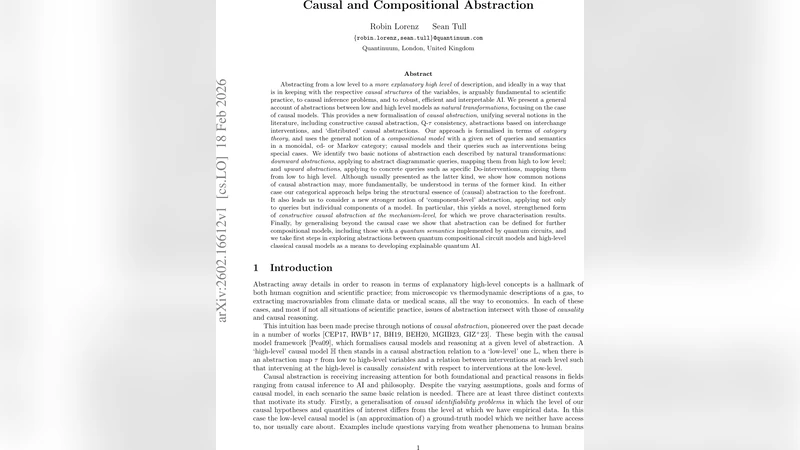
Abstracting from a low level to a more explanatory high level of description, and ideally while preserving causal structure, is fundamental to scientific practice, to causal inference problems, and to robust, efficient and interpretable AI. We present a general account of abstractions between low and high level models as natural transformations, focusing on the case of causal models. This provides a new formalisation of causal abstraction, unifying several notions in the literature, including constructive causal abstraction, Q-$τ$ consistency, abstractions based on interchange interventions, and distributed' causal abstractions. Our approach is formalised in terms of category theory, and uses the general notion of a compositional model with a given set of queries and semantics in a monoidal, cd- or Markov category; causal models and their queries such as interventions being special cases. We identify two basic notions of abstraction: downward abstractions mapping queries from high to low level; and upward abstractions, mapping concrete queries such as Do-interventions from low to high. Although usually presented as the latter, we show how common causal abstractions may, more fundamentally, be understood in terms of the former. Our approach also leads us to consider a new stronger notion of component-level’ abstraction, applying to the individual components of a model. In particular, this yields a novel, strengthened form of constructive causal abstraction at the mechanism-level, for which we prove characterisation results. Finally, we show that abstraction can be generalised to further compositional models, including those with a quantum semantics implemented by quantum circuits, and we take first steps in exploring abstractions between quantum compositional circuit models and high-level classical causal models as a means to explainable quantum AI.
💡 Research Summary
The paper tackles the fundamental scientific practice of moving from a detailed low‑level description to a more explanatory high‑level one while preserving causal relationships. It proposes a unified, category‑theoretic framework in which abstractions between models are expressed as natural transformations. The authors first introduce the notion of a compositional model: a model equipped with a set of queries and a semantics functor living in a monoidal, cd‑, or Markov category. Classical causal models (DAGs with structural equations and do‑interventions) appear as a special case of this general setting.
Two basic kinds of abstraction are defined. Downward abstraction maps each high‑level query to a corresponding low‑level query such that the semantics are preserved; formally, for every query q in the high‑level model H we have ⟦q⟧_H = ⟦α(q)⟧_L where α is the natural transformation. This captures the idea of designing low‑level experiments that answer high‑level scientific questions. Upward abstraction does the opposite: it translates concrete low‑level interventions (e.g., do‑operations) into abstract high‑level interventions. While much of the existing literature focuses on upward abstractions (constructive causal abstraction, Q‑τ consistency, interchange interventions, etc.), the authors argue that these are really derived from a more primitive downward abstraction, and that a well‑behaved upward map exists only when a suitable downward map is present.
A major contribution is the introduction of component‑level abstraction. Here the correspondence is required not just at the level of variables but at the level of individual mechanisms (the structural functions attached to each node). The paper defines a mechanism‑level constructive abstraction and proves a characterisation theorem: a component‑level abstraction exists iff every low‑level mechanism is isomorphic to a high‑level mechanism under the mapping. This strengthens earlier notions such as distributed causal abstraction by demanding exact mechanistic alignment.
The framework is then extended beyond classical probabilistic models to quantum compositional models. Quantum circuits are modelled in a CPM‑category (the categorical counterpart of completely positive maps). The authors construct natural transformations from high‑level classical causal models to low‑level quantum circuit models, showing that, under certain restrictions (e.g., when classical stochastic components are embedded in a quantum circuit), the semantics of interventions can be faithfully transferred. This opens a pathway toward “explainable quantum AI,” where high‑level causal reasoning can be used to interpret the behaviour of quantum algorithms.
Overall, the paper offers four key advances: (1) a universal categorical language for causal abstraction, (2) a clear distinction and relationship between downward and upward abstractions, (3) a rigorous, mechanism‑level notion of abstraction with provable necessary and sufficient conditions, and (4) an initial foray into linking quantum circuit semantics with classical causal explanations. By unifying disparate strands of the literature, the work provides a solid theoretical foundation for robust, interpretable, and compositional AI systems across both classical and quantum domains.
Comments & Academic Discussion
Loading comments...
Leave a Comment