A New Lower Bound for the Diagonal Poset Ramsey Numbers
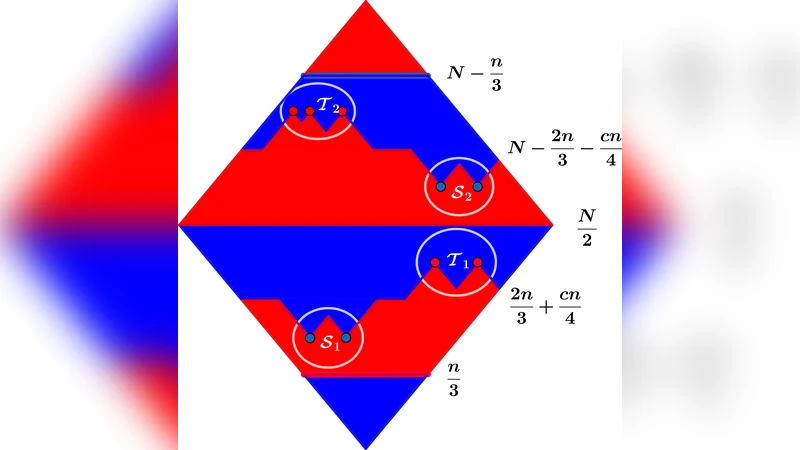
Given two finite posets $\mathcal P$ and $\mathcal Q$, their Ramsey number, denoted by $R(\mathcal P,\mathcal Q)$, is defined to be the smallest integer $N$ such that any blue/red colouring of the vertices of the hypercube $Q_N$ has either a blue induced copy of $\mathcal P$, or a red induced copy of $\mathcal Q$. Axenovich and Walzer showed that, for fixed $\mathcal P$, $R(\mathcal P, Q_n)$ grows linearly with $n$. However, for the diagonal question, we do not even come close to knowing the order of growth of $R(Q_n,Q_n)$. The current upper bound is $R(Q_n,Q_n)\leq n^2-(1-o(1))n\log n$, due to Axenovich and Winter. What about lower bounds? It is trivial to see that $2n\leq R(Q_n,Q_n)$, but surprisingly, even an incremental improvement required significant work. Recently, an elegant probabilistic argument of Winter gave that, for large enough $n$, $R(Q_n,Q_n)\geq 2.02n$. In this paper we show that $R(Q_n,Q_n)\geq 2.7n+k$, where $k$ is a constant. Our current techniques might in principle show that in fact, for every $ε>0$, for large enough $n$, $R(Q_n,Q_n)\geq (3-ε)n$. Our methods exploit careful modifications of layered-colourings, for a large number of layers. These modifications are stronger than previous arguments as they are more constructive, rather than purely probabilistic.
💡 Research Summary
The paper investigates the diagonal poset Ramsey number $R(Q_n,Q_n)$, the smallest dimension $N$ of a hypercube $Q_N$ such that any red/blue vertex‑colouring forces a monochromatic induced copy of the $n$‑dimensional Boolean lattice $Q_n$. While the upper bound $R(Q_n,Q_n)\le n^2-(1!-!o(1))n\log n$ is known (Axenovich–Winter), the lower bound has remained essentially trivial: $2n\le R(Q_n,Q_n)$, with a modest improvement to $2.02n$ obtained by Winter via a probabilistic argument.
The authors present a substantially stronger constructive lower bound: for all sufficiently large $n$,
\
Comments & Academic Discussion
Loading comments...
Leave a Comment