The Quantum Symmetric Simple Exclusion Process in the Continuum and Free Processes
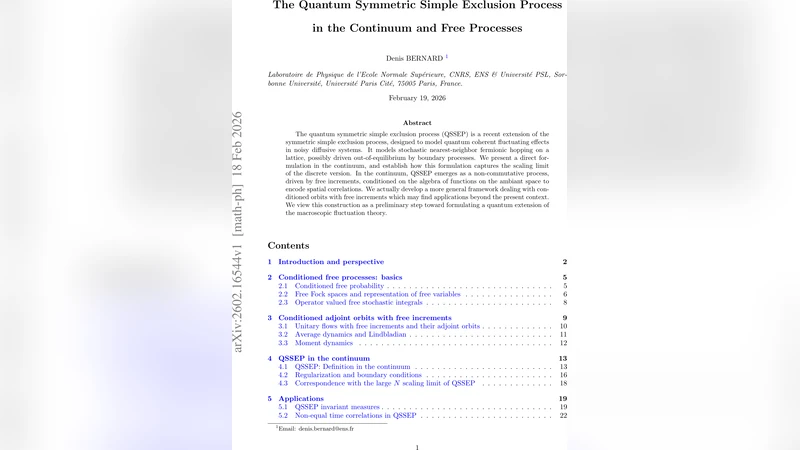
The quantum symmetric simple exclusion process (QSSEP) is a recent extension of the symmetric simple exclusion process, designed to model quantum coherent fluctuating effects in noisy diffusive systems. It models stochastic nearest-neighbor fermionic hopping on a lattice, possibly driven out-of-equilibrium by boundary processes. We present a direct formulation in the continuum, and establish how this formulation captures the scaling limit of the discrete version. In the continuum, QSSEP emerges as a non-commutative process, driven by free increments, conditioned on the algebra of functions on the ambiant space to encode spatial correlations. We actually develop a more general framework dealing with conditioned orbits with free increments which may find applications beyond the present context. We view this construction as a preliminary step toward formulating a quantum extension of the macroscopic fluctuation theory.
💡 Research Summary
The paper presents a comprehensive study of the Quantum Symmetric Simple Exclusion Process (QSSEP), a quantum extension of the classical symmetric simple exclusion process (SSEP) that incorporates coherent fermionic hopping and stochastic noise. The authors begin by recalling the discrete lattice formulation of QSSEP, where nearest‑neighbour fermionic creation and annihilation operators are coupled to Lindblad dissipators that generate random hopping events. This discrete model respects particle‑number conservation and can be driven out of equilibrium by imposing different boundary reservoirs.
The central contribution is the derivation of a continuum limit. By scaling the lattice spacing (a\to0) and the time variable as (t\to t/a^{2}), the authors show that the microscopic density and current operators converge to non‑commutative fields (\rho(x,t)) and (J(x,t)). Crucially, the limiting stochastic dynamics is not a classical Gaussian field but a free‑probability process: the increments are freely independent rather than classically independent. The authors formalise this by introducing “conditioned free increments”, i.e. free‑independent noise that is conditioned on the commutative algebra of spatial functions (C(\mathbb{R})). This conditioning encodes spatial correlations while preserving the free‑independence of temporal increments.
Two main theorems are proved. The first theorem establishes that the two‑point correlation functions of the discrete QSSEP converge to the covariance of a free‑Gaussian process, which coincides with the classical Brownian covariance (\min(x,y)-xy) but retains a non‑commutative operator structure. The second theorem demonstrates that the continuum QSSEP satisfies a stochastic differential equation driven by a free‑Gaussian noise (\xi(x,t)) with the conditional expectation onto (C(\mathbb{R})). In explicit form the macroscopic continuity equation reads
\
Comments & Academic Discussion
Loading comments...
Leave a Comment