Generalised Linear Models Driven by Latent Processes: Asymptotic Theory and Applications
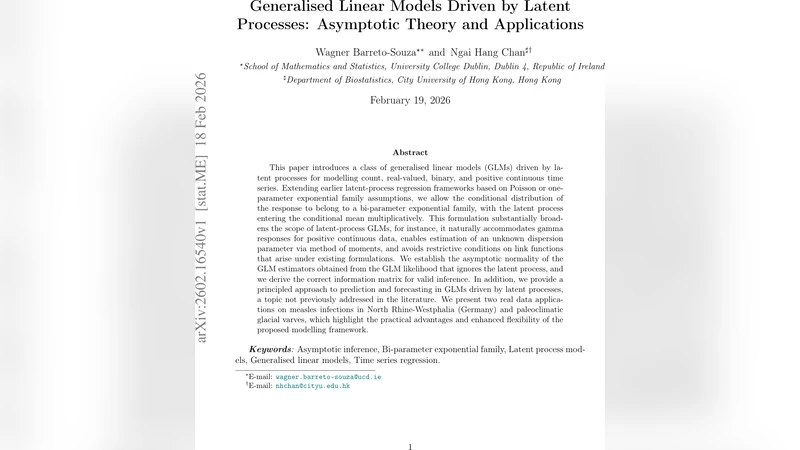
This paper introduces a class of generalised linear models (GLMs) driven by latent processes for modelling count, real-valued, binary, and positive continuous time series. Extending earlier latent-process regression frameworks based on Poisson or one-parameter exponential family assumptions, we allow the conditional distribution of the response to belong to a bi-parameter exponential family, with the latent process entering the conditional mean multiplicatively. This formulation substantially broadens the scope of latent-process GLMs, for instance, it naturally accommodates gamma responses for positive continuous data, enables estimation of an unknown dispersion parameter via method of moments, and avoids restrictive conditions on link functions that arise under existing formulations. We establish the asymptotic normality of the GLM estimators obtained from the GLM likelihood that ignores the latent process, and we derive the correct information matrix for valid inference. In addition, we provide a principled approach to prediction and forecasting in GLMs driven by latent processes, a topic not previously addressed in the literature. We present two real data applications on measles infections in North Rhine-Westphalia (Germany) and paleoclimatic glacial varves, which highlight the practical advantages and enhanced flexibility of the proposed modelling framework.
💡 Research Summary
**
This paper proposes a broad class of generalized linear models (GLMs) in which an unobserved latent process enters multiplicatively into the conditional mean of the response variable. While earlier latent‑process regression frameworks were restricted to Poisson or other one‑parameter exponential families, the authors allow the conditional distribution of the response to belong to any two‑parameter exponential family (e.g., gamma, beta, normal). The model can be written as
\
Comments & Academic Discussion
Loading comments...
Leave a Comment