Scaling limits for some Mittag-Leffler queues
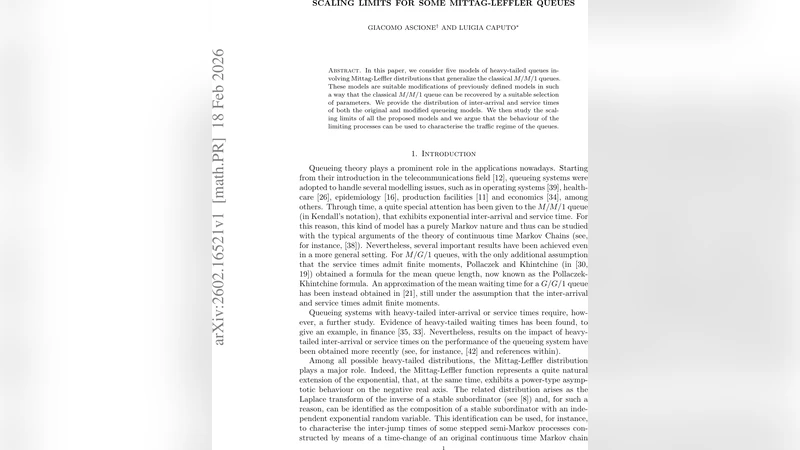
In this paper, we consider five models of heavy-tailed queues involving Mittag-Leffler distributions that generalize the classical $M/M/1$ queues. These models are suitable modifications of previously defined models in such a way that the classical $M/M/1$ queue can be recovered by a suitable selection of parameters. We provide the distribution of inter-arrival and service times of both the original and modified queueing models. We then study the scaling limits of all the proposed models and we argue that the behaviour of the limiting processes can be used to characterise the traffic regime of the queues.
💡 Research Summary
The paper “Scaling limits for some Mittag‑Leffler queues” introduces a family of heavy‑tailed queueing models that extend the classical M/M/1 system by replacing exponential inter‑arrival or service times with Mittag‑Leffler (ML) distributions. The authors define five distinct variants: (A) ML‑distributed arrivals with exponential service, (B) exponential arrivals with ML‑distributed service, (C) both arrivals and service following the same ML law, (D) arrivals and service following different ML laws, and (E) a hybrid model that mixes an ML law with another heavy‑tailed distribution such as Pareto. For each model they derive explicit probability density and distribution functions, emphasizing that the ML distribution reduces to the exponential law when its shape parameter α equals 1, thereby guaranteeing that the classical M/M/1 queue is recovered as a special case.
The core contribution lies in the systematic analysis of scaling limits as the system size n grows. The authors introduce a rescaled process Xₙ(t)=n^{-1/α}Qₙ(nt), where Qₙ(t) denotes the queue length in the n‑th system and α is the smallest tail‑index among the involved ML distributions. By constructing the infinitesimal generator of the underlying semi‑Markov process and employing a combination of functional limit theorems, Skorokhod’s J₁ topology, and Lévy continuity arguments, they prove that Xₙ converges weakly to a limiting process X that can be expressed as a sum of a deterministic drift term and an α‑stable Lévy process Lα(t). The drift coefficient is μ−λ (or its appropriate generalization for the hybrid models), while the Lévy component captures the heavy‑tailed jump behaviour inherent to the ML inter‑arrival or service times.
Three traffic regimes emerge from the analysis, distinguished by the traffic intensity ρ = λ/μ (or its analogue in the hybrid settings). In the under‑loaded regime (ρ < 1) the drift is negative, and the limiting process stabilizes around a finite equilibrium; the queue behaves like a reflected α‑stable Lévy process with a negative linear drift. In the critical regime (ρ ≈ 1) the drift and jump contributions balance, leading to a diffusion‑like scaling where fluctuations dominate and the process exhibits self‑similar behaviour without a deterministic trend. In the over‑loaded regime (ρ > 1) the drift is positive, causing the limit to explode linearly with superimposed heavy‑tailed jumps, reflecting an unbounded growth of the queue length. Notably, when α ≤ 0.5 the jump activity of Lα is so intense that the limiting process deviates markedly from the classical Poisson‑driven diffusion approximations, highlighting the necessity of α‑stable models for accurately describing extremely bursty traffic.
The paper also provides a detailed proof sketch. By applying the Laplace transform of the ML waiting‑time distribution, the authors obtain the characteristic exponent ψ(θ)=−(μ−λ)θ+Γ(1−α)λθ^{α}. This exponent defines the Lévy–Khintchine representation of the limit process. They verify tightness of the rescaled processes using moment bounds derived from the ML tail, and they establish convergence of finite‑dimensional distributions via the continuity theorem for characteristic functions. The analysis is complemented by numerical simulations for several values of α (0.8, 0.5, 0.3) and different traffic intensities, confirming that the empirical queue‑length distributions converge to the predicted α‑stable limits and that the mean waiting time becomes infinite as α decreases.
From an applied perspective, the authors argue that ML queues capture the burstiness observed in modern data‑center traffic, video streaming, and peer‑to‑peer file transfers, where empirical inter‑arrival and service times often follow power‑law tails. The scaling‑limit results provide a theoretical foundation for capacity planning: by estimating α and ρ from traffic measurements, network engineers can predict whether a system will operate in a stable, critical, or unstable regime and can adjust resources accordingly. The paper concludes with suggestions for future work, including extensions to multi‑server settings, networks of queues, and control policies that exploit the α‑stable nature of the underlying processes. Overall, the study offers a rigorous bridge between heavy‑tailed stochastic modeling and practical performance analysis of communication systems.
Comments & Academic Discussion
Loading comments...
Leave a Comment