Linear Landau equation as a limit of a tagged particle in mean field interaction with a free gas
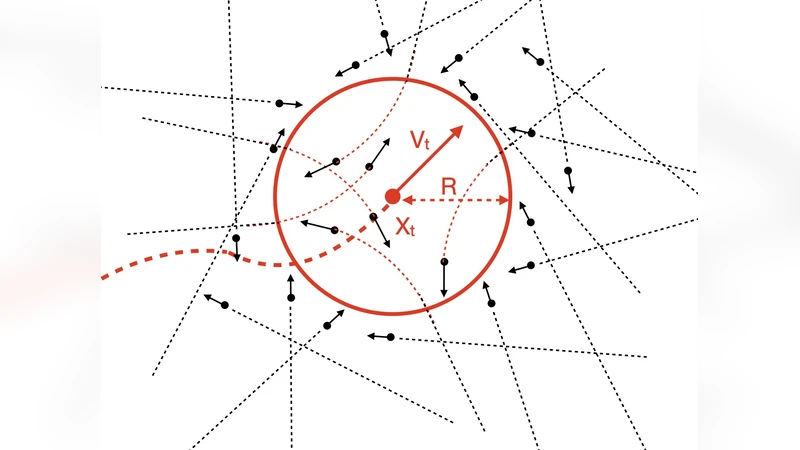
We consider a tagged particle in mean field interaction with a free gas of density N at equilibrium. In dimensions $d\geq4$, we prove the convergence of its trajectory, as N goes to infinity, to the one of a diffusion process associated with the linear Landau equation. The proof of the convergence of the martingale problem relies on two key ingredients: long time stability results of the microscopic dynamics, and controls on the probability of particle recollisions.
💡 Research Summary
The paper studies a tagged particle moving in a free gas whose particles interact with the tagged particle through a mean‑field (weak, $1/N$‑scaled) potential. The gas consists of $N$ particles at equilibrium, each independently distributed according to a Maxwell‑Boltzmann law, while the tagged particle follows the same Hamiltonian dynamics but feels the cumulative force generated by all gas particles. The authors focus on spatial dimensions $d\ge 4$ and investigate the limit $N\to\infty$ of the tagged particle’s trajectory.
The main result is that, under the stated scaling, the trajectory $(X_t^N,V_t^N)$ converges in law (in the Skorokhod topology on path space) to a diffusion process whose generator is precisely the linear Landau operator. In other words, the macroscopic evolution of the tagged particle is governed by the linear Landau equation, which is the Fokker‑Planck description of a particle undergoing small, frequent deflections due to a background of weakly interacting particles.
To prove this convergence the authors formulate a martingale problem for the limiting diffusion. They must show that the processes $M_t^\phi$, defined by
\
Comments & Academic Discussion
Loading comments...
Leave a Comment