Joint beamforming and mode optimization for multi-functional STAR-RIS-aided integrated sensing and communication networks
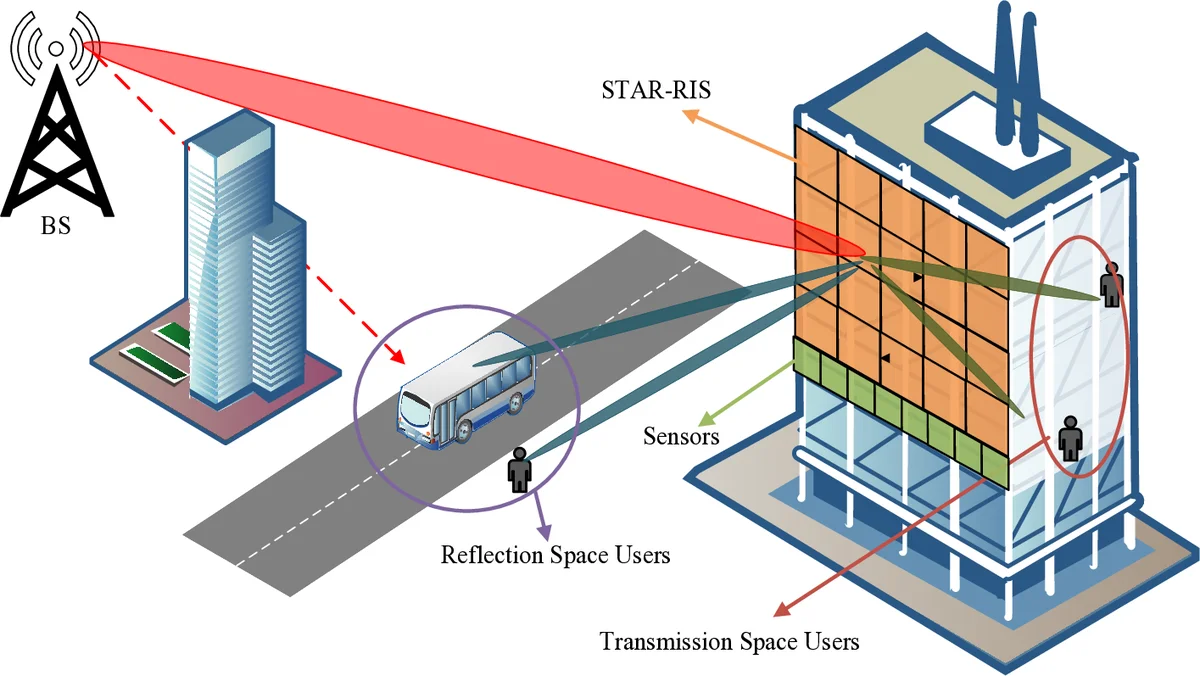
This paper investigates the design of integrated sensing and communication (ISAC) systems assisted by simultaneously transmitting and reflecting reconfigurable intelligent surfaces (STAR-RISs), which act as multi-functional programmable metasurfaces capable of supporting concurrent communication and sensing within a unified architecture. We propose a two-stage ISAC protocol, in which the preparation phase performs direction estimation for outdoor users located in the reflection space, while maintaining communication with both outdoor and indoor users in the transmission space. The subsequent communication phase exploits the estimated directions to enhance information transfer. The directions of outdoor users are modeled as Gaussian random variables to capture estimation uncertainty, and the corresponding average communication performance is incorporated into the design. Building on this framework, we formulate a performance-balanced optimization problem that maximizes the communication sum-rate while guaranteeing the required sensing accuracy, jointly determining the beamforming vectors at the base station (BS), the STAR-RIS transmission and reflection coefficients, and the metasurface partition between energy-splitting and transmit-only modes. The physical constraints of STAR-RIS elements and the required sensing performance are explicitly enforced. To address the non-convex nature of the problem, we combine fractional programming, Lagrangian dual reformulation, and successive convex approximation. The binary metasurface partition is ultimately recovered via continuous relaxation followed by projection-based binarization. Numerical results demonstrate that the proposed design achieves an effective trade-off between sensing accuracy and communication throughput, by significantly outperforming conventional STAR-RIS-aided ISAC schemes.
💡 Research Summary
This paper addresses the design of integrated sensing and communication (ISAC) systems assisted by simultaneously transmitting and reflecting reconfigurable intelligent surfaces (STAR‑RIS). Unlike conventional RIS, which only reflects incident signals, STAR‑RIS can split the incoming energy into a transmitted part and a reflected part, thereby serving users located on both sides of the surface. The authors propose a two‑stage ISAC protocol. In the preparation phase, the base station (BS) estimates the directions of outdoor users that reside in the reflection space while simultaneously maintaining communication with both outdoor and indoor users in the transmission space. The direction estimates are modeled as Gaussian random variables to capture the inherent estimation error, and the average communication performance under this uncertainty is incorporated into the system design. In the subsequent communication phase, the estimated directions are exploited to steer the BS and RIS beams for enhanced data transmission.
The core design problem is formulated as a performance‑balanced optimization: maximize the sum‑rate of all communication users subject to a sensing accuracy constraint (e.g., a bound on the mean‑square error of target parameter estimation). The decision variables include (i) the beamforming vectors at the multi‑antenna BS, (ii) the complex transmission and reflection coefficients of each STAR‑RIS element, and (iii) a binary partition of the metasurface indicating whether each element operates in energy‑splitting (ES) mode or transmit‑only (TS) mode. Physical constraints such as unit‑modulus of the phase shifters, the power‑budget at the BS, the energy‑conservation law for each RIS element (the sum of transmitted and reflected power cannot exceed one), and the required sensing MSE are explicitly enforced.
Because the problem is highly non‑convex—owing to the logarithmic sum‑rate objective, the product terms between beamformers and RIS coefficients, and the binary mode selection—the authors develop a tailored algorithmic framework. First, fractional programming (FP) is employed to transform the sum‑rate maximization into a series of weighted linear objectives, enabling the use of Dinkelbach‑type updates. Second, a Lagrangian dual reformulation introduces a multiplier for the sensing constraint, turning the original constrained problem into an equivalent dual problem that can be solved iteratively. Third, successive convex approximation (SCA) linearizes the remaining non‑convex terms (e.g., the quadratic forms of the RIS coefficients) around the current iterate, yielding a convex sub‑problem at each iteration. Fourth, the binary mode‑selection variables are relaxed to the continuous interval
Comments & Academic Discussion
Loading comments...
Leave a Comment