Derivations as Algebras
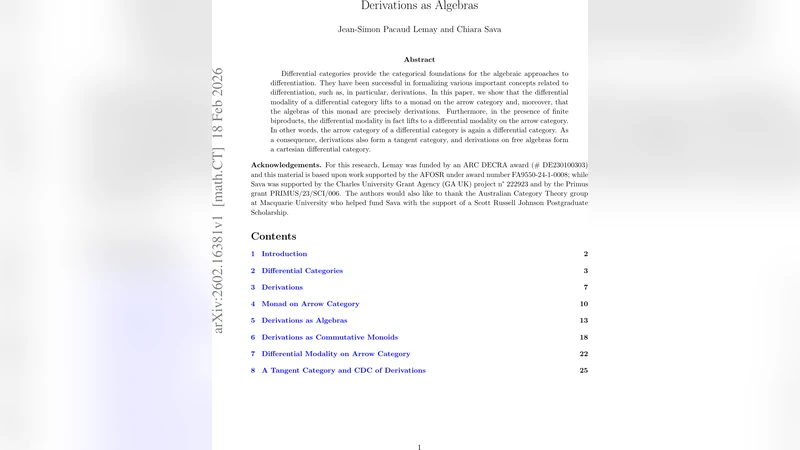
Differential categories provide the categorical foundations for the algebraic approaches to differentiation. They have been successful in formalizing various important concepts related to differentiation, such as, in particular, derivations. In this paper, we show that the differential modality of a differential category lifts to a monad on the arrow category and, moreover, that the algebras of this monad are precisely derivations. Furthermore, in the presence of finite biproducts, the differential modality in fact lifts to a differential modality on the arrow category. In other words, the arrow category of a differential category is again a differential category. As a consequence, derivations also form a tangent category, and derivations on free algebras form a cartesian differential category.
💡 Research Summary
The paper investigates the categorical foundations of differentiation by focusing on differential categories, which provide an abstract setting for algebraic approaches to differentiation. The central object of study is the differential modality “!” that equips each object X of a differential category with a “linear‑logic‑style” comonad !X together with a linearization map L: !X → X⊗!X and a differential operator D: X → !X⊗X satisfying the usual Leibniz rule and linearity. While the modality captures differentiation at the object level, it does not directly address differentiation of morphisms (i.e., derivations).
To bridge this gap the authors lift the differential modality from the base category C to its arrow category Arrow(C). An object of Arrow(C) is a morphism f : A → B in C, and a morphism between two such objects is a commuting square. The paper defines, for each arrow f, a lifted comonad !̂f and constructs a monad (·)̂ on Arrow(C) whose unit η̂_f : f → !̂f and multiplication μ̂_f : !!̂f → !̂f are obtained by applying the original comonad structure pointwise and then checking compatibility with arrow composition. The lifted monad inherits all the axioms of the original differential modality, but now lives in the category of morphisms rather than objects.
The main theorem states that algebras for this monad are precisely derivations. An algebra consists of a structure map α : !̂f → f satisfying the usual algebra equations α ∘ η̂_f = id_f and α ∘ μ̂_f = α ∘ !̂α. By expanding these equations the authors show that α encodes a linear map d : A → B that satisfies the Leibniz rule d(ab) = d(a)b + a d(b). Hence the monadic algebraic data is exactly the data of a derivation, giving a clean categorical characterisation of derivations as monad algebras.
When the underlying differential category possesses finite biproducts, the authors prove that the lifted differential modality itself satisfies the axioms of a differential modality on Arrow(C). This requires showing that the lifted comonad interacts appropriately with biproducts and that the linearization and differential operators can be defined on arrows in a way that respects the biproduct structure. Consequently, Arrow(C) becomes a differential category in its own right. This “closure under arrows” result is significant: it demonstrates that the structure of a differential category is stable under passage to the arrow category, mirroring the well‑known stability of cartesian closed categories under the arrow construction.
From this stability, two immediate corollaries follow. First, the category of derivations (i.e., the category of (·)̂‑algebras) inherits a tangent structure, making it a tangent category in the sense of Rosicky and Cockett‑Cruttwell. The tangent functor is given by the lifted differential modality, and the usual tangent axioms (pullbacks, vertical lift, etc.) hold because they are inherited from the ambient differential category. Second, when one restricts to free algebras for a given algebraic theory, the derivations on those free algebras form a Cartesian differential category. In this setting the differential combinator D satisfies the Cartesian differential axioms (linearity, chain rule, etc.) and the underlying category has finite products, providing a concrete model of Cartesian differential categories arising from algebraic syntax.
Overall, the paper makes three substantial contributions. (1) It provides a systematic method for lifting the differential modality to the arrow level, thereby giving a monadic description of derivations. (2) It shows that under mild assumptions (finite biproducts) the arrow category of a differential category is again a differential category, establishing a new closure property. (3) It identifies the resulting algebraic structures as tangent categories and, in the case of free algebras, as Cartesian differential categories. These results deepen the connection between categorical models of differentiation and classical algebraic notions such as derivations, and they open new avenues for applying differential categorical techniques to areas like automatic differentiation, linear logic, and differential dynamical systems.
Comments & Academic Discussion
Loading comments...
Leave a Comment