Long cycles in vertex transitive digraphs
One of the most well-known conjectures concerning Hamiltonicity in graphs asserts that any sufficiently large connected vertex transitive graph contains a Hamilton cycle. In this form, it was first written down by Thomassen in 1978, inspired by a clo…
Authors: ** 논문 본문에 저자 정보가 명시되어 있지 않으므로, 여기서는 “저자 정보 제공되지 않음”이라고 표기한다. **
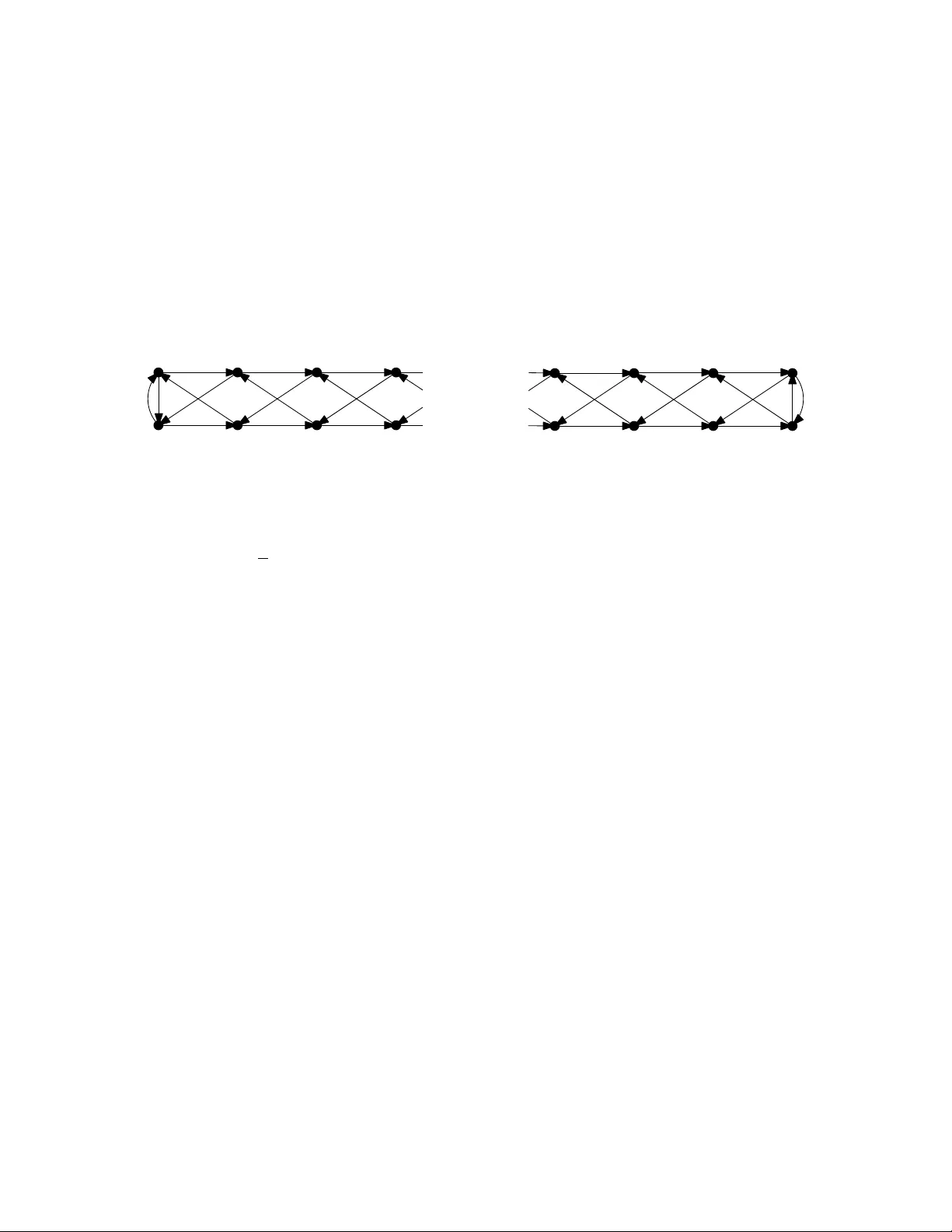
Long cycles in v ertex transitiv e digraphs Matija Bucić ∗ Kevin Hendrey † Bo jan Mohar ‡ Raphael Steiner § Liana Y eprem yan ¶ Abstract One of the most w ell-known conjectures concerning Hamiltonicit y in graphs asserts that any sufficien tly large connected v ertex transitiv e graph con tains a Hamilton cycle. In this form, it w as first written do wn b y Thomassen in 1978, inspired by a closely related conjecture due to Lo v ász from 1969. It has been attributed to sev eral other authors in a survey on the topic by Witte and Gallian in 1984. The analogous question for v ertex transitiv e digraphs has an ev en longer history , ha ving b een first considered by Rankin in 1946. It is arguably more natural from the group-theoretic p ersp ectiv e underlying this problem in b oth settings. T rotter and Erdős pro ved in 1978 that there are infinitely many connected vertex transitive digraphs whic h are not Hamiltonian. This left op en the v ery natural question of how long a directed cycle one can guaran tee in a connected v ertex transitiv e digraph on n v ertices. In 1981, Alspach ask ed if the maximum perimeter gap (the gap b etw een the circumference and the order of the digraph) is a growing function in n . W e answer this question in the affirmative, sho wing that it grows at least as fast as (1 − o (1)) ln n . On the other hand, we prov e that one can alw ays find a directed cycle of length at least Ω( n 1 / 3 ) , establishing the first low er b ound growing with n , pro viding a directed analogue of a famous result of Babai from 1979 in the undirected setting. 1 In tro duction Finding long paths and cycles in graphs is one of the most classical directions of study in graph theory . P erhaps the most famous instance of this general direction is the question of finding the longest p ossible cycle, namely one that tra verses all the vertices. Suc h a cycle is called a Hamilton cycle , and a graph con taining it is said to b e Hamiltonian . Hamiltonicit y is a v ery classical and extensiv ely studied graph prop erty . In general, it is a hard problem to decide if a giv en graph is Hamiltonian. In fact, this is one of Karp’s famous 21 NP-hard problems [9], and is often used to establish hardness of other computational problems. ∗ F aculty of Mathematics, Univ ersity of Vienna, Austria, and Department of Mathematics, Princeton Universit y , USA. Email: matija.bucic@univie.ac.at . Research supp orted in part b y NSF A w ard DMS-2349013. † Sc ho ol of Mathematics, Monash Universit y , Australia. Research supp orted b y the Australian Research Council. ‡ Departmen t of Mathematics, Simon F raser Universit y , Burnaby , BC, Canada. Email: mohar@sfu.ca . Researc h supp orted in part by the NSERC Discov ery Grant R832714 (Canada), by the ERC Synergy grant (Europ ean Union, ER C, KARST, pro ject num b er 101071836), and by the Research Core Grant P1-0297 of ARIS (Slov enia). On lea ve from: FMF, Department of Mathematics, Universit y of Ljubljana, Ljubljana, Slo venia. § Departmen t of Mathematics, ETH Zürich, Switzerland. Email: raphaelmario.steiner@math.ethz.ch . Research supp orted b y SNSF Ambizione grant. ¶ Departmen t of Mathematics, Emory Universit y , A tlanta, GA 30322. Email: lyeprem@emory.edu . Researc h supp orted b y NSF A w ard DMS-2247013. 1 This go es a long w ay tow ards explaining wh y there are so man y in teresting results establishing sufficien t conditions for Hamiltonicit y . The simplest one, featured in essentially ev ery in tro ductory course on graph theory , is Dirac’s theorem from 1952, which states that an y graph with minim um degree at least n 2 is Hamiltonian. A ma jor do wnside of Dirac’s theorem is that it only applies for v ery dense graphs, leading to a more challenging question of finding natural graph prop erties that w ould force Hamiltonicit y ev en for m uch sparser graphs. Perhaps the most in triguing candidate, first considered in the 1960s, is symmetry . This idea first app eared in a communication by Lov ász [14] from 1969, where he conjectured that any connected v ertex transitiv e graph m ust con tain a Hamilton path. Thomassen (see [2]) refined this conjecture in 1978 b y asserting that any sufficiently large connected vertex transitiv e graph is Hamiltonian. These conjectures hav e attracted an immense amoun t of w ork o ver the y ears, with m ultiple surv eys on the topic [1, 5, 22, 28] b eing written, starting as early as the 1980s. Despite this attention, b oth conjectures remain widely open and most of what is kno wn concerns v arious additional assumptions under which the conjectures hold. On the other hand, Babai [2] already in 1979 initiated a very general direction of attack, namely of trying to at least find a long cycle in every connected v ertex transitiv e graph (without any additional assumptions). In particular, he prov ed that an n -v ertex connected vertex transitive graph alwa ys has a cycle of length Ω( √ n ) . In recen t years, there hav e b een sev eral impro vemen ts ov er this result, all making interesting connections to a n um b er of other in teresting graph theoretic problems [6, 7, 15, 21] leading to the curren t state of the art of Ω( n 9 / 14 ) pro ved in [21]. In this pap er, we are in terested in the directed analogue of this problem. Namely , how long a cycle can w e find in any n -vertex connected vertex transitive digraph? This question is even more classical, owing to the fact that in the arguably most interesting instance of the problem, namely that of Ca yley digraphs, the directed v ariant is more natural 1 and translates to a natural group rearrangemen t problem. Indeed, the t wo oldest pap ers to consider this problem started from this group theoretic question and translated it to the Cayley digraph instance of our problem. These w ere a 1946 paper b y Rankin [23], and an indep enden t 1959 pap er b y Rapaport-Strasser [24]. Both of these works attribute their motiv ation to Campanology (as well as the “knigh t tour” problem in the latter case), where v arious instances of this problem hav e b een solved in practice, more than a cen tury b efore (see [23, Section 4] or [27, Chapter 15] for more details). The directed analog of Thomassen’s conjecture was first disprov ed 2 b y T rotter and Erdős [26] in 1978, who exhibited an infinite family of connected vertex transitiv e digraphs without Hamilton cycles. Motiv ated by this result, Alspach ask ed already in 1981 whether such graphs need to b e at least “nearly” Hamiltonian. Here, to formalize this question, w e can use the p erimeter gap , defined as the difference b etw een the num b er of vertices and the length of the longest directed cycle in a digraph, as a measure of how far from Hamiltonian a graph is. In particular, Alspac h (Question 7 in [1]) asked if for an y constan t C there exists a connected v ertex transitiv e digraph with p erimeter gap larger than C . W e answer this question in the affirmativ e in the follo wing quantitativ e form. Theorem 1.1. F or infinitely many natur al numb ers n , ther e exists a c onne cte d vertex tr ansitive digr aph on n vertic es with p erimeter gap at le ast (1 − o (1)) ln( n ) . Giv en this result, the question of ho w long of a cycle we can actually guaran tee, raised by Babai in the undirected case already in 1979, b ecomes ev en more natural in the directed case. Here, it 1 The k ey difference is that in the digraph case, one deals with arbitrary generating sets, not just symmetric ones, and this is more natural from the group theoretic p erspective. 2 T echnically , the argumen t from [26] relies on the existence of infinitely many so-called Sophie-Germain primes, whic h is still an op en problem in n umber theory to this da y . W e discuss this in more detail in Section 3. 2 w as not ev en known whether one can guaran tee a cycle of length gro wing with n . W e pro ve suc h a result, establishing a directed analog of Babai’s result from 1979. Theorem 1.2. In any c onne cte d vertex tr ansitive digr aph D on n ≥ 2 vertic es ther e is a dir e cte d cycle of length at le ast Ω( n 1 / 3 ) . W e note that neither Babai’s result nor the aforemen tioned recen t results improving on it extend to the directed case. This is b ecause all of these proofs at v arious places crucially rely on the fact that in a 2 -connected graph G , an y t wo longest cycles m ust intersect. How ev er, an analogous statement fails badly for strongly 2 -connected digraphs, even if they are assumed to b e 2 -out- and 2 -in-regular: In Figure 1.1 w e illustrate a construction of strongly 2 -connected 2 -regular digraphs with arbitrarily man y vertex-disjoin t longest directed cycles. ...... Figure 1.1: A family of strongly 2 -connected 2 -regular digraphs suc h that an y longest directed cycle has length four, while the maximum length of a directed path is not b ounded. In this family , the n umber of vertex-disjoin t longest directed cycles can b e arbitrarily large. In fact, our arguments pro vide slightly longer directed paths in place of directed cycles, namely of length at least Ω( √ n ) , see Theorem 2.5. Using this, we also get a new proof of Babai’s result in the undirected setting where the longest cycle and path are alw ays within a constant factor of eac h other, see [13]. Ho wev er, the same family of examples illustrated in Figure 1.1 sho ws that in general it do es not suffice to use the existence of long directed paths and strong 2 -connectivit y to infer the existence of long directed cycles. Hence, to prov e Theorem 1.2, w e need additional ideas, b ey ond the comparativ ely simpler ideas that suffice to guarantee a long directed path. Notation. In this pap er, all graphs and digraphs are finite, unless explicitly mentioned otherwise. Giv en a digraph D w e denote by V ( D ) its v ertex set, and by A ( D ) the set of its arcs. Given U ⊆ V ( D ) w e denote by N + ( U ) the external out-neigh b orho o d of U , namely the set of vertices not in U whic h are endp oin ts of arcs with the start vertices in U . N − ( U ) is similarly defined as the external in-neigh b orho o d. Giv en u, v ∈ V ( D ) w e write d ( u, v ) for the directed distance from u to v , namely the length of a shortest directed path from u to v (setting it to b e infinit y if suc h a path do es not exist). The directed diameter of D is the maximum of d ( u, v ) ov er all u, v ∈ V ( D ) . A digraph is said to b e strongly connected if its diameter is finite. It is said to b e connected if its underlying graph, obtained b y removing the directions from all edges, is connected. It is not hard to see that if D is a vertex transitive digraph then these tw o notions coincide. Given an undirected graph G and vertices u, v ∈ V ( G ) , we denote by d ( u, v ) = d ( v , u ) the distance b etw een u and v in G . The diameter of G is sup u,v ∈ V ( G ) d ( u, v ) . 2 Finding long paths and cycles in v ertex transitiv e digraphs In this section, w e pro v e Theorem 1.2. W e begin here with a brief sketc h and o verview of the proof. The pro of naturally splits in to t wo parts dep ending on ho w large the directed diameter of our graph is. W e deal with the case when the diameter is small in Section 2.1. In this case, w e will b e able to show that the graph must ha ve some w eak (sublinear) expansion prop erties (see Theorem 2.2) whic h combined with a directed v ariant of a DFS-t yp e argument for finding long paths or cycles in 3 expanders, gives us a long cycle (see Theorem 2.4). W e deal with the case of large directed diameter in Section 2.2. In this case, a key idea is to reduce our directed problem to an undirected one. T o do so, w e in tro duce an auxiliary undirected graph (the cycle graph, see Theorem 2.6). W e sho w that (unless our digraph already has a long directed cycle) our auxiliary graph inherits the large diameter property (see Theorem 2.7). It also inherits a sligh tly w eaker version of v ertex transitivit y (whic h we dub “near transitivity”, see Theorem 2.9). While a long cycle in our auxiliary undirected graph migh t not on its own translate back to a long directed cycle in the original digraph, we sho w that a long induc e d cycle does suffice (see Theorem 2.8). Finally , we show that in a nearly transitive graph with a large diameter, one can, in fact, find a long induced cycle (see Theorem 2.11), which completes the pro of. 2.1 Expansion properties of v ertex transitiv e digraphs In this subsection, w e will deal with the small diameter case of Theorem 1.2. W e start by in tro ducing the notion of graph expansion that we will w ork with. Definition 2.1. A digr aph D is an α -expander if | V ( D ) | ≥ 2 and for every U ⊆ V ( D ) with | U | ≤ 2 3 | V ( D ) | , we have | N + ( U ) | ≥ α | U | and | N − ( U ) | ≥ α | U | . The follo wing lemma sho ws that vertex transitiv e digraphs with small diameter m ust hav e some w eak expansion prop erties. Lemma 2.2. L et D b e a c onne cte d, vertex tr ansitive digr aph with dir e cte d diameter d . Then, D is a 1 3 d -exp ander. T o pro v e this lemma, w e will extend the pro of of a classical result due to Babai on the v ertex- expansion of vertex transitive graphs [3] to the setting of vertex transitive digraphs. As in Babai’s pro of, it will b e conv enient to first consider the sp ecial case of Ca yley digraphs and then reduce the general case to it. Recall that giv en a finite group (Γ , · ) and a set of generators S of Γ , the Cayley digr aph Cay(Γ , S ) has v ertex-set Γ and an arc ( x, y ) from a group elemen t x to another group elemen t y if and only if x − 1 y ∈ S . The follo wing statement implies that Cayley digraphs are 1 3 d -expanders, where d denotes the directed diameter of the Ca yley digraph. Lemma 2.3. L et Γ b e a finite gr oup, d ∈ N and supp ose that S ⊆ Γ is such that every element of Γ c an b e written as a pr o duct of at most d elements of S (empty pr o duct and r ep etitions al lowe d). Then, for every subset X ⊆ Γ with | X | ≤ 2 3 | Γ | ther e exists some s ∈ S such that | X s \ X | ≥ | X | 3 d . Pr o of. W e start by observing that there exists some g ∈ Γ suc h that | X g \ X | ≥ 1 3 | X | . T o see this, note that if we sample g ∈ Γ uniformly at random, then for every h ∈ Γ the probabilit y that h ∈ X g equals | X | | Γ | , and hence the exp ected size of | X g \ X | is exactly | X | | Γ | ( | Γ | − | X | ) ≥ 1 3 | X | . Thus, suc h a g ∈ Γ must exist. Let now s 1 , . . . , s t ∈ S with t ≤ d b e suc h that g = s t · · · s 1 . F or 0 ≤ i ≤ t define g i := s i · · · s 1 . W e then ha ve X g \ X ⊆ t [ i =1 ( X g i \ X g i − 1 ) . Hence, there exists some i ∈ [ t ] such that | X g i \ X g i − 1 | ≥ 1 t | X g \ X | ≥ 1 3 d | X | . This shows that | X s i \ X | = | ( X s i \ X ) g i − 1 | = | X g i \ X g i − 1 | ≥ 1 3 d | X | . Since s i ∈ S , this concludes the pro of. 4 The desired result for the expansion of vertex transitive digraphs is no w an easy consequence of the ab o ve. Pr o of of L emma 2.2. Fix an arbitrary vertex v ∈ V ( D ) , let Γ denote the automorphism group of D , and let S ⊆ Γ b e defined as the set of all automorphisms ϕ ∈ Γ such that ϕ ( v ) is an out-neighbor of v in D . W e claim that ev ery elemen t of Γ can b e written as a composition of at most d elemen ts of S . Indeed, let ϕ ∈ Γ be giv en arbitrarily . Then, since D has directed diameter d , there exists some t ≤ d and a sequence of v ertices v = x 0 , x 1 , . . . , x t = ϕ ( v ) suc h that ( x i − 1 , x i ) ∈ A ( D ) for all i ∈ [ t ] . F or i = 0 , . . . , t , let ϕ i denote an automorphism such that ϕ i ( v ) = x i , where w e let ϕ 0 b e the iden tity and ϕ t := ϕ . Then we can see that ϕ = ϕ − 1 0 ◦ ϕ t = ( ϕ − 1 0 ◦ ϕ 1 ) ◦ ( ϕ − 1 1 ◦ ϕ 2 ) ◦ · · · ◦ ( ϕ − 1 t − 1 ◦ ϕ t ) . By construction each of the automorphisms ϕ − 1 i − 1 ◦ ϕ i for i ∈ [ t ] sends v to an out-neighbor of v . Hence, w e hav e written ϕ as a comp osition of at most d members of S , as desired. Let n := | V ( D ) | and let U ⊆ V ( D ) be an arbitrary subset with | U | ≤ 2 3 n . Let X ⊆ Γ b e defined as the set of all automorphisms ϕ ∈ Γ such that ϕ ( v ) ∈ U . Observ e that | X | = | U | n · | Γ | ≤ 2 3 | Γ | . W e can no w apply Lemma 2.3 to Γ , the set S and the set X to find that there exists some s ∈ S such that | X s \ X | ≥ 1 3 d | X | . In other words, there exist at least 1 3 d | X | automorphisms ϕ of D with ϕ ( v ) ∈ U and ϕ ( s ( v )) / ∈ U . By the definition of S , in this situation we then alwa ys hav e ϕ ( s ( v )) ∈ N + D ( U ) . Since D is vertex transitive, for every vertex x ∈ N + D ( U ) there are exactly | Γ | n automorphisms ϕ with ϕ ( s ( v )) = x . Hence, the ab ov e yields at least 1 3 d | X | | Γ | /n = 1 3 d | U | n | Γ | | Γ | /n = 1 3 d | U | distinct v ertices in N + D ( U ) . This establishes the desired inequality | N + D ( U ) | ≥ 1 3 d | U | , concluding the pro of. The follo wing lemma guaran tees a long cycle in an expanding digraph. It is a directed v ariant of the so-called DFS lemma, see [10]. Lemma 2.4. A n n -vertex α -exp ander D with α > 0 c ontains a dir e cte d cycle of length at le ast αn 3 . Pr o of. Let v 1 b e an arbitrary vertex in D . Since D is an α -expander, D is strongly connected and ev ery vertex in D is a descendant of v 1 . As long as we can, w e rep eat the following pro cess. Giv en a directed path v 1 v 2 . . . v i , if there exists an outneighbor of v i that is not in { v 1 , . . . , v i − 1 } and has at least 2 n 3 descendan ts in the digraph induced on V ( D ) \ { v 1 , . . . , v i } , we choose such an outneigh b or v i +1 and contin ue. This pro cess m ust ev en tually stop since the size of the induced sub digraph we consider decreases b y one in each step. Let us supp ose this process stops after t steps with a path P = v 1 v 2 . . . v t with v t ha ving at least 2 n 3 descendan ts in the sub digraph induced on V ( D ) \ { v 1 , . . . , v t − 1 } but eac h of its outneighbors not on P has at most 2 n 3 descendan ts in the sub digraph induced on V ( D ) \ { v 1 , . . . , v t } . This implies that there is a subset S of outneighbors of v t in D − V ( P ) such that the set U of all descendant s (in D − V ( P ) ) of the v ertices in S has at least n 3 and at most 2 n 3 v ertices. Since D is an expander, U has at least αn 3 outneigh b ors in D . All these outneigh b ors must be in P , so taking the one that is closest to v 1 on P , gives us a cycle in D of at least that length. As we shall see next, com bining the ab o ve t wo lemmas already yields a short pro of of the aforemen- tioned v ariant of Theorem 1.2 where w e seek a path instead of a cycle. Theorem 2.5. In any c onne cte d vertex tr ansitive digr aph on n vertic es, ther e is a dir e cte d p ath of length at le ast Ω( n 1 / 2 ) . 5 Pr o of. Let D b e any giv en connected vertex transitiv e digraph on n vertices. One easily c hec ks that then D must also be regular (i.e., there exists some r ∈ N such that ev ery vertex has out- and in-degree exactly r ). Indeed, v ertex-transitivity directly implies that there exist n umbers r 1 , r 2 suc h that ev ery v ertex of D has out-degree r 1 and in-degree r 2 . But then the n umber of arcs in D equals r 1 n and r 2 n , so w e must hav e r 1 = r 2 , as desired. In particular, D is an Eulerian digraph and hence strongly connected. Let d ∈ N denote the directed diameter of D . By Lemma 2.2 we hav e that D is a 1 3 d -expander, and by applying Theorem 2.4 w e find that D contains a directed cycle (and hence path) of length at least n 9 d . On the other hand, since D is strongly connected with diameter d , there exists a directed path of length d in D . All in all, it follo ws that the maximum length of a directed path in D is at least max n n 9 d , d o ≥ r n 9 d · d = 1 3 √ n. This concludes the pro of of the theorem. W e note that we may apply this theorem in the undirected setting as well (b y considering the vertex transitiv e digraph obtained b y replacing every edge with tw o arcs joining its tw o v ertices, one in eac h direction). Since in a v ertex transitiv e graph the length of a longest path and cycle differs only b y a constant factor [13], this giv es a new pro of of the result of Babai from 1979, guaranteeing the existence of a cycle of length Ω( √ n ) in any connected v ertex transitiv e graph [2]. 2.2 The cycle graph The follo wing definition of an auxiliary graph is going to prov e very useful in finding long cycles. Definition 2.6. Given a digr aph D , its cycle graph C ( D ) is the gr aph whose vertex-set c onsists of al l dir e cte d cycles of D , with two of them adjac ent if and only if they interse ct in at le ast one vertex. W e next prov e t wo lemmas relating properties of this auxiliary graph to the original digraph. Lemma 2.7. F or any c onne cte d vertex tr ansitive digr aph D with dir e cte d diameter d and cir cum- fer enc e ℓ its cycle gr aph is c onne cte d with diameter at le ast d ℓ − 1 . Pr o of. Supp ose C 1 , C 2 ∈ C ( D ) and fix v 1 ∈ C 1 , v 2 ∈ C 2 . Since D is strongly connected, there is a directed path with vertex sequence v 1 = u 0 , u 1 , . . . , u ℓ = v 1 from v 1 to v 2 in D . Again by strong connectivit y , for each 1 ≤ i ≤ ℓ there exists a directed cycle C ′ i in D through the arc ( u i − 1 , u i ) . No w, the sequence C 1 , C ′ 1 , . . . , C ′ ℓ , C 2 yields a walk in C ( D ) from C 1 to C 2 . This pro ves that C ( D ) is connected. F or the diameter b ound, take v 1 , v 2 ∈ V ( D ) such that the shortest directed path from v 1 to v 2 in D has length d , and take arbitrary directed cycles C 1 con taining v 1 and C 2 con taining v 2 . Let C ′ 0 , C ′ 1 , . . . , C ′ t b e a shortest path with C ′ 0 = C 1 and C ′ t = C 2 in C ( D ) . Starting at v 1 and following C ′ 0 un til we reach the first v ertex of C ′ 1 and then following C ′ 1 un til we reach the first v ertex of C ′ 2 and so on, we obtain a directed w alk from v 1 to v 2 of length at most ( t + 1) ℓ in D . Since v 1 , v 2 are at directed distance d in D , this implies t ≥ d ℓ − 1 , as claimed. Lemma 2.8. F or any digr aph D , if C ( D ) c ontains an induc e d cycle of length ℓ ≥ 4 , then D c ontains a dir e cte d cycle of length at le ast ℓ . Pr o of. Let C 1 , . . . , C ℓ ∈ C ( D ) b e an induced cycle. Note that since ℓ ≥ 4 , C 2 and C ℓ are not adjacent in C ( D ) and so C 1 ∩ C ℓ and C 1 ∩ C 2 are disjoin t. Pic k v ertices v 1 ∈ C 1 ∩ C ℓ and v 2 ∈ C 1 ∩ C 2 that 6 are joined by a directed path from v 1 to v 2 in C 1 with no other v ertices of C ℓ or C 2 on it. W e no w rep eat the following for 2 ≤ i ≤ ℓ − 1 . Giv en v i ∈ C i ∩ C i − 1 w e follo w C i un til w e first reac h a v ertex of C i +1 whic h we set to b e v i +1 . The key prop erty w e maintain by pic king the first suc h vertex is that the path from v i to v i +1 on C i do es not contain other vertices of C i +1 , so it will in particular b e disjoint from the path from v i +1 to v i +2 on C i +1 (except for v i +1 ). Finally , once w e reac h v ℓ w e simply close the cycle by w alking along C ℓ un til v 1 , whic h we can, since the path from v 1 to v 2 on C 1 do es not con tain any vertices of C ℓ except for v 1 . Hence, v 1 v 2 . . . v ℓ v 1 is a directed cycle of length at least ℓ in D . V ertex transitivit y of a digraph D might not b e inherited in full by its cycle graph C ( D ) . It turns out that C ( D ) does, in fact, inherit the following sligh tly w eaker notion of transitivit y . Definition 2.9. A gr aph G is nearly transitiv e if for any two vertic es v , u ∈ V ( G ) , ther e exists an automorphism of G mapping v to u or to a neighb or of u . Note that, in particular, a v ertex transitive graph is nearly transitiv e. Near transitivity serv es as a useful approximation of vertex transitivit y for our purposes, in the sense that while in a vertex transitiv e graph one can map an y vertex to any other v ertex, in a nearly transitiv e graph one can map an y vertex v ery close to an y other vertex (namely , to a vertex at distance at most one). The follo wing easy lemma sho ws that vertex transitivit y of a digraph D implies near transitivity of its cycle graph. Lemma 2.10. F or any c onne cte d vertex tr ansitive digr aph D , its cycle gr aph C ( D ) is ne arly tr an- sitive. Pr o of. Note first that any automorphism ϕ : V ( D ) → V ( D ) giv es rise to a natural automorphism ϕ ′ of C ( D ) which maps an y C ∈ V ( C ( D )) to its image under ϕ . No w let C 1 , C 2 ∈ V ( C ( D )) and pic k v ∈ C 1 , u ∈ C 2 . Pick an automorphism ϕ of D which maps v to u . Now, ϕ ′ ( C 1 ) is a cycle of D passing through u , so in particular it in tersects C 2 and is hence either equal to C 2 or adjacen t to C 2 in C ( D ) . The following is the key lemma of this section, which we find interesting in its own right. W e note that questions of similar flav or ha ve b een considered b efore, see e.g. [4, 16] (although with a v ery differen t fo cus). It guaran tees the existence of a long induced cycle in a nearly transitive graph. Lemma 2.11. In any c onne cte d, ne arly tr ansitive gr aph G with diameter d ≥ 20 , ther e is an induc e d cycle of length at le ast d − 17 . Pr o of. Supp ose to wards a con tradiction that every induced cycle in G has length less than d 4 . Let us fix a shortest path S b etw een tw o vertices v , u at distance d in G . Note that S is a geo desic path and is hence induced. Let m b e a v ertex of S at distance at least d − 1 2 from b oth u and v . Let L b e the subpath of S betw een v and m and let R b e the subpath b etw een m and u . Let P b e an induced path in G of maximum length sub ject to the condition that the subpath Q of P on its last ⌈ d − 5 2 ⌉ v ertices is a geo desic path. Note that S satisfies this condition and so such a path exists and has length at least d . Let w be the common endp oint of Q and P , let x b e the other endp oin t of P and let y b e the other endp oin t of Q . Let S ′ b e the image of S under an automorphism ϕ mapping m to w or a neighbor of w . Let L ′ := ϕ ( L ) , R ′ := ϕ ( R ) , v ′ := ϕ ( v ) , u ′ := ϕ ( u ) and w ′ := ϕ ( m ) . 7 W e first claim that either L ′ or R ′ in tersects Q ∪ N ( Q ) only in verti ces at distance at most 3 from w ′ . T o see this, let a ′ and b ′ b e vertices of L ′ ∩ ( Q ∪ N ( Q )) and R ′ ∩ ( Q ∪ N ( Q )) resp ectively . Let a and b b e vertices of Q at distance at most one from a ′ and b ′ , resp ectively . See Figure 2.1 for an illustration of the setup so far. Figure 2.1: Illustration of the setup in the proof of Theorem 2.11. Dashed lines depict pairs of v ertices at distance up to one. L ′ ∪ R ′ = S ′ is a geo desic path, and so is Q . This implies that d ( w , a ) is v ery close to d ( w , a ′ ) and d ( w , b ) to d ( w, b ′ ) . The argument no w relies on the fact that d ( a ′ , b ′ ) is roughly the sum of these t wo distances since a ′ , b ′ are b oth v ertices of the geo desic path S ′ , but also b y going through the a - b segment, w e can find a path of distance roughly the difference betw een these t wo distances. The conclusion is that one of these distances needs to b e very small. Note that since d ( w , w ′ ) , d ( a, a ′ ) , d ( b, b ′ ) ≤ 1 , w e get via triangle inequality that | d ( a ′ , w ′ ) − d ( a, w ) | ≤ d ( a ′ , a ) + d ( w , w ′ ) ≤ 2 and (2.1) | d ( b ′ , w ′ ) − d ( b, w ) | ≤ d ( b ′ , b ) + d ( w , w ′ ) ≤ 2 . (2.2) Since S ′ is geo desic (b eing an image of a geo desic path under an automorphism), so are all of its subpaths. Combining this with sev eral applications of the triangle inequalit y , we get d ( a ′ , w ′ ) + d ( b ′ , w ′ ) = d ( a ′ , b ′ ) ≤ d ( a, b ) + 2 = | d ( a, w ) − d ( b, w ) | + 2 . (2.3) Com bining (2.1), (2.2) and (2.3) we obtain d ( a ′ , w ′ ) + d ( b ′ , w ′ ) ≤ | d ( a ′ , w ′ ) − d ( b ′ , w ′ ) | + 6 = ⇒ min { d ( a ′ , w ′ ) , d ( b ′ , w ′ ) } ≤ 3 , as claimed. Supp ose without loss of generalit y that L ′ in tersects Q ∪ N ( Q ) only in v ertices at distance at most 3 from w ′ . Pick a vertex c in this in tersection farthest from w ′ . Let z b e a v ertex at distance at most one from c on Q , farthest from w . By the triangle inequality , we kno w that d ( z , w ) ≤ d ( c, w ′ ) + 2 ≤ 5 . No w, let Q ′ b e the subpath of Q from y to z , and let L ′′ b e the subpath of L ′ from c to v ′ . Note that V ( Q ′ ) ∪ V ( L ′′ ) induces a path by construction (since c and z are equal or adjacent). Let P ′ denote the subpath of P from x to y . W e no w claim that there must b e a pair of vertices s ∈ V ( P ′ ) and t ∈ V ( L ′′ ) with d ( s, t ) ≤ 1 . Indeed, suppose for a contradiction such a pair does not exist. Then P ′ and L ′′ are vertex-disjoi nt and ha ve no connecting edges. In particular, app ending the path induced by V ( Q ′ ) ∪ V ( L ′′ ) to P ′ , w e obtain an induced path whose last ⌈ d − 5 2 ⌉ v ertices induce 8 a subpath of L ′ and thus a geodesic path. Moreo ver, the total length of the new path is at least | E ( P ) | + d − 1 2 − 8 + 1 > | E ( P ) | , and this con tradicts our c hoice of P . Hence, there indeed need to exist v ertices s ∈ V ( P ′ ) , t ∈ V ( L ′ ) with s = t or st ∈ E ( G ) . Pick suc h s and t for which d P ′ ( s, y ) + d L ′′ ( t, c ) is minimized. Let C b e the cycle formed by the union of the segment of P ′ from s to y , the segment of L ′′ from t to c , the edge st if s = t , as w ell as the path in G induced b y V ( Q ′ ) ∪ V ( L ′′ ) . It is not hard to see that by our c hoice of c, z , s, t respectively C forms an induced cycle in G . Since C by definition contains Q ′ as a subpath and since Q ′ is geo desic, we find that | E ( C ) | ≥ 2 | E ( Q ′ ) | ≥ 2( d − 7 2 − 5) = d − 17 , as desired. W e are now ready to formally put together the pro of of Theorem 1.2. Pr o of of The or em 1.2. If our digraph has diameter d ≤ n 2 / 3 , then by Theorems 2.2 and 2.4 we can find a directed cycle of length Ω( n 1 / 3 ) . Supp ose now d ≥ n 2 / 3 . By Theorem 2.7 w e either hav e a cycle in D of length at least Ω( n 1 / 3 ) or C ( D ) has diameter at least O ( n 1 / 3 ) . By Theorems 2.10 and 2.11 we can no w find an induced cycle in C ( D ) of length Ω( n 1 / 3 ) which via Theorem 2.8 gives a directed cycle in D of length Ω( n 1 / 3 ) , completing the pro of. 3 P erimeter gap in v e rtex transitiv e digraphs It is well-kno wn (see, e.g. T rotter and Erdős [26]) that there exist arbitrarily large connected v ertex transitiv e digraphs which are not Hamiltonian. In fact, an easy counterexample is also giv en b y a natural “toroidal” v ersion of our construction depicted in Figure 1.1, where the bidirected edges are replaced by edges wrapping around, provided it consists of 8 n + 4 vertices, for any n ≥ 1 . In this section, w e pro ve Theorem 1.1, sho wing that for infinitely man y n there are connected vertex transitiv e digraphs of order n with p erimeter gap as large as (1 − o (1)) ln n . T o do so, we follo w [26] and consider Cartesian pro ducts of directed cycles. Recall that given t wo digraphs D 1 , D 2 , the Cartesian pr o duct D 1 □ D 2 is the digraph with vertex-set V ( D 1 ) × V ( D 2 ) in whic h there is an arc from a v ertex ( u 1 , u 2 ) to another vertex ( v 1 , v 2 ) if and only if u 1 = v 1 and ( u 2 , v 2 ) ∈ A ( D 2 ) or u 2 = v 2 and ( u 1 , v 1 ) ∈ A ( D 2 ) . It is not hard to c heck that the Cartesian pro duct of tw o vertex transitive digraphs is still vertex transitiv e. T rotter and Erdős [26] obtained a characterization of when the cartesian product C n 1 □ C n 2 of tw o directed cycles is Hamiltonian (Rankin [23] actually obtained a less direct c haracterization which applies in far more generality and, in particular, easily implies this result, see [17, Section 5]). W e will only need the necessit y part, whic h we state b elo w, and include a short pro of for the sake of completeness. Theorem 3.1 (cf. Theorem 1 in [26]) . L et n 1 , n 2 ≥ 2 b e inte gers, and let d := gcd( n 1 , n 2 ) . If C n 1 □ C n 2 admits a dir e cte d Hamiltonian cycle, then d ≥ 2 and ther e exist p ositive inte gers d 1 , d 2 such that d 1 + d 2 = d and gcd( n i , d i ) = 1 for i = 1 , 2 . Pr o of. It will b e con venien t to view C n 1 □ C n 2 as a Ca yley-digraph D of the group Z n 1 × Z n 2 with generator set S = { (1 , 0) , (0 , 1) } . Supp ose that indeed we hav e a directed Hamilton cycle C . This giv es a natural partition of V ( D ) into a set V → of vertices from which C con tin ues along a (1 , 0) edge and V ↑ as those from which it contin ues along a (0 , 1) edge. Note that | V → | + | V ↑ | = n 1 n 2 and that V → , V ↑ = ∅ since n 1 , n 2 ≥ 2 imply that following only one t yp e of edges does not create a Hamilton cycle. Observ e next that for an y v ∈ V ↑ w e also hav e 3 v + (1 , − 1) ∈ V ↑ . Indeed, since v ∈ V ↑ , we know 3 All v ector op erations are done in Z n 1 × Z n 2 . 9 that v + (1 , 0) could not b e preceded by v in C , lea ving v + (1 , − 1) as the only option. This implies that d = gcd( n 1 , n 2 ) ≥ 2 , as otherwise (1 , − 1) generates Z n 1 × Z n 2 b y the Chinese Remainder Theorem and we w ould hav e either V ↑ or V → b eing the whole set (making the other empty , whic h is imp ossible). Similarly , if v ∈ V ↑ w e also ha v e v + ( d, 0) ∈ V ↑ since ( d, 0) ∈ ⟨ (1 , − 1) ⟩ . Indeed, the system a ≡ 1 mo d n 1 d and a ≡ 0 mod n 2 d has a solution since gcd( n 1 d , n 2 d ) = 1 . If a is this solution w e ha ve ad (1 , − 1) = ( d, 0) , as claimed. F urthermore, since ( d − j, j ) = ( d, 0) − j (1 , − 1) w e in fact conclude v ∈ V ↑ = ⇒ v + ( d − j, j ) ∈ V ↑ , for an y j . If w e write C = v 1 v 2 . . . v n this implies that v i ∈ V ↑ ⇔ v i + d ∈ V ↑ since v i + d = v i + j (1 , 0) + ( d − j )(0 , 1) = v i + ( j, d − j ) for some j . Let no w v d +1 = v 1 + ( d 1 , d 2 ) where d 1 + d 2 = d . Note that this implies that exactly d 1 v ertices among v 1 , . . . , v d are in V → and exactly d 2 in V ↑ . By our observ ations abov e, we further kno w that the same is true ab out any set of v ertices v id +1 , . . . , v ( i +1) d . So, in particular, w e can conclude that v kd +1 = v 1 + k ( d 1 , d 2 ) . This implies that the order o of ( d 1 , d 2 ) in Z n 1 × Z n 2 equals n 1 n 2 d . On the other hand, if w e write o i for the order of d i in Z n i w e ha v e that o = lcm( o 1 , o 2 ) . If there existed a prime p dividing b oth n i and d i , then o i | n i p , so assuming also p ∤ d we get o = lcm( o 1 , o 2 ) ≤ lcm( n i p , n 3 − i ) ≤ n 1 n 2 /p gcd( n i /p,n 3 − i ) ≤ n 1 n 2 pd < n 1 n 2 d , a con tradiction. Similarly , if p | d , w e can conclude also that p | d − d i = d 3 − i , so p divides b oth n 1 , n 2 and w e hav e o = lcm( o 1 , o 2 ) ≤ lcm( n 1 /p, n 2 /p ) ≤ n 1 n 2 /p 2 gcd( n 1 /p,n 2 /p ) ≤ n 1 n 2 /p 2 d/p < n 1 n 2 d . So gcd( n i , d i ) = 1 for both i = 1 , 2 , as claimed. Using Theorem 3.1, one can obtain the follo wing low er bound on the p erimeter gap of C n 1 □ C n 2 . Lemma 3.2. L et n 1 , n 2 ∈ N , let d := gcd( n 1 , n 2 ) , and supp ose that for al l p ositive inte gers d 1 , d 2 such that d 1 + d 2 = d we have gcd( n 1 , d 1 ) ≥ 2 or gcd( n 1 , d 1 ) ≥ 2 . Then, the p erimeter gap of C n 1 □ C n 2 is at le ast d . Pr o of. Let C b e a maximum length directed cycle in D := C n 1 □ C n 2 . As before, we view D as a Ca yley-digraph of the group Z n 1 × Z n 2 with generator set S = { (1 , 0) , (0 , 1) } and w e classify the arcs on C in to t wo types: Those arcs whic h correspond to the elemen t (1 , 0) of S and those whic h corresp ond to the elemen t (0 , 1) of S . Let ℓ 1 , ℓ 2 denote the n umber of arcs on C of the first and second t yp e, resp ectively . W e can then see that, since C is a directed cycle, we m ust hav e ℓ 1 (1 , 0) + ℓ 2 (0 , 1) = (0 , 0) , i.e., ℓ 1 is divisible by n 1 and ℓ 2 is divisible by n 2 . In particular, b oth ℓ 1 and ℓ 2 m ust b e divisible b y d , and hence the length | C | = ℓ 1 + ℓ 2 of C m ust also b e divisible by d . Since also n = n 1 n 2 is divisible by d , it follows that either | C | = n or | C | ≤ n − d . How ev er, the first case is imp ossible by our assumption in the lemma, whic h together with Theorem 3.1 rules out the existence of a directed Hamiltonian cycle. Hence, we indeed must hav e | C | ≤ n − d , proving that the p erimeter gap is at least d . Let us call a n umber d ∈ N prime p artitionable [26] (alternativ ely , these num b ers are also referred to as Erdős-W o o ds n umbers) if there exist n 1 , n 2 ∈ N suc h that d = gcd( n 1 , n 2 ) and for every pair of p ositiv e n umbers d 1 , d 2 with d 1 + d 2 = d w e ha ve gcd( n i , d i ) > 1 for some i ∈ { 1 , 2 } . In this case, we call ( n 1 , n 2 ) a witness for d b eing prime partitionable. A ccording to Lemma 3.2, for every prime partitionable num b er d ∈ N with witness ( n 1 , n 2 ) there exists a connected v ertex transitiv e digraph on n 1 n 2 v ertices with p erimeter gap at least d . Hence, Alspach’s question has a p ositiv e answ er pro vided we can sho w that there exist infinitely man y prime partitionable n umbers. Curiously , T rotter and Erdős [26] claimed this result in their pap er from 1979. Ho w ever, their proof w as flaw ed, as we wan t to explain now: Their pro of was starting from the assumption (claimed as 10 a fact in the pap er by T rotter and Erdős) that there exist infinitely many pairs of prime num b ers p 1 , p 2 suc h that p 2 = 2 p 1 + 1 . Ho w ever, a prime num b er p 1 suc h that 2 p 1 + 1 is also a prime is called a Sophie-Germain prime , and until to da y it remains a widely op en problem whether infinitely many suc h num b ers exist. In the following, we present a mo dified argument a voiding this assumption. W e shall also need an explicit quantitativ e b ound on the num b ers n 1 , n 2 with gcd( n 1 , n 2 ) = d certifying that a certain n um b er d is prime partitionable in order to obtain our Theorem 1.1. In the pro of, w e mak e use of the follo wing result due to Motohashi, whic h is one of man y results related to estimates of the famous Linnik c onstant in n um b er theory [11, 12]. Theorem 3.3 (Motohashi [18]) . Ther e exists an absolute c onstant ϑ < 1 . 64 such that, for infinitely many primes p , ther e exists another prime q such that q ≡ 1 (mo d p ) and q < p ϑ . W e shall deduce the following consequence of Motohashi’s theorem. Lemma 3.4. Ther e ar e infinitely many numb ers d ∈ N such that d is prime-p artitionable, and this c an b e witnesse d by numb ers ( n 1 , n 2 ) such that n 1 n 2 ≤ e d + o ( d ) . Pr o of. Let ϑ < 1 . 64 b e the constant from Theorem 3.3. Let us pic k arbitrarily one of the infinitely man y prime num b ers p satisfying the statement of Theorem 3.3. W e will define d, n 1 , n 2 dep ending on p satisfying the desired prop erties as follo ws. First, we pic k some prime n um b er q such that q ≡ 1 (mo d p ) and suc h that q ≤ p ϑ (whic h exists by Theorem 3.3 and our choice of p ). No w, we define d := p + q , n 1 := dpq and n 2 := d · Q z ∈ P \{ p,q } ,z 1 for some i ∈ { 1 , 2 } . T o wards a con tradiction, supp ose that n 1 , d 1 and n 2 , d 2 are coprime. Then, b y definition of n 2 , we immediately see that d 2 cannot ha ve any prime factor distinct from p or q . F urthermore, q 2 > pq > p 2 > p + p ϑ > p + q = d by our c hoice of p and q (without loss of generalit y w e may assume that p is sufficiently large). Since d 2 < d , it follows that d 2 ∈ { 1 , p, q } . Ho wev er, this implies that d 1 ∈ { p + q − 1 , p, q } . Since neither p nor q is coprime with n 1 b y definition, w e conclude that d 1 = p + q − 1 . But since q ≡ 1 (mo d p ) , it then follo ws that d 1 is divisible by p , again a contradiction, since n 1 is also divisible by p . Having obtained a con tradiction in all p ossible cases, w e conclude that we indeed must hav e gcd( n i , d i ) > 1 for some i ∈ { 1 , 2 } . Hence, we hav e shown that d is prime partitionable with witness ( n 1 , n 2 ) . Since we create infinitely many distinct num b ers d when making infinitely man y distinct c hoices for p in this construction, this concludes the pro of of the first part of the statement of the lemma. It remains then to v erify that n 1 , n 2 as defined ab ov e satisfy n 1 n 2 ≤ e d + o ( d ) . This, ho wev er, is easy to chec k: By the prime num b er theorem there are at most (1 + o (1)) d ln( d ) prime n umbers smaller than d , whic h implies: n 1 n 2 = d 2 Y z ∈ P ,z 0 and infinitely many values of n for which ther e exists a c onne cte d vertex tr ansitive digr aph of or der n , whose p erimeter gap is at le ast εn . In fact, it would already be in teresting to improv e our logarithmic b ound from Theorem 1.1 to a p olynomial one. On the other hand, we pro v e that suc h digraphs alwa ys ha v e cycles of length at least Ω( n 1 / 3 ) . Giv en that this is sligh tly weak er than the best known b ounds in the undirected setting, it w ould b e in teresting to at least asymptotically match the b est known b ounds or ev en to sho w that, in general, the answ ers in the directed and undirected cases are asymptotically the same. Conjecture 4.2. L et c ( n ) denote the minimum cir cumfer enc e of a c onne cte d vertex tr ansitive gr aph on n vertic es. L et d ( n ) denote the minimum cir cumfer enc e of a c onne cte d vertex tr ansitive digr aph on n vertic es. Then d ( n ) = Θ( c ( n )) . As men tioned in the introduction and illustrated by Figure 1.1, a ma jor obstacle to translating results from graphs to digraphs is that, in contrast to 2 -connected graphs, strongly 2 -connected digraphs may con tain vertex-disjoin t longest cycles. T o o vercome this obstacle, it mak es sense to consider conditions on digraphs which might guarantee that every pair of longest cycles intersect. W e wonder if v ertex transitivity could be such a condition. Question 4.3. Is it true that in any c onne cte d vertex tr ansitive digr aph, any two longest dir e cte d cycles interse ct? Another very natural question to ask is: What happ ens in the infinite case? Here, if one remo ves the bidirected edges in Figure 1.1 and extends it on b oth sides to infinit y , one obtains an example of an infinite strongly 2 -connected vertex-transitiv e digraph that has no directed cycles of length greater than four. Ho w ever, this example is not strongly 3 -connected, and it is natural to ask if one can mak e such a construction that is strongly k -connected for any constant k . One can sho w that strong connectivity together with high minimum degree is insufficien t to guarantee long cycles in this setting by considering the digraph obtained from a k -regular tree b y replacing eac h v ertex by an indep endent set of size 2 and eac h edge by a directed C 4 . Another in teresting question is whether the answ er is the same if w e lo ok for a long path instead of a cycle in a connected v ertex transitiv e digraph. In the undirected setting, this is the case, at least up to a constant factor, thanks to a classical result in this direction (see, e.g. [13]). Question 4.4. Do es ther e exist C > 0 such that in any vertex tr ansitive digr aph, the length of a longest p ath is by at most a factor of C lar ger than the length of a longest dir e cte d cycle? Theorem 1.1 sho ws that the t wo lengths can differ b y at least an additive logarithmic term. Indeed, our construction uses a Cayley digraph ov er an abelian group, and it is a classical result of Holsztyński and Strube [8] that ev ery Ca yley digraph ov er an abelian group con tains a directed Hamiltonian path. 12 It is kno wn for a long time that there exist Ca yley digraphs that do not contain a Hamilton path. The oldest claimed instance of such a construction app ears as an exercise in an early textb o ok on algorithms by Nijenhuis and Wilf [20]. How ever, this was later shown to b e false in [25]. Another construction, attributed to Milnor, was stated in [19] without proof, and w as extended and improv ed up on b y Morris in [17]. It would b e in teresting to pro v e a v arian t of Theorem 1.1 where the longest directed path has length at most n − ω (1) . A ckno wledgments. This w ork was initiated at the 2025 Barbados Graph Theory workshop in Ho- leto wn, Barbados. The authors thank the organizers for creating a stimulating w orking atmosphere. The fourth author w ould lik e to thank Anders Martinsson for interesting discussions related to the sub ject of this pap er. References [1] B. Alspach, The se ar ch for long p aths and cycles in vertex-tr ansitive gr aphs and digr aphs , Combi- natorial mathematics, VII I (Geelong, 1980), Lecture Notes in Math., vol. 884, Springer, Berlin, 1981, pp. 14–22. [2] L. Babai, L ong cycles in vertex-tr ansitive gr aphs , J. Graph Theory 3 (1979), no. 3, 301–304. [3] L. Babai, L o c al exp ansion of vertex-tr ansitive gr aphs and r andom gener ation in finite gr oups , Pro ceedings of the T w ent y-Third Ann ual ACM Symp osium on Theory of Computing (New Y ork, NY, USA), STOC ’91, Asso ciation for Computing Mac hinery , 1991, p. 164–174. [4] J. Beisegel, M. Chudno vsky , V. Gurvich, M. Milanič, and M. Serv atius, A voidable vertic es and e dges in gr aphs: existenc e, char acterization, and applic ations , Discrete Appl. Math. 309 (2022), 285–300. [5] S. J. Curran and J. A. Gallian, Hamiltonian cycles and p aths in Cayley gr aphs and digr aphs—a survey , Discrete Math. 156 (1996), no. 1-3, 1–18. [6] M. De V os, L onger cycles in vertex tr ansitive gr aphs , preprint arXiv.2302.04255. [7] C. Gro enland, S. Longbrak e, R. Steiner, J. T urcotte, and L. Y eprem y an, L ongest cycles in vertex-tr ansitive and highly c onne cte d gr aphs , Bull. Lond. Math. So c. 57 (2025), no. 10, 2975– 2990. [8] W. Holsztyński and R. F. E. Strub e, Paths and cir cuits in finite gr oups , Discrete Math. 22 (1978), no. 3, 263–272. [9] R. M. Karp, R e ducibility among c ombinatorial pr oblems , Complexit y of computer computations, The IBM Research Symposia, 1972, pp. 85–103. [10] M. Krivelevic h, Exp anders—how to find them, and what to find in them , Surveys in com bina- torics 2019, Lond. Math. Soc. Lecture Note Ser., vol. 456, Cambridge Univ. Press, Cam bridge, 2019, pp. 115–142. [11] U. V. Linnik, On the le ast prime in an arithmetic pr o gr ession. I. The b asic the or em , Rec. Math. [Mat. Sb ornik] N.S. 15/57 (1944), 139–178. [12] U. V. Linnik, On the le ast prime in an arithmetic pr o gr ession. II. The Deuring-Heilbr onn phe- nomenon , Rec. Math. [Mat. Sb ornik] N.S. 15/57 (1944), 347–368. 13 [13] S. C. Lo c ke, R elative lengths of p aths and cycles in k -c onne cte d gr aphs , J. Combin. Theory Ser. B 32 (1982), no. 2, 206–222. [14] L. Lo vász, Pr oblem 11 , Combinatorial Structures and Their Applications, Pro c. Calgary Inter- nat. Conf. on Com binatorial structures and their applications, 1969, Gordon and Breach, 1970, p. 497. [15] J. Ma and Z. Zhao, Interse ctions of longest cycles in vertex-tr ansitive and highly c onne cte d gr aphs , preprint arXiv:2508.17438 (2025). [16] M. Milanič and Ð. Mitrović, Closing p aths to cycles in symmetric gr aphs , preprint arXiv:2510.05404 (2025). [17] D. W. Morris, On Cayley digr aphs that do not have Hamiltonian p aths , In t. J. Comb. (2013), Art. ID 725809, 7. [18] Y. Motohashi, A note on the le ast prime in an arithmetic pr o gr ession with a prime differ enc e , A cta Arith. 17 (1970), 283–285. [19] M. B. Nathanson, Partial pr o ducts in finite gr oups , Discrete Math. 15 (1976), no. 2, 201–203. [20] A. Nijenh uis and H. S. Wilf, Combinatorial algorithms , second ed., Computer Science and Applied Mathematics, Academic Press, Inc. [Harcourt Brace Jov ano vich, Publishers], New Y ork- London, 1978, F or computers and calculators. [21] S. Norin, R. Steiner, S. Thomassé, and P . W ollan, Smal l hitting sets for longest p aths and cycles , Preprin t, to app ear in Pro c. AMS (2025). [22] I. P ak and R. Radoičić, Hamiltonian p aths in Cayley gr aphs , Discrete Math. 309 (2009), no. 17, 5501–5508. [23] R. A. Rankin, A c amp anolo gic al pr oblem in gr oup the ory , Proc. Cam bridge Philos. So c. 44 (1948), 17–25. [24] E. Rapap ort-Strasser, Cayley c olor gr oups and Hamilton lines , Scripta Math. 24 (1959), 51–58. [25] F. Ruskey , M. Jiang, and A. W eston, The Hamiltonicity of dir e cte d σ - τ Cayley gr aphs (or: A tale of b acktr acking) , Discrete Appl. Math. 57 (1995), no. 1, 75–83. [26] W. T. T rotter Jr. and P . Erdős, When the Cartesian Pr o duct of Dir e cte d Cycles is Hamiltonian , Journal of Graph Theory 2 (1978), no. 2, 137–142. [27] A. T. White, Gr aphs, gr oups and surfac es , second ed., North-Holland Mathematics Studies, v ol. 8, North-Holland Publishing Co., Amsterdam, 1984. [28] D. Witte and J. A. Gallian, A survey: Hamiltonian cycles in Cayley gr aphs , Discrete Math. 51 (1984), no. 3, 293–304. 14
Original Paper
Loading high-quality paper...
Comments & Academic Discussion
Loading comments...
Leave a Comment