Introducing the b-value: combining unbiased and biased estimators from a sensitivity analysis perspective
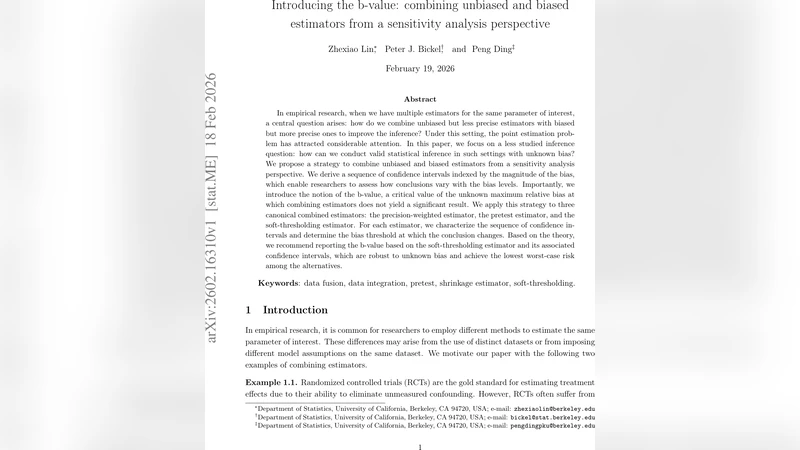
In empirical research, when we have multiple estimators for the same parameter of interest, a central question arises: how do we combine unbiased but less precise estimators with biased but more precise ones to improve the inference? Under this setting, the point estimation problem has attracted considerable attention. In this paper, we focus on a less studied inference question: how can we conduct valid statistical inference in such settings with unknown bias? We propose a strategy to combine unbiased and biased estimators from a sensitivity analysis perspective. We derive a sequence of confidence intervals indexed by the magnitude of the bias, which enable researchers to assess how conclusions vary with the bias levels. Importantly, we introduce the notion of the b-value, a critical value of the unknown maximum relative bias at which combining estimators does not yield a significant result. We apply this strategy to three canonical combined estimators: the precision-weighted estimator, the pretest estimator, and the soft-thresholding estimator. For each estimator, we characterize the sequence of confidence intervals and determine the bias threshold at which the conclusion changes. Based on the theory, we recommend reporting the b-value based on the soft-thresholding estimator and its associated confidence intervals, which are robust to unknown bias and achieve the lowest worst-case risk among the alternatives.
💡 Research Summary
The paper tackles a common yet under‑explored problem in empirical research: how to draw valid statistical inference when multiple estimators of the same parameter are available, some unbiased but noisy and others biased but precise, and the magnitude of the bias is unknown. While the point‑estimation literature has long focused on optimal weighting or pre‑test rules to improve mean‑squared error, the authors shift the focus to inference by framing the problem as a sensitivity analysis.
The central idea is to treat the unknown bias as a nuisance parameter θ and to construct a family of confidence intervals (CIs) indexed by the absolute value of θ. For any prespecified bound b on the relative bias, the corresponding CI tells the researcher whether the combined estimator remains statistically significant under the worst‑case bias of size ≤ b. This leads to the definition of the b‑value, the critical magnitude of the maximum relative bias at which the combined estimator’s CI first includes the null value (or otherwise loses significance). In other words, if the true bias is smaller than the b‑value, the combined estimator yields a significant result; if the bias exceeds this threshold, the conclusion changes.
The authors apply this framework to three canonical combined estimators:
-
Precision‑weighted estimator – weights each component by the inverse of its variance. The authors show that when a low‑variance, biased estimator receives a large weight, the CI inflates rapidly as bias grows. By parameterising bias, they derive bias‑adjusted CIs and identify the b‑value at which significance is lost.
-
Pre‑test estimator – selects the unbiased estimator only if a preliminary test suggests bias is below a certain threshold. The paper demonstrates that the test’s critical value itself is highly sensitive to unknown bias. Using the b‑value approach, the authors provide a dynamic adjustment of the pre‑test rule and the resulting CI, quantifying the risk of an incorrect selection.
-
Soft‑thresholding estimator – applies a smooth shrinkage function (akin to the LASSO) to the raw estimators, continuously trading off bias and variance. Here the shrinkage parameter λ directly controls the robustness to bias. The authors analytically link λ to the b‑value and prove that, for any given maximum bias, the soft‑thresholding rule attains the smallest worst‑case (minimax) risk among the three methods.
All results are derived under a minimax risk criterion, ensuring that the proposed CIs are valid even in the most adverse bias scenario. Simulation studies illustrate how the three estimators behave as the assumed bias bound b varies, confirming the theoretical ordering of robustness. A real‑world application in a medical treatment‑effect study demonstrates the practical utility: by reporting the b‑value alongside the soft‑thresholding estimate, researchers can transparently communicate how much unobserved confounding the conclusion can tolerate before it becomes non‑significant.
The paper’s major contribution is a systematic, bias‑sensitive inference framework that replaces the traditional single‑point CI with a continuum of bias‑indexed intervals. This enables analysts to perform a transparent sensitivity analysis, to quantify the robustness of their conclusions, and to choose an estimator that balances precision with protection against unknown bias. The authors recommend reporting the soft‑thresholding estimator together with its associated b‑value and bias‑indexed CIs, as this combination offers the lowest worst‑case risk while remaining easy to interpret for applied researchers.
In summary, the work extends the toolbox for combining unbiased and biased estimators from point‑estimation to full inference, introduces the b‑value as a clear, interpretable metric of bias tolerance, and provides rigorous theoretical and empirical support for the soft‑thresholding approach as the most robust choice in practice.
Comments & Academic Discussion
Loading comments...
Leave a Comment