Ellipsoids in pseudoconvex domains
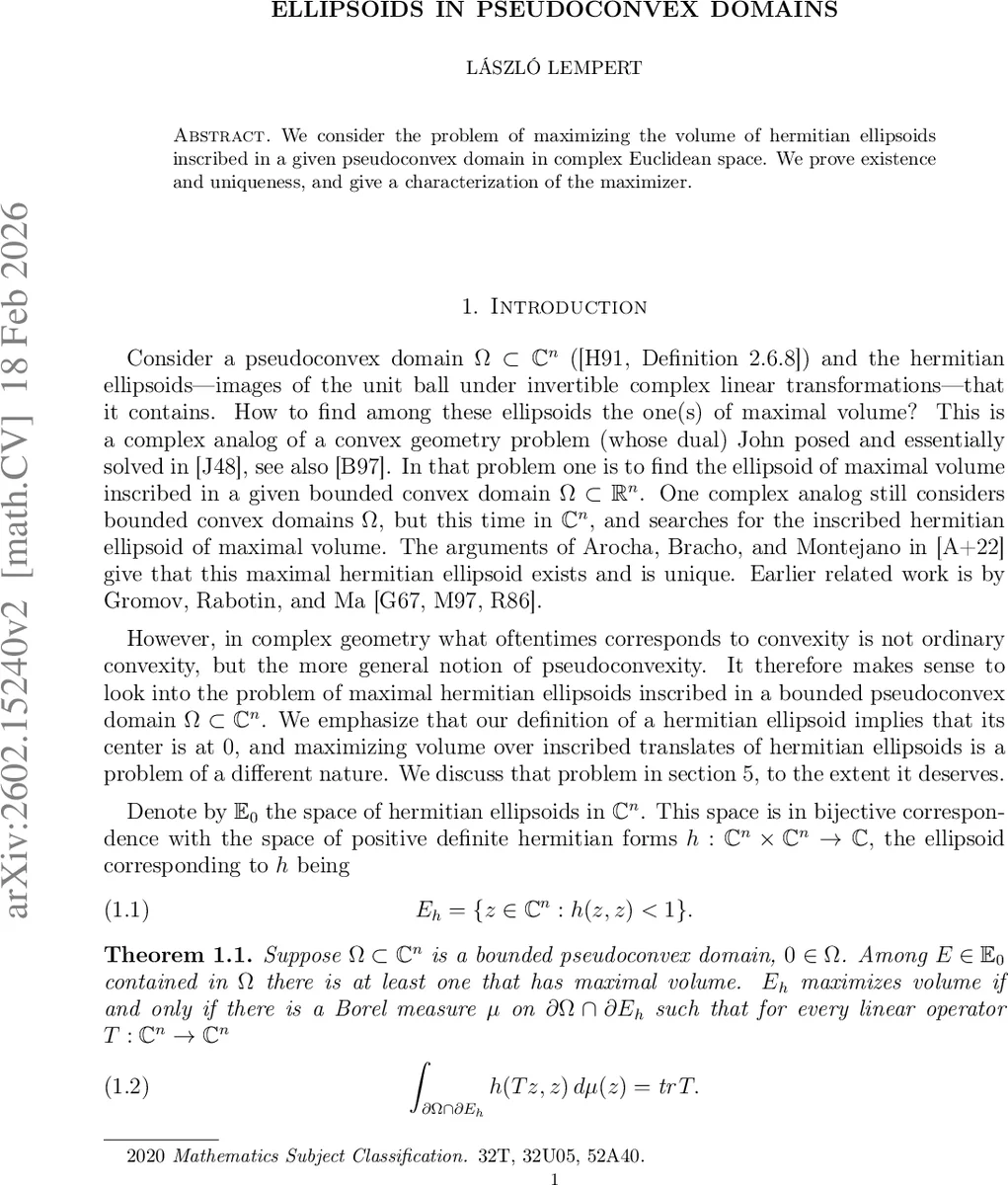
We consider the problem of maximizing the volume of hermitian ellipsoids inscribed in a given pseudoconvex domain in complex Euclidean space. We prove existence and uniqueness, and give a characterization of the maximizer.
💡 Research Summary
The paper addresses the problem of finding a Hermitian ellipsoid of maximal volume that can be inscribed in a bounded pseudoconvex domain Ω⊂ℂⁿ. A Hermitian ellipsoid is defined as the image of the unit ball under an invertible complex linear map, equivalently as the set {z∈ℂⁿ : h(z,z)<1} for a positive‑definite Hermitian form h. The main contributions are as follows.
Existence and necessary condition (Theorem 1.1).
Using a compactness argument analogous to John’s theorem, the authors show that at least one ellipsoid of maximal volume exists. Moreover, any maximizer E_h must satisfy a measure‑theoretic condition: there exists a Borel measure μ supported on the common boundary ∂Ω∩∂E_h, with total mass n, such that for every linear operator T on ℂⁿ,
∫_{∂Ω∩∂E_h} h(Tz,z) dμ(z) = tr T.
This identity links the trace of T with the Hermitian form h evaluated on the boundary points, and it is derived via a Lagrange‑multiplier argument in the space of linear operators.
Geodesic convexity (Theorem 1.3).
The space ℰ₀ of all Hermitian ellipsoids can be identified with the symmetric space GL(n,ℂ)/U(n). Between any two ellipsoids E_h and E_k there is a unique positive self‑adjoint operator A (with respect to h) such that A E_h = E_k. The curve E(t)=A^t E_h (0≤t≤1) is a geodesic in ℰ₀. The authors prove that if the endpoints of a geodesic are contained in Ω, then the whole geodesic lies in Ω. Consequently, the set of ellipsoids inscribed in Ω is convex in ℰ₀. This convexity is crucial for establishing global optimality of a maximizer.
Uniqueness (Theorem 1.2).
If the boundary ∂Ω contains no non‑trivial holomorphic disc, then the maximal ellipsoid is unique. The proof uses the convexity result: if two maximizers existed, the geodesic joining them would consist entirely of maximizers, forcing the associated self‑adjoint operator A to satisfy A=0, which implies the two ellipsoids coincide. Conversely, when ∂Ω does contain a holomorphic disc, multiple maximizers can occur; explicit examples in ℂ² are provided.
Translations of ellipsoids (Section 5).
The authors extend the problem to ellipsoids with arbitrary centers, i.e., sets of the form {z : h(z−c,z−c)<1}. An analogous measure condition involving both the linear part and the translation vector is derived, but it is shown not to be sufficient for maximality. Simple one‑dimensional counter‑examples and a two‑dimensional “Cassini ovaloid” domain demonstrate that even when the condition holds, a larger‑volume ellipsoid may exist. This highlights the special role of the origin in the earlier results.
Examples and non‑uniqueness.
Two families of counter‑examples are constructed. First, in Ω={|xy|<1, |x|,|y|<3}⊂ℂ², a continuum of ellipsoids parameterized by p∈(½,2) all have the same maximal volume, illustrating non‑uniqueness when holomorphic discs are present. Second, a strongly pseudoconvex “Cassini” domain Ω={|z−p||z+p|<λ²} (λ>1, p=(1,0)) is symmetric under z↦−z, so both an ellipsoid E and its opposite −E are maximal, providing a non‑unique situation even under strong pseudoconvexity.
Technical significance.
The paper blends complex analysis, convex geometry, and the theory of symmetric spaces. The measure‑theoretic condition (1.2) gives a clean dual description of the optimality problem in terms of linear functionals on the operator space. The geodesic convexity result is a novel complex‑analytic analogue of the classical convexity of inscribed ellipsoids in real convex bodies. By distinguishing between ordinary convexity and pseudoconvexity, the authors clarify when uniqueness can be expected and when multiple maximizers naturally arise.
Future directions.
Potential extensions include: (i) a finer classification of maximal ellipsoids in non‑symmetric pseudoconvex domains; (ii) connections with Kähler geometry, building on the authors’ earlier work
Comments & Academic Discussion
Loading comments...
Leave a Comment