Geometric differentiation of simplicial manifolds
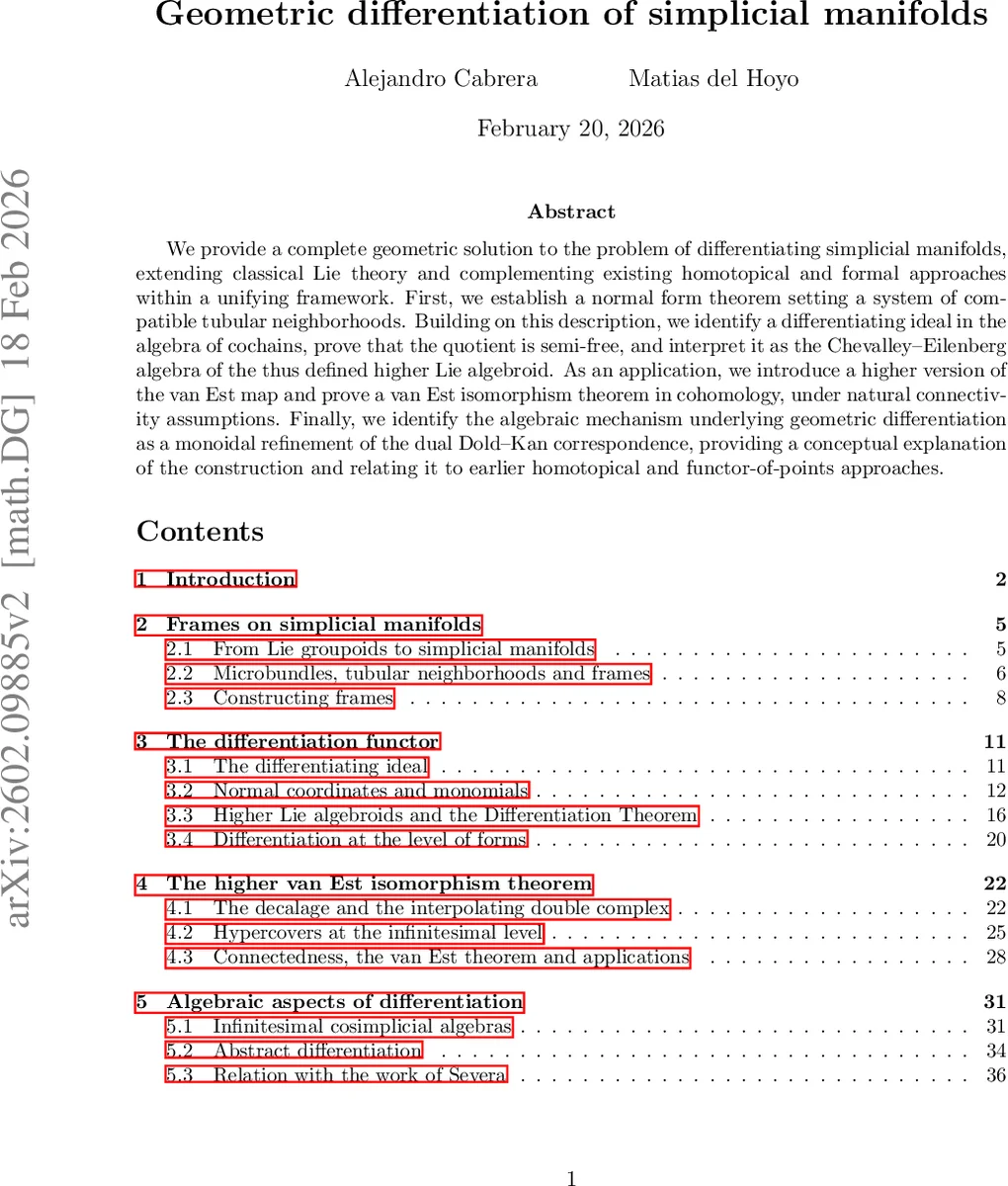
We provide a complete geometric solution to the problem of differentiating simplicial manifolds, extending classical Lie theory and complementing existing homotopical and formal approaches within a unifying framework. First, we establish a normal form theorem setting a system of compatible tubular neighborhoods. Building on this description, we identify a differentiating ideal in the algebra of cochains, prove that the quotient is semi-free, and interpret it as the Chevalley-Eilenberg algebra of the thus defined higher Lie algebroid. As an application, we introduce a higher version of the van Est map and prove a van Est isomorphism theorem in cohomology, under natural connectivity assumptions. Finally, we identify the algebraic mechanism underlying geometric differentiation as a monoidal refinement of the dual Dold-Kan correspondence, providing a conceptual explanation of the construction and relating it to earlier homotopical and functor-of-points approaches.
💡 Research Summary
The paper “Geometric differentiation of simplicial manifolds” develops a fully geometric, concrete method for differentiating simplicial manifolds, thereby extending classical Lie theory to higher Lie groupoids and providing a unifying framework that connects several existing homotopical and formal approaches.
The authors begin by introducing the notion of a frame, a compatible system of tubular neighbourhoods for a simplicial manifold (G_{\bullet}). Using Milnor’s microbundle language, each pair ((G_{n},G_{0})) is equipped with a normal bundle (\nu(G_{n},G_{0})) and a smooth embedding (\varphi_{n}) that intertwines all positive face maps and all degeneracy maps. The Frame Theorem (Theorem 2.3.4) shows that such a system exists for any simplicial manifold and provides a simultaneous normal form near the object space (G_{0}).
With a frame in hand, the authors compare smooth functions on (G_{n}) with polynomial functions on the fibres of the normal bundle. Inside the normalized cochain algebra (C^{N}(G)) they identify an ideal (J) encoding higher‑order vanishing along the degeneracy locus; its closure (\widehat J = J + \delta J) is called the differentiating ideal (Definition 3.1.2). The quotient (C^{N}(G)/\widehat J) is proved to be a semi‑free commutative differential graded algebra whose indecomposables are precisely the sections of the graded dual of a vector bundle (A G). This bundle, equipped with a differential induced from the simplicial structure, is the higher Lie algebroid (or N‑Q‑manifold) associated to the original simplicial manifold. The resulting dg‑algebra is identified as the Chevalley–Eilenberg algebra (CE(A G)) of this higher algebroid (Theorem 3.3.5). Moreover, the frame yields an explicit splitting (\varphi^{\star}: S(\Gamma A^{*}) \to C^{N}(G)/\widehat J).
The construction extends from functions to differential forms by using the Bott–Shulman complex of the simplicial manifold. The corresponding quotient reproduces the Weil algebra of the higher Lie algebroid (Corollary 3.4.8), thereby recovering the classical picture for Lie groups and Lie groupoids.
A central application is a higher van Est isomorphism. The authors define a natural van Est map (\operatorname{ve}: C^{N}(G) \to CE(A G)) as the canonical projection. They introduce a notion of (n)-connectedness for simplicial manifolds (Definition 4.3.1), expressed in terms of the connectivity of the fibres of the face maps. Using Illusie’s Decalage construction and an interpolating double complex, they prove that if (G) is (n)-connected then (\operatorname{ve}) induces an isomorphism in cohomology (H^{k}(G) \cong H^{k}(A G)) for all (k \le n) (Theorem 4.3.4). This result generalises the classical van Est theorem and yields concrete tools for integrating infinitesimal cocycles, with applications such as a Lie‑theoretic description of shifted symplectic structures on higher groupoids (Corollary 4.3.8).
In the final section the authors give an abstract categorical interpretation of differentiation. They view the algebra of smooth functions on a simplicial manifold as a cosimplicial commutative algebra and define an abstract differentiation functor (\mathcal N’) by quotienting by the same differentiating ideal. They prove that (\mathcal N’) is left adjoint to the denormalisation functor (K) (Theorem 5.2.5), making differential graded algebras a reflective subcategory of cosimplicial algebras. This perspective shows that geometric differentiation is precisely the left adjoint to monoidal denormalisation, unifying earlier approaches by Severa, Pridham, Rogers, and others, and relating the construction to the dual Dold–Kan correspondence and Beilinson’s small algebras.
The paper concludes with a discussion of future directions: extensions to bisimplicial manifolds and iterated differentiation, applications to shifted Poisson and Courant structures, systematic study of finite‑dimensional integration of higher Lie algebroids, and potential impact on higher stack theory and moduli problems.
Overall, the work provides a concrete, calculable, and geometrically transparent method for passing from global higher groupoid data to infinitesimal higher Lie algebroid data, establishes a robust higher van Est theorem, and situates the construction within a clean categorical framework that bridges several strands of modern higher differential geometry.
Comments & Academic Discussion
Loading comments...
Leave a Comment