Simple connectedness of the Ran space
The space of all finite non-empty subsets of a topological space $X$, also known as the Ran space of $X$, is weakly contractible for $X$ path connected. We consider subspaces $\mathrm{Ran}{\leqslant n}(X)$ of the Ran space given by all subsets of $X$ of size at most $n$, and present results on their first homotopy groups. In particular, we show that the induced map $π_1(\mathrm{Ran}{\leqslant n}(X)) \to π_1(\mathrm{Ran}{\leqslant n+2}(X))$ is trivial for all positive integers $n$, and even more, show that $π_1(\mathrm{Ran}{\leqslant n}(X)) = 0$ for all $n\geqslant 4$, by explicitly drawing the path homotopies that contract any loop to a point.
💡 Research Summary
The paper investigates the fundamental group of the Ran space of a topological space X, focusing on the subspaces Ran_{\le n}(X) consisting of all non‑empty finite subsets of X of cardinality at most n. While it is known that the full Ran space Ran(X) is weakly contractible when X is path‑connected, the homotopy groups of the truncated spaces Ran_{\le n}(X) have not been described in a constructive way for arbitrary X.
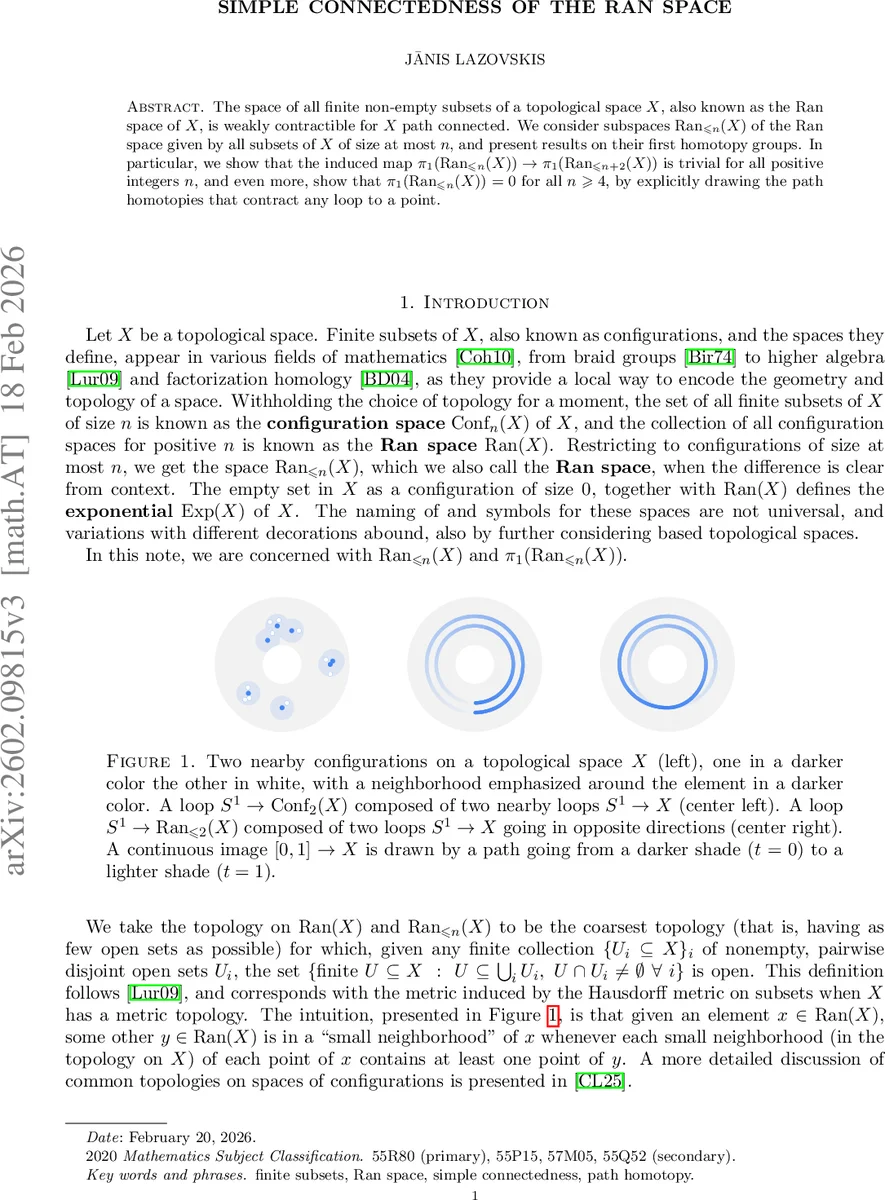
The author first fixes the “coarsest” topology on Ran(X) (following Lurie) – the one generated by requiring that, for any finite family of pairwise disjoint open subsets of X, the collection of finite subsets lying entirely inside the union and intersecting each member in at most one point is open. This topology coincides with the Hausdorff metric topology when X is metrizable.
A central technical tool is the notion of a branch point and a merge point of a loop σ : S¹ → Ran_{\le n}(X). Roughly, a branch point is a point of X that, as the loop progresses, repeatedly appears together with another point in arbitrarily small neighborhoods; a merge point is the time‑reverse analogue. Lemma 3 shows that any loop can be homotoped, by sliding all branch and merge points to a chosen base point b∈X, to a loop \hatσ that factors through the product Xⁿ via the diagonal map. In other words, after homotopy the loop is a collection of n ordinary loops in X that all start and end at b.
With this decomposition in hand, the paper proves two families of results.
-
Triviality of the inclusion on π₁ for n=1. Lemma 4 and Proposition 5 give an explicit homotopy (illustrated in Figure 3) showing that the inclusion i : Ran_{\le 1}(S¹) ≅ S¹ → Ran_{\le 3}(S¹) induces the zero map on π₁. The homotopy consists of duplicating the original circle, rotating one copy, stretching, cutting, gluing, and finally shrinking to the constant loop. By functoriality this argument works for any X, yielding that π₁(i) is trivial for the inclusion Ran_{\le 1}(X) → Ran_{\le 3}(X).
-
Generalisation to arbitrary n. Theorem 6 extends the previous case: for every n≥1 the inclusion i : Ran_{\le n}(X) ↪ Ran_{\le n+2}(X) induces the zero homomorphism on π₁. The proof uses the factorisation of the diagonal map Δ : Ran_{\le n}(X) → Ran_{\le n}(X)×Ran_{\le n}(X) followed by the union map into Ran_{\le 2n}(X). By inserting the base‑point factor Ran_{\le 1}(X) and applying the n=1 result on the second coordinate, the loop i∘σ is shown to factor through a constant map, hence null‑homotopic.
Next, Theorem 7 shows that any loop in Ran_{\le n}(X) can be homotoped to a loop that actually lands in Ran_{\le 2}(X). This is achieved by re‑parameterising the constituent loops \hatσ_j so that at any given time at most two distinct points of X appear among the n components. Consequently the image lies in the subspace of subsets of size ≤2.
Finally, Theorem 8 combines the previous steps: for n≥4 every loop in Ran_{\le n}(X) can first be moved into Ran_{\le 2}(X) (Theorem 7) and then contracted using the explicit homotopy from the n=1 case (applied to each of the at most two points). Hence π₁(Ran_{\le n}(X))=0 for all n≥4, i.e., these truncated Ran spaces are simply connected. The paper notes that the case n=3 is known to be simply connected for CW‑complexes (Tufley 2004), but the present constructive method does not directly cover arbitrary spaces. Counterexamples for n=1,2 (e.g., Ran_{\le 2}(S¹) is a Möbius band) are also discussed.
Overall, the work provides a visual, constructive proof of simple connectedness for most truncated Ran spaces, avoiding reliance on CW‑complex machinery, van Kampen arguments, or abstract homotopy equivalences. The explicit path homotopies and the branch/merge point analysis give a clear geometric picture of why the inclusion maps on π₁ become trivial and why the spaces become simply connected once the allowed subset size reaches four. This contributes both to the understanding of configuration‑type spaces and to potential applications where explicit homotopies are required.
Comments & Academic Discussion
Loading comments...
Leave a Comment