Congruences modulo powers of $2$ for three restricted partition functions of Pushpa and Vasuki
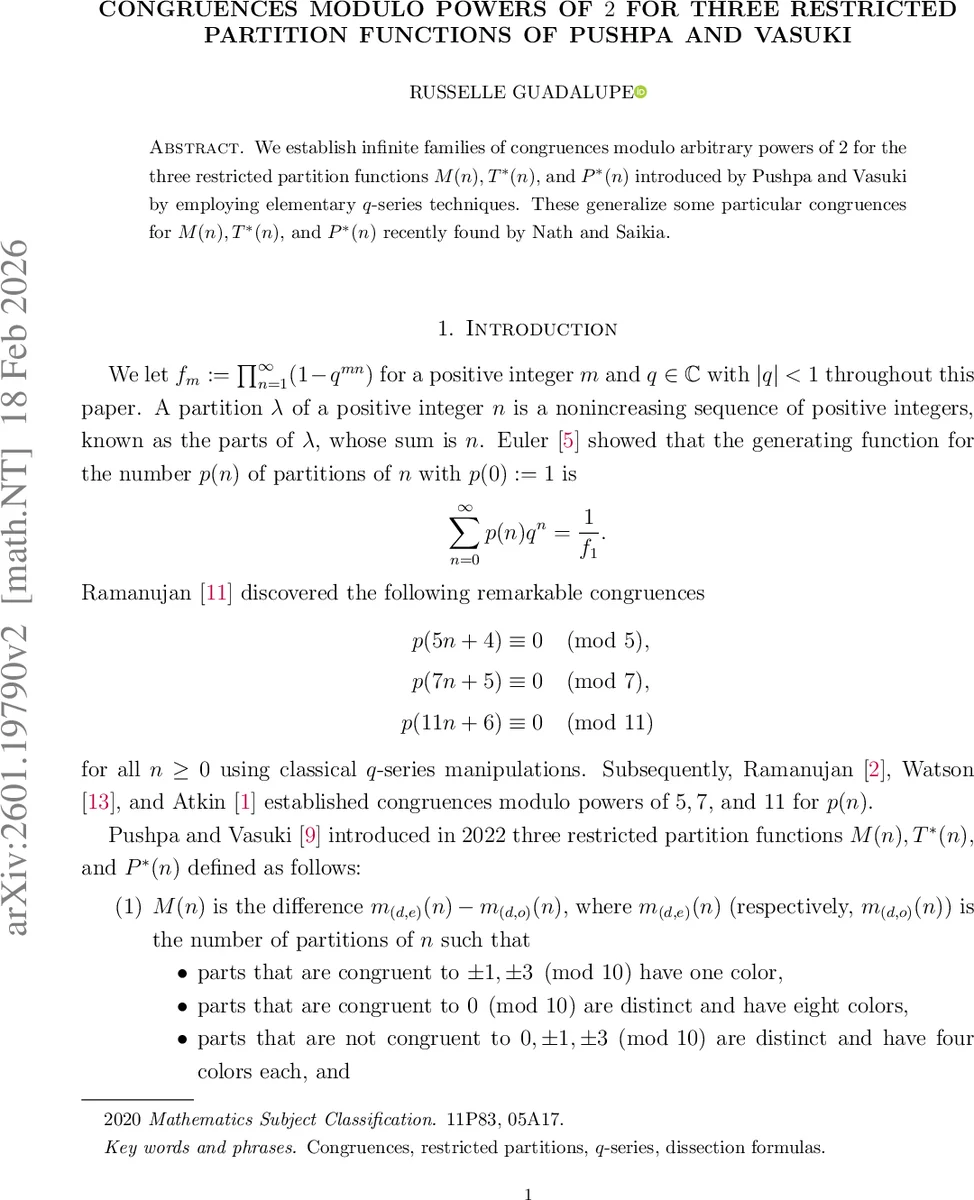
We establish infinite families of congruences modulo arbitrary powers of $2$ for the three restricted partition functions $M(n), T^\ast(n)$, and $P^\ast(n)$ introduced by Pushpa and Vasuki by employing elementary $q$-series techniques. These generalize some particular congruences for $M(n), T^\ast(n)$, and $P^\ast(n)$ recently found by Nath and Saikia.
💡 Research Summary
The paper investigates three restricted partition functions introduced by Pushpa and Vasuki—denoted M(n), T⁎(n), and P⁎(n)—and establishes infinite families of congruences modulo arbitrary powers of 2. Using elementary q‑series manipulations and theta‑function identities, the authors derive generating functions for these functions and then prove congruences that generalize earlier results modulo powers of 5 obtained by Nath and Saikia.
First, the authors recall the standard eta‑product notation f_m(q)=∏_{n≥1}(1−q^{mn}) and give the generating functions:
- ∑ M(n)qⁿ = f₅² f₅⁵ / (f₁ f₁₀),
- ∑ T⁎(n)qⁿ = f₅ / (f₅¹⁰ f₂ f₅),
- ∑ P⁎(n)qⁿ = f₄ / (f₄⁵).
In Lemma 2.1 three key theta‑function identities (2.1)–(2.3) are proved, relying on Ramanujan’s k(q) function and classical product expansions. Lemma 2.2 rewrites the generating function for P⁎(n) in terms of f₄‑products. Lemma 2.3 then extracts the generating functions for the shifted sequences M(2n+3) and T⁎(2n+2), expressed as linear combinations of f₄‑products and the product f₁ f₂ f₃⁵ f₃¹⁰.
The core of the paper is Theorem 3.1, which provides, for any integer k≥1, generating functions for
- M(2k n+2k+1−1),
- T⁎(2k n+2k+1−2),
- P⁎(2k n+2k+1−1). These are written as ∑ M(…)qⁿ = A_k f₄¹ f₄⁵/q − 8 A_{k−1} f₄² f₄¹⁰ + 5·2^k f₁ f₂ f₃⁵ f₃¹⁰, and analogous formulas for T⁎ (with coefficient B_k) and P⁎ (with coefficient C_k). The sequences A_k, B_k, C_k satisfy linear recurrences: A_k = −4A_{k−1} − 8A_{k−2} + 5·2^{k−1}, B_k = −4B_{k−1} − 8B_{k−2} + 5·2^{k−1}, C_k = −4C_{k−1} − 8C_{k−2}, with initial values A₀=A₁=B₁=C₀=1, B₀=0, C₁=−4. Induction on k, together with the theta identities, yields the generating functions for all k.
Theorem 1.1 follows from the observation that A_k and B_k are divisible by 2^{k−1} but not by 2^{k}. This divisibility is proved by strong induction, using the recurrence relations. Consequently, M(2^{k}n + 2^{k} + 1 − 1) ≡ 0 (mod 2^{k−1}), T⁎(2^{k}n + 2^{k} + 1 − 2) ≡ 0 (mod 2^{k−1}), for all k≥1, which are the congruences (1.1) and (1.2).
For P⁎(n), Lemma 3.2 determines the exact closed form of C_k: C_{4k}= (−64)^{k}, C_{4k+1}= −4(−64)^{k}, C_{4k+2}= 8(−64)^{k}, C_{4k+3}= 0. Substituting these values into the generating function (3.3) yields four families of congruences: P⁎(2^{4k}n + 2^{4k}+1−1) ≡ 0 (mod 2^{6k}), P⁎(2^{4k+1}n + 2^{4k+2}+1−1) ≡ 0 (mod 2^{6k+2}), P⁎(2^{4k+2}n + 2^{4k+3}+1−1) ≡ 0 (mod 2^{6k+3}), P⁎(2^{4k+3}n + 2^{4k+4}+1−1) ≡ 0 (mod 2^{6k+6}), and additionally P⁎(2^{4k+3}n + 3·2^{4k+3}−1)=0, which correspond to (1.3)–(1.7).
The paper situates these results within the broader literature on partition congruences: after recalling Ramanujan’s classical congruences and the work of Atkin, Watson, and others on powers of 5, 7, and 11, it notes that Pushpa–Vasuki’s functions extend the notion of colored partitions. Nath and Saikia previously obtained infinite families modulo powers of 5 using Radu’s algorithmic approach; the present work replaces that heavy computational machinery with purely elementary q‑series techniques, thereby providing more transparent proofs and extending the congruences to powers of 2.
In summary, the authors successfully construct infinite families of congruences modulo 2^k for M(n), T⁎(n), and P⁎(n) by deriving suitable generating functions, establishing recursive coefficient sequences, and proving precise divisibility properties. The methods are elementary yet powerful, opening the door for similar investigations of other colored or restricted partition functions in the context of 2‑adic arithmetic.
Comments & Academic Discussion
Loading comments...
Leave a Comment