Hidden low-discrepancy structures in random point sets
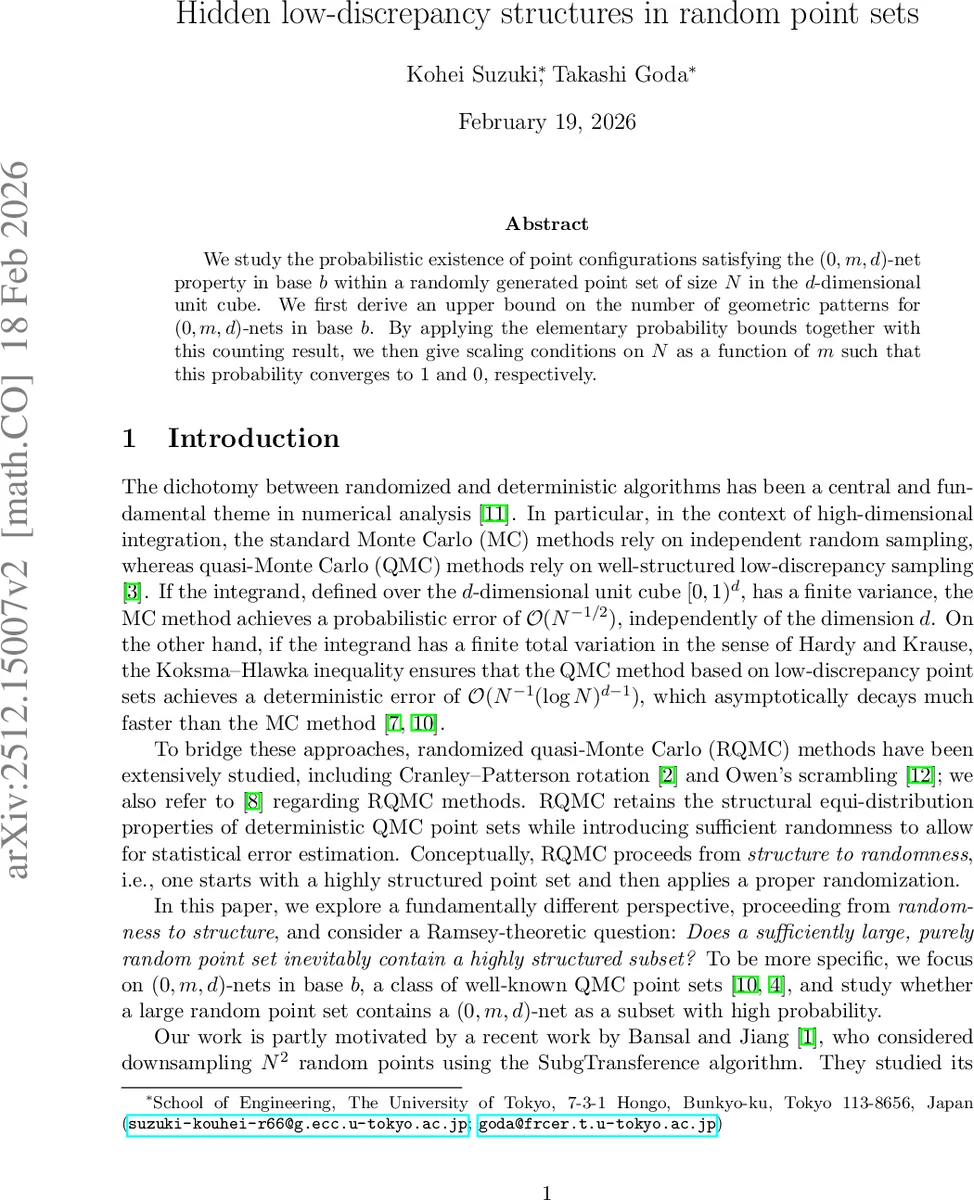
We study the probabilistic existence of point configurations satisfying the $(0, m, d)$-net property in base $b$ within a randomly generated point set of size $N$ in the $d$-dimensional unit cube. We first derive an upper bound on the number of geometric patterns for $(0, m, d)$-nets in base $b$. By applying the elementary probability bounds together with this counting result, we then give scaling conditions on $N$ as a function of $m$ such that this probability converges to $1$ and $0$, respectively.
💡 Research Summary
The paper investigates a Ramsey‑type question in the context of high‑dimensional numerical integration: given a set of N points drawn independently and uniformly at random from the d‑dimensional unit cube, does the set necessarily contain a highly structured low‑discrepancy subset, namely a (0, m, d)-net in base b? A (0, m, d)-net consists of b^m points such that every elementary interval whose base‑b digit‑sum equals m contains exactly one point; such nets are the cornerstone of quasi‑Monte Carlo (QMC) methods because they achieve star‑discrepancy of order O(N⁻¹(log N)^{d‑1}).
The authors first translate the geometric definition of a (0, m, d)-net into an “admissible pattern” on the integer lattice Z_{b^m}^d: a pattern is a selection of b^m distinct lattice cells (sub‑cubes) that satisfies the same equi‑distribution condition. They denote by a_{b,d}(m) the total number of admissible patterns. Using a recursive construction for two‑dimensional nets (Leobacher‑Pillichshammer‑Schell) they show that a_{b,2}(m) = (b!)^{b^{m‑1}}. For general dimension d they observe that any two‑dimensional projection of a (0, m, d)-net is a (0, m, 2)-net, which yields the simple upper bound a_{b,d}(m) ≤ (b!)^{b^{m‑1}(d‑1)}.
With this combinatorial estimate in hand, the probabilistic analysis proceeds by defining, for each admissible pattern k, an indicator X_k that equals 1 if every cell of pattern k contains at least one of the N random points. Let X = Σ_k X_k be the total number of realized patterns. The event that the random set contains a (0, m, d)-net is exactly {X>0}. By the union bound we have
p_N(b^m) ≤ P(X>0) ≤ a_{b,d}(m)·p_N(b^m),
where p_N(b^m) is the probability that a fixed collection of b^m disjoint cells each receives at least one point.
The probability that a single cell is empty after N draws is (1‑1/b^{md})^N ≤ exp(‑N/b^{md}). Applying the union bound over the b^m cells gives
1‑p_N(b^m) ≤ b^m·exp(‑N/b^{md}).
If N ≥ (1+ε)·b^{md}·m·log b for some ε>0, the exponent tends to –∞ as m→∞, so p_N(b^m)→1 and consequently P(X>0)→1. This lower‑bound matches the expected number of draws needed to hit all b^m cells, which is b^{md}·H_{b^m} ≈ b^{md}·m·log b (the harmonic number approximation noted in Remark 3.3).
For the upper bound the authors exploit negative association of the occupancy events (Kumar‑Joag‑Dev & Proschan, 1983). This yields
p_N(b^m) ≤ (N·b^{‑md})^{b^m}.
Multiplying by the combinatorial factor a_{b,d}(m) gives
a_{b,d}(m)·p_N(b^m) ≤ (b!)^{b^{m‑1}(d‑1)}·(N·b^{‑md})^{b^m}.
If N ≤ (1‑ε)·b^{md}/(b!)^{m(d‑1)/b} (equivalently N ≤ (1‑ε)·b^{m}·e^{(1‑1/b)m(d‑1)}), the right‑hand side decays like (1‑ε)·b^{m} → 0, forcing P(X>0)→0.
The case d=1 is trivial because there is exactly one admissible pattern; the same bounds apply directly.
Thus the main theorem establishes two complementary scaling regimes:
- Supercritical regime – when N grows at least as (1+ε)·b^{md}·m·log b, a random point set almost surely contains a (0, m, d)-net.
- Subcritical regime – when N is smaller than (1‑ε)·b^{m}·e^{(1‑1/b)m(d‑1)}, the probability of containing such a net tends to zero.
These results provide a rigorous answer to the “randomness → structure” question: sufficiently many random points inevitably embed a low‑discrepancy net, while too few points almost surely fail to do so. The analysis bridges combinatorial counting, probabilistic occupancy theory, and discrepancy theory, and offers a quantitative benchmark for algorithms that aim to extract structured subsets from large random samples (e.g., subsampling strategies in randomized QMC). The paper also highlights that the critical sample size aligns with the expected coupon‑collector time for covering all b^m cells, reinforcing the intuition that the emergence of low‑discrepancy structure is essentially a covering problem. This insight may guide the design of hybrid Monte Carlo/QMC methods where one first draws a large random pool and then selects a low‑discrepancy subset, guaranteeing high‑quality integration with provable probabilistic guarantees.
Comments & Academic Discussion
Loading comments...
Leave a Comment