AMBER: A tether-deployable gripping crawler with compliant microspines for canopy manipulation
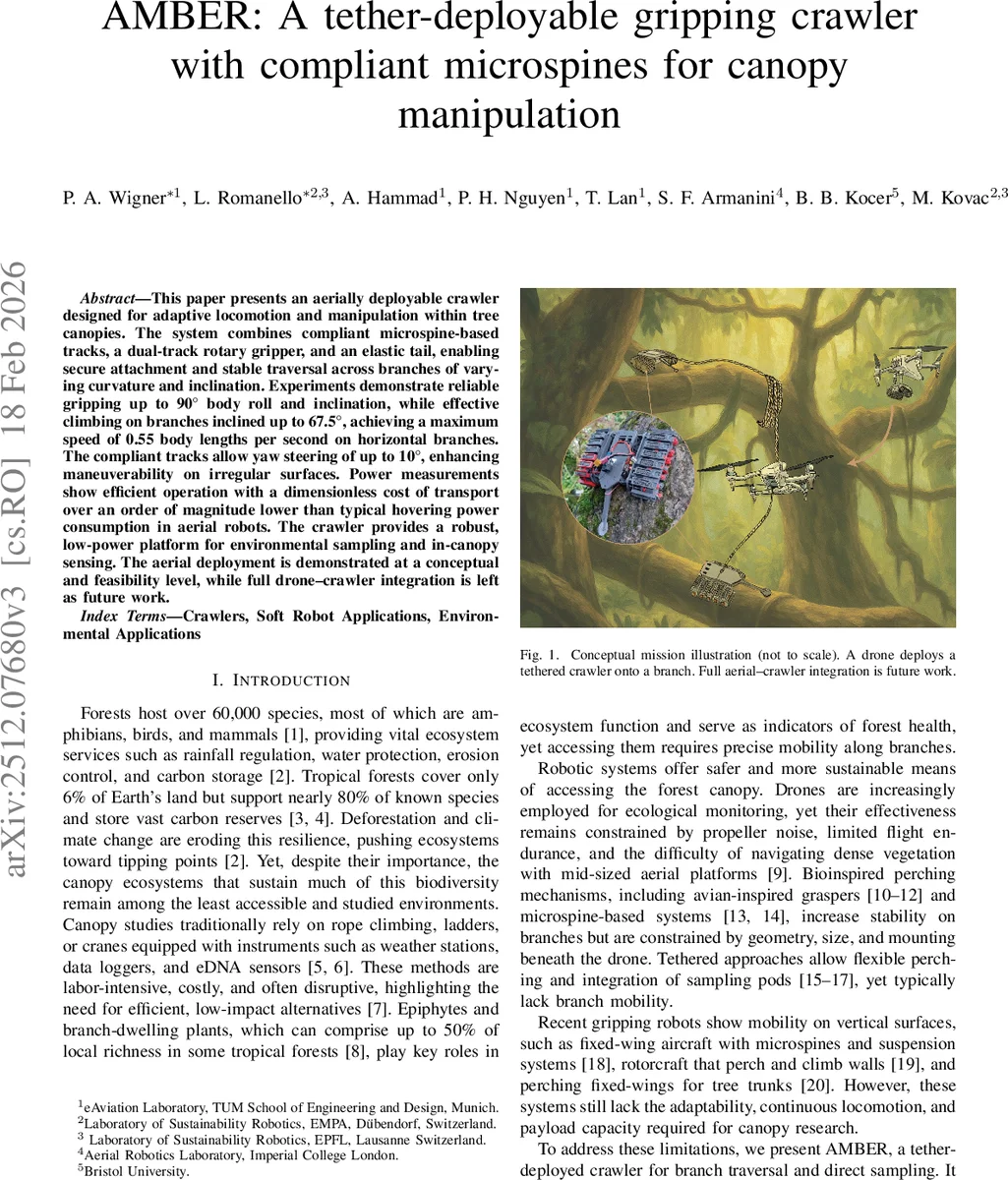
This paper presents an aerially deployable crawler designed for adaptive locomotion and manipulation within tree canopies. The system combines compliant microspine-based tracks, a dual-track rotary gripper, and an elastic tail, enabling secure attachment and stable traversal across branches of varying curvature and inclination. Experiments demonstrate reliable gripping up to 90$^\circ$ body roll and inclination, while effective climbing on branches inclined up to 67.5$^\circ$, achieving a maximum speed of 0.55 body lengths per second on horizontal branches. The compliant tracks allow yaw steering of up to 10$^\circ$, enhancing maneuverability on irregular surfaces. Power measurements show efficient operation with a dimensionless cost of transport over an order of magnitude lower than typical hovering power consumption in aerial robots. The crawler provides a robust, low-power platform for environmental sampling and in-canopy sensing. The aerial deployment is demonstrated at a conceptual and feasibility level, while full drone-crawler integration is left as future work.
💡 Research Summary
The paper introduces AMBER, a lightweight, tether‑deployed crawling robot designed for autonomous locomotion and manipulation within tree canopies. The authors identify three major limitations of existing canopy‑access technologies: (1) traditional rope‑climbing or crane‑based methods are labor‑intensive and disruptive; (2) aerial drones can perch but lack the ability to move along branches; and (3) current climbing robots are either too heavy for aerial deployment or are limited to vertical or smooth surfaces. To address these gaps, AMBER integrates three core subsystems: a Dual‑Track Rotary Grasper (DTRG), a compliant microspine‑based continuous track, and a passive elastic tail with a wheel.
The DTRG consists of two synchronized tracks driven by a single Dynamixel XL‑330‑M288‑T servo through a 1:4 gear reduction, delivering up to 12.5 N of gripping force within a 28 mm internal diameter. The gripper can open to a half‑angle of 90° and close to 35°, keeping the robot’s body tangential to the branch surface and minimizing collision risk. The continuous track is built from 3D‑printed PLA links, each equipped with a spine carrier attached to a thin PLA spring. Microspines are fabricated from surgical needles with a 10 µm tip radius; experimental comparison of 45° and 60° spine angles on branches of 40–150 mm diameter showed that 60° spines provide more consistent attachment across diameters, leading to their selection. Each spine can exert roughly 1 N of normal force and travel laterally up to 5 mm, allowing three to five spines to engage simultaneously and distribute load evenly.
A 100 mm long passive tail incorporates a small wheel mounted on a tunable spring‑damper. The tail does not require active control; instead, it passively shifts the robot’s center of mass and provides additional frictional contact on steep branches. Experiments demonstrated that the tail increases normal pull‑off force by up to 15 % on inclinations below 45° and enables stable attachment on slopes between 45° and 90°, where the robot without a tail fails to grip.
The authors evaluated gripping performance on a 95 mm diameter branch across pitch (inclination), roll (rotation around the branch), and yaw (steering misalignment). The optimal gripping angle was found to be 84.4°, delivering the highest normal pull‑off force. Pull‑off forces decreased with increasing pitch due to the gravitational moment, but remained sufficient for slopes up to 67.5°. The robot maintained grip up to 90° roll, and yaw steering was possible up to 10° before the number of engaged spines dropped to two, causing instability.
Crawling tests on straight beams and irregular branches measured a maximum forward speed of 0.55 body lengths per second on horizontal branches (≈0.33 m s⁻¹). Power consumption during locomotion averaged 8.5 W for the tracks plus ~2 W for the gripper, resulting in a dimensionless cost of transport (COT) an order of magnitude lower than typical hovering power consumption of aerial robots. The complete system weighs approximately 700 g and fits within a 54 × 37 × 120 mm envelope, allowing integration with a commercial DJI F450 drone with less than a 50 % reduction in flight time.
The paper acknowledges several limitations and future work directions: (1) the current implementation relies on a simple tether for deployment and recovery; autonomous release and re‑capture mechanisms are not yet demonstrated. (2) Automatic adjustment of the gripping angle based on branch geometry is proposed but not realized; a force sensor could enable closed‑loop grip optimization. (3) Long‑term durability in humid, biologically active canopy environments has not been tested. (4) Full drone‑crawler integration, including coordinated flight‑ground control loops, remains a future research step.
In summary, AMBER presents a novel combination of compliant microspine tracks, a dual‑track rotary grasper, and a passive elastic tail that together enable low‑power, stable locomotion on branches of varying curvature and inclination. By leveraging tethered aerial deployment, the platform offers a promising, less invasive alternative for in‑canopy environmental sampling, sensor placement, and ecological monitoring, potentially reducing the logistical and ecological costs associated with traditional canopy access methods.
Comments & Academic Discussion
Loading comments...
Leave a Comment