On the Robustness of RSMA to Adversarial BD-RIS-Induced Interference
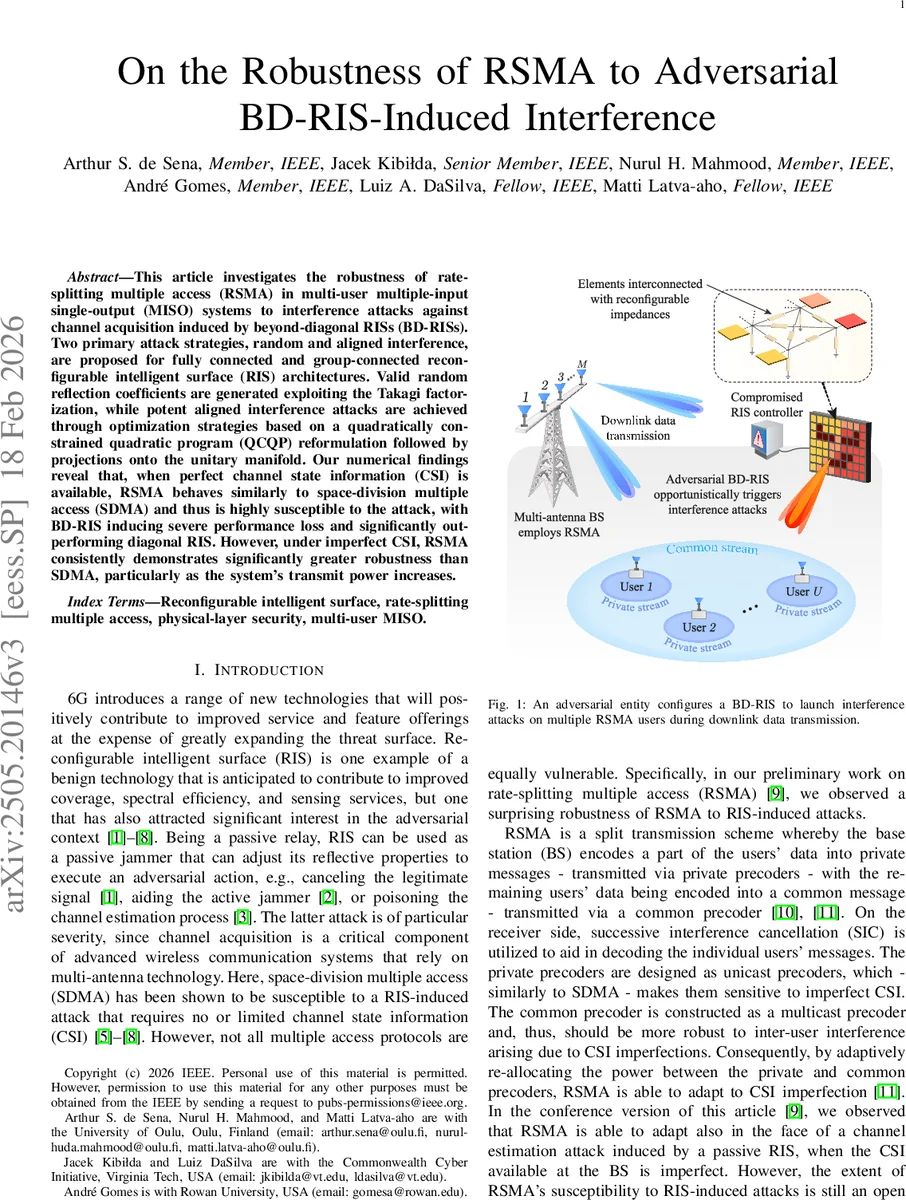
This article investigates the robustness of rate-splitting multiple access (RSMA) in multi-user multiple-input single-output (MISO) systems to interference attacks against channel acquisition induced by beyond-diagonal RISs (BD-RISs). Two primary attack strategies, random and aligned interference, are proposed for fully connected and group-connected reconfigurable intelligent surface (RIS) architectures. Valid random reflection coefficients are generated exploiting the Takagi factorization, while potent aligned interference attacks are achieved through optimization strategies based on a quadratically constrained quadratic program (QCQP) reformulation followed by projections onto the unitary manifold. Our numerical findings reveal that, when perfect channel state information (CSI) is available, RSMA behaves similarly to space-division multiple access (SDMA) and thus is highly susceptible to the attack, with BD-RIS inducing severe performance loss and significantly outperforming diagonal RIS. However, under imperfect CSI, RSMA consistently demonstrates significantly greater robustness than SDMA, particularly as the system’s transmit power increases.
💡 Research Summary
This paper investigates how robust Rate‑Splitting Multiple Access (RSMA) is against adversarial attacks that exploit beyond‑diagonal reconfigurable intelligent surfaces (BD‑RIS) during channel acquisition in multi‑user MISO downlink systems. Three RIS architectures are considered: fully‑connected, group‑connected, and single‑connected (the conventional diagonal RIS). For each architecture two attack modes are devised: a random attack and an aligned attack.
The random attack generates valid BD‑RIS reflection matrices by applying Takagi factorization to arbitrary complex matrices, guaranteeing the required symmetry and unitary (or block‑wise unitary) constraints. This method is computationally light and leverages inter‑element coupling to produce stronger interference than independent phase‑shift attacks on diagonal RIS.
The aligned attack assumes the adversary knows the RIS‑to‑user channels and seeks to maximize the reflected interference power toward legitimate users. By exploiting the symmetric structure of BD‑RIS matrices, the original non‑convex problem is reformulated into a quadratically constrained quadratic program (QCQP). The QCQP is solved efficiently using singular‑value decomposition (SVD) followed by a projection onto the unitary manifold via Takagi factorization, ensuring all physical constraints are satisfied.
The system model follows the standard RSMA paradigm: a common message is precoded with a multicast beamformer while each user also receives a private message via a unicast precoder. RSMA adapts to channel state information (CSI) quality by reallocating power between the common and private streams and by employing successive interference cancellation (SIC) at the receivers. Imperfect CSI is modeled through estimation errors and SIC imperfections.
Extensive Monte‑Carlo simulations are carried out for transmit powers ranging from –10 dBm to 30 dBm and RIS element counts of 32, 64, and 128. When CSI is perfect, both RSMA and conventional space‑division multiple access (SDMA) suffer comparable rate losses; BD‑RIS (especially fully‑connected and group‑connected) induces 5–9 dB additional degradation relative to a diagonal RIS. This confirms that RSMA’s private‑precoder‑dominant operation under perfect CSI makes it as vulnerable as SDMA.
When CSI is imperfect (≈10 % error), RSMA exhibits a markedly higher robustness. As transmit power increases, the robustness index (defined between 0 and 1) for RSMA rises from ~0.4 to >0.85, while SDMA’s index remains below 0.2. At high power (≥20 dBm) the RSMA sum‑rate loss due to the attack drops below 1 bps/Hz, effectively recovering the performance. The key mechanism is the adaptive shift of power toward the common stream, which, together with SIC, mitigates the extra interference introduced by the BD‑RIS.
The study also shows that the performance gap between RSMA and SDMA widens as the RIS size grows, because the additional degrees of freedom in BD‑RIS amplify the attack impact on larger arrays. A brief discussion on hardware non‑idealities (phase‑shift errors, mutual coupling, non‑ideal scattering matrices) indicates that while such impairments can reduce attack effectiveness, the structural advantage of BD‑RIS remains significant.
In summary, the paper demonstrates that RSMA is highly susceptible to BD‑RIS attacks under perfect CSI, but its inherent adaptability—power reallocation to the common message and reliance on SIC—provides substantial resilience when CSI is imperfect or transmit power is sufficiently high. These findings highlight the importance of considering RIS‑induced adversarial scenarios in the design of future 6G systems and suggest that RSMA, combined with robust channel estimation and SIC techniques, offers a promising pathway toward secure and reliable high‑frequency wireless networks.
Comments & Academic Discussion
Loading comments...
Leave a Comment