Multiple polylogarithms and the Steinberg module
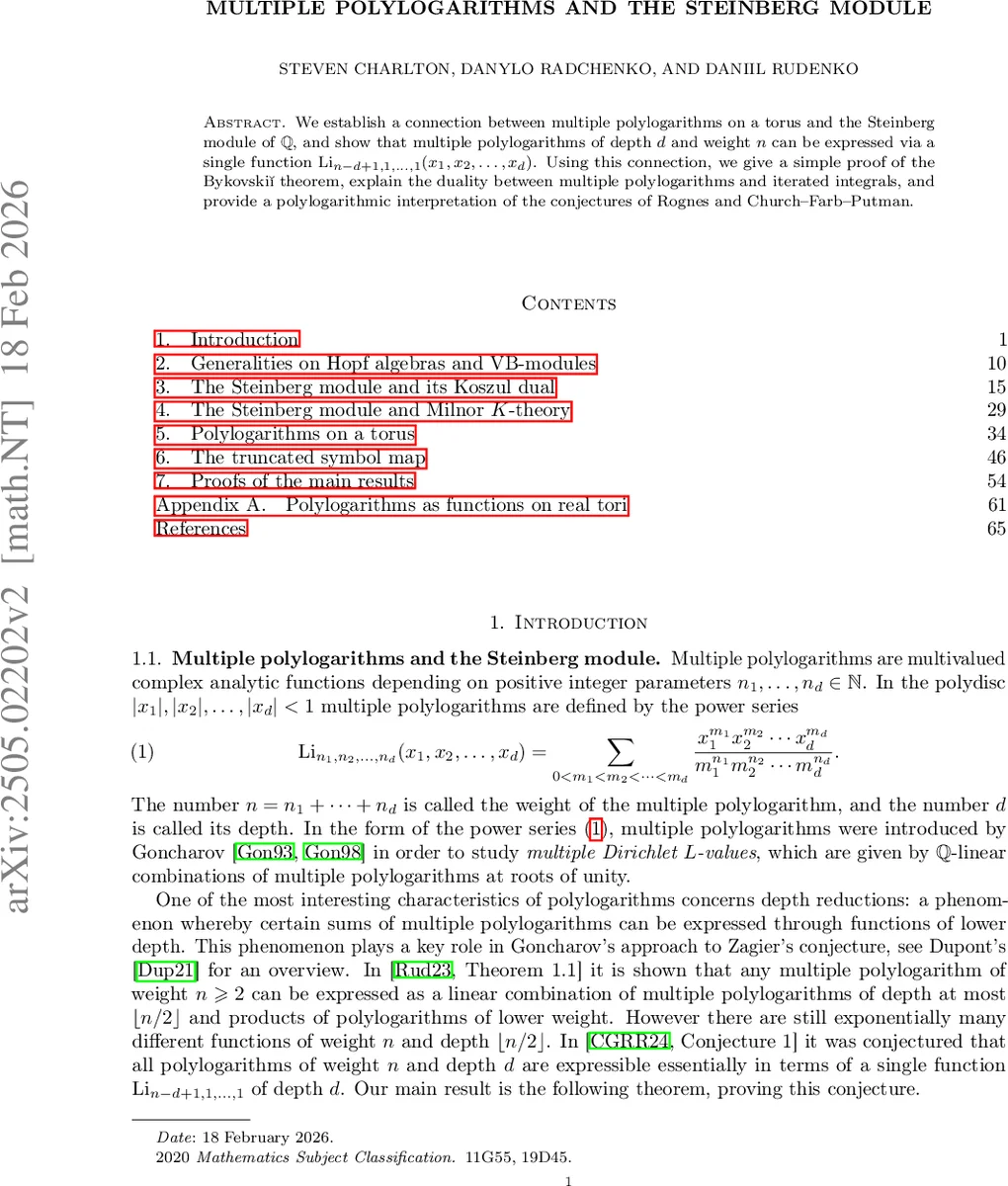
We establish a connection between multiple polylogarithms on a torus and the Steinberg module of $\mathbb{Q}$, and show that multiple polylogarithms of depth $d$ and weight $n$ can be expressed via a single function $\mathrm{Li}_{n-d+1,1,\dots,1}(x_1,x_2,\dots,x_d)$. Using this connection, we give a simple proof of the Bykovski\uı theorem, explain the duality between multiple polylogarithms and iterated integrals, and provide a polylogarithmic interpretation of the conjectures of Rognes and Church-Farb-Putman.
💡 Research Summary
This paper establishes a profound and novel connection between the theory of multiple polylogarithms and the Steinberg module from algebraic topology, leading to significant advances in understanding the algebraic structure of polylogarithms and their relations.
The central achievement is the construction of an explicit GL(V)-equivariant isomorphism between a space of multiple polylogarithms on an algebraic torus T^d and a tensor product of Steinberg modules. Specifically, the authors prove that the space gr_D^d L_n(T^d)—which consists of depth d, weight n multiple polylogarithms modulo those of lower depth—is isomorphic to St(V) ⊗ St(V) ⊗ S^{n-d} V, where V is the rational vector space derived from the character lattice of the torus. The map sends the classical polylogarithm Li_{n1,…,nd}(x1,…,xd) to a specific tensor product of Steinberg cycles and a symmetric product of basis vectors.
This structural theorem has several major consequences:
- Maximal Depth Reduction: It proves a conjecture from
Comments & Academic Discussion
Loading comments...
Leave a Comment