$(S_2)$-ifications, semi-Nagata rings, and the lifting problem
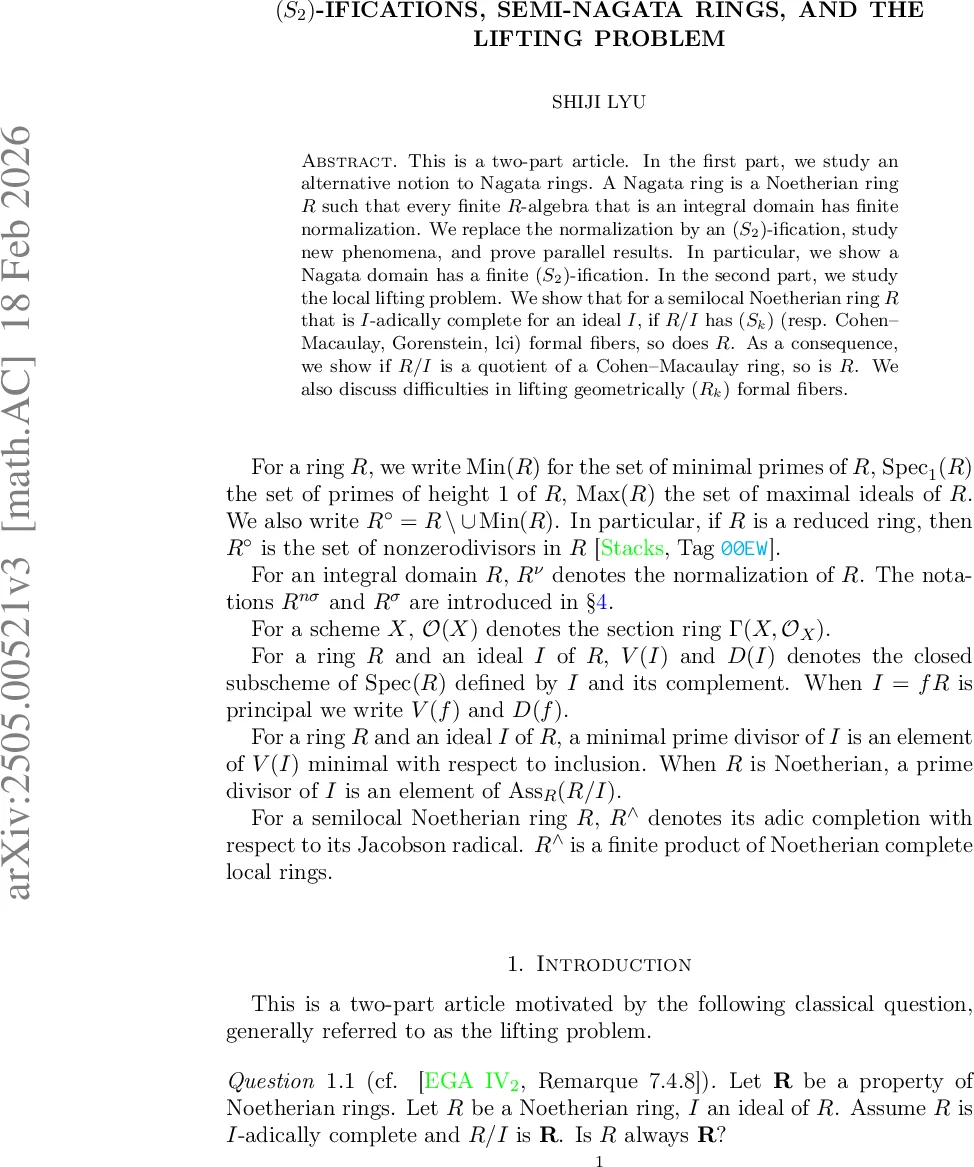
This is a two-part article. In the first part, we study an alternative notion to Nagata rings. A Nagata ring is a Noetherian ring $R$ such that every finite $R$-algebra that is an integral domain has finite normalization. We replace the normalization by an $(S_2)$-ification, study new phenomena, and prove parallel results. In particular, we show a Nagata domain has a finite $(S_2)$-ification. In the second part, we study the local lifting problem. We show that for a semilocal Noetherian ring $R$ that is $I$-adically complete for an ideal $I$, if $R/I$ has $(S_k)$ (resp. Cohen–Macaulay, Gorenstein, lci) formal fibers, so does $R$. As a consequence, we show if $R/I$ is a quotient of a Cohen–Macaulay ring, so is $R$. We also discuss difficulties in lifting geometrically $(R_k)$ formal fibers.
💡 Research Summary
The paper is divided into two largely independent parts, each addressing a different aspect of the relationship between finiteness conditions on Noetherian rings and the behavior of certain “nice” algebraic properties under completion and quotient operations.
In the first part (Sections 2–8) the author introduces a new class of rings called semi‑Nagata rings. Classical Nagata rings are defined by the finiteness of normalizations of all finite domain algebras. The author replaces the normalization by the smallest finite extension satisfying Serre’s condition (S₂), called an (S₂)-ification. A semi‑Nagata ring is a Noetherian ring R such that for every finite R‑algebra B which is an integral domain there exists a finite inclusion B → C with C an (S₂) domain and Bₚ = Cₚ for all height‑one primes p of B.
The main structural result (Theorem 1.2) gives four equivalent characterizations of semi‑Nagata rings: (i) for semilocal R this is equivalent to having (S₁) formal fibers; (ii) the property is stable under essentially finite type extensions; (iii) it can be detected locally by the existence of an element f ∉ p such that (R/p)₍f₎ is (S₂) together with (S₁) formal fibers; (iv) it is precisely the analogue of the classical Nagata condition with (S₂)-ifications in place of normalizations. Theorem 1.3 recalls the classical Nagata equivalences, and Corollary 1.4 immediately yields that every Nagata ring is semi‑Nagata, so every Nagata domain admits a finite (S₂)-ification.
A substantial technical development concerns the construction and uniqueness of (S₂)-ifications. For a Noetherian domain R the author defines
Rₙ^σ = ⋂_{p∈Spec₁(R)} Rₚ and R^σ = Rₙ^σ ∩ R^ν,
where R^ν is the normalization. In many cases Rₙ^σ already satisfies (S₂) and equals the (S₂)-ification, but there are obstructions, called FONSIs (finite obstruction of non‑S₂). When FONSIs are present, Rₙ^σ fails to be integral over R, and one must replace it by R^σ. Theorem 4.8 shows that the absence of FONSIs guarantees that Rₙ^σ is the desired (S₂)-ification; Theorem 6.4 proves that for a semilocal ring one can always find a finite subalgebra of R^σ free of FONSIs, which is the key step toward proving the semi‑Nagata equivalences. The paper also discusses pathological examples where an infinite ascending chain of (S₂)-ifications occurs (Example 7.9) and where (S₂)-ifications of modules may not exist (Remark 7.10).
The second part (Sections 9–14) tackles the local lifting problem: given a semilocal Noetherian ring R that is I‑adically complete, if the quotient R/I enjoys a certain property P, does R itself enjoy P? The author treats five families of properties: (Sₖ) for any k ≥ 0, Cohen–Macaulay, Gorenstein, locally complete intersection (lci), and “quotient of a Cohen–Macaulay ring”. Theorem 1.8 asserts that the answer is affirmative for all these families.
The strategy follows Nishimura’s method of assigning to each complete local ring (A,m) an m‑primary ideal that cuts out the non‑P locus on the punctured spectrum, in a way that is functorial for flat maps preserving the fibers. For (Sₖ), Cohen–Macaulay, and Gorenstein this assignment is straightforward. The lci case is more delicate because the cotangent complex L_{A/ℤ} need not have finite cohomology. The author studies the modules Cₙ introduced in recent work of Bhatt–Iyengar, shows they have a well‑behaved structure (Lemma 12.3), and defines a suitable Fitting invariant for n ≥ dim A + 2 (Definition 12.6). This invariant detects the failure of the lci condition and yields the required ideal.
Section 14 discusses partial lifting results, such as lifting properties that hold in codimension 0 or Cohen–Macaulayness in codimension 1, and explains why the same techniques encounter obstacles for geometrically (Rₖ) formal fibers.
Finally, Theorem 8.1 shows that for a universally catenary, I‑adically complete ring R, if R/I is semi‑Nagata then R is semi‑Nagata, providing a lifting result for the new class as well.
Overall, the paper introduces (S₂)-ification as a natural replacement for normalization in the Nagata context, develops a detailed obstruction theory (FONSIs), and leverages these tools to obtain new lifting theorems for a broad spectrum of homological properties. The results deepen the understanding of how Serre’s conditions, Cohen–Macaulayness, Gorensteinness, and lci behave under completion and quotient, and they open avenues for further exploration of (S₂)-closures and their role in the geometry of singularities.
Comments & Academic Discussion
Loading comments...
Leave a Comment