Chebyshev polynomials in the complex plane and on the real line
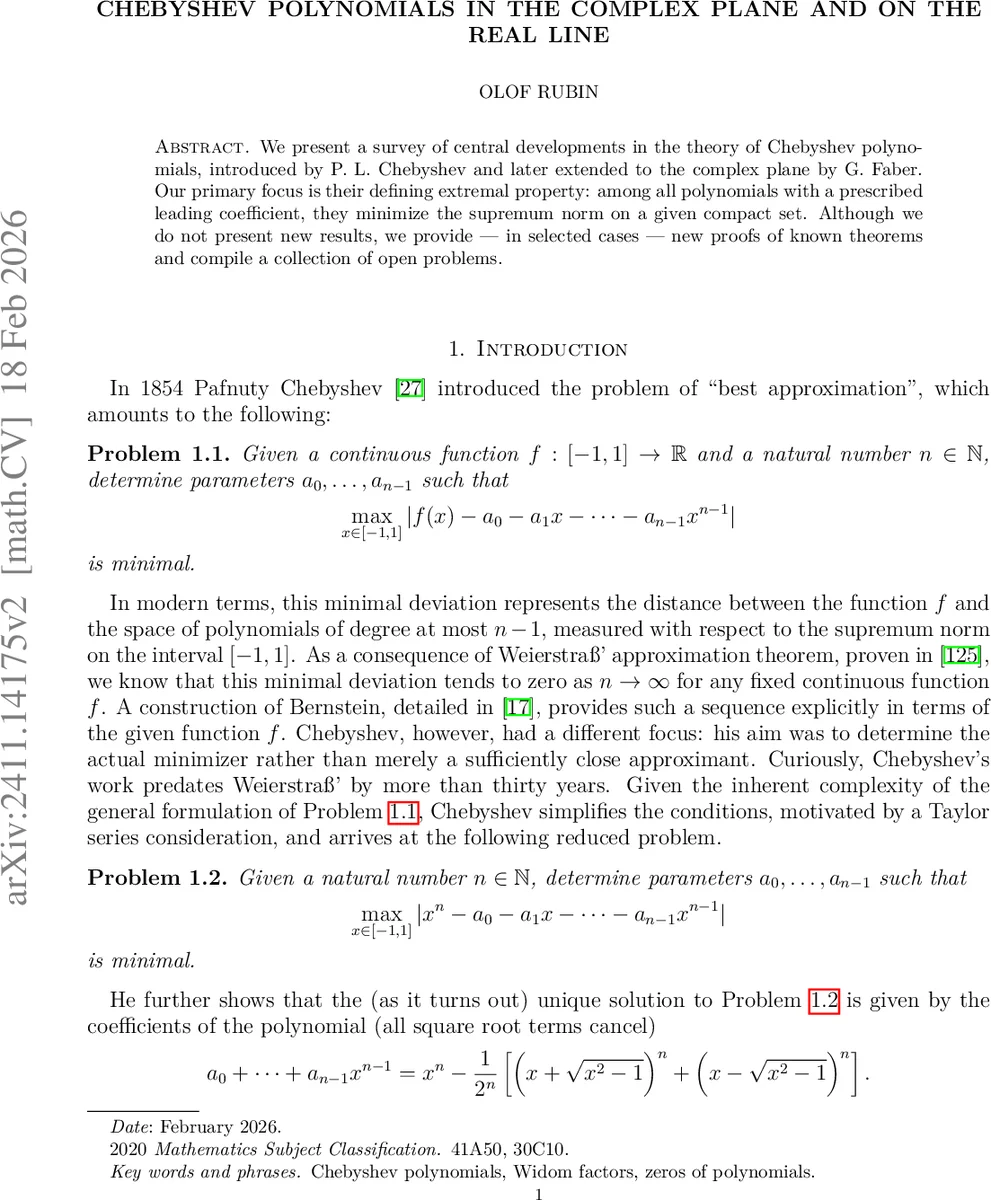
We present a survey of central developments in the theory of Chebyshev polynomials, introduced by P.~L.~Chebyshev and later extended to the complex plane by G.~Faber. Our primary focus is their defining extremal property: among all polynomials with a prescribed leading coefficient, they minimize the supremum norm on a given compact set. Although we do not present new results, we provide – in selected cases – new proofs of known theorems and compile a collection of open problems.
💡 Research Summary
The manuscript offers a comprehensive survey of Chebyshev polynomials, tracing their origins from P. L. Chebyshev’s 1854 “best approximation” problem to G. Faber’s extension into the complex plane. The central theme is the extremal property: among all monic polynomials of degree (n) (or, equivalently, all polynomials with a prescribed leading coefficient), the Chebyshev polynomial minimizes the supremum norm on a prescribed compact set. The authors deliberately avoid presenting new theorems; instead, they provide fresh proofs of classical results and compile a list of open questions.
The paper begins with a historical overview, emphasizing Chebyshev’s reduction of the general best‑approximation problem to the special case of approximating the monomial (x^{n}) on (
Comments & Academic Discussion
Loading comments...
Leave a Comment