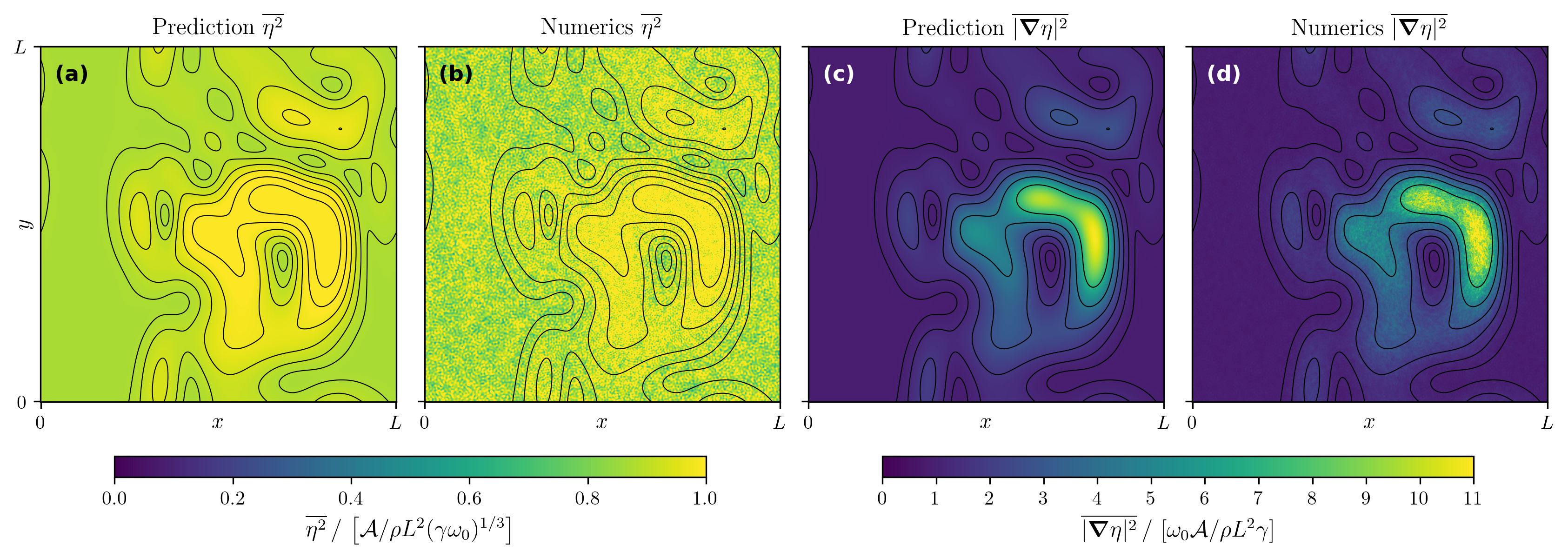
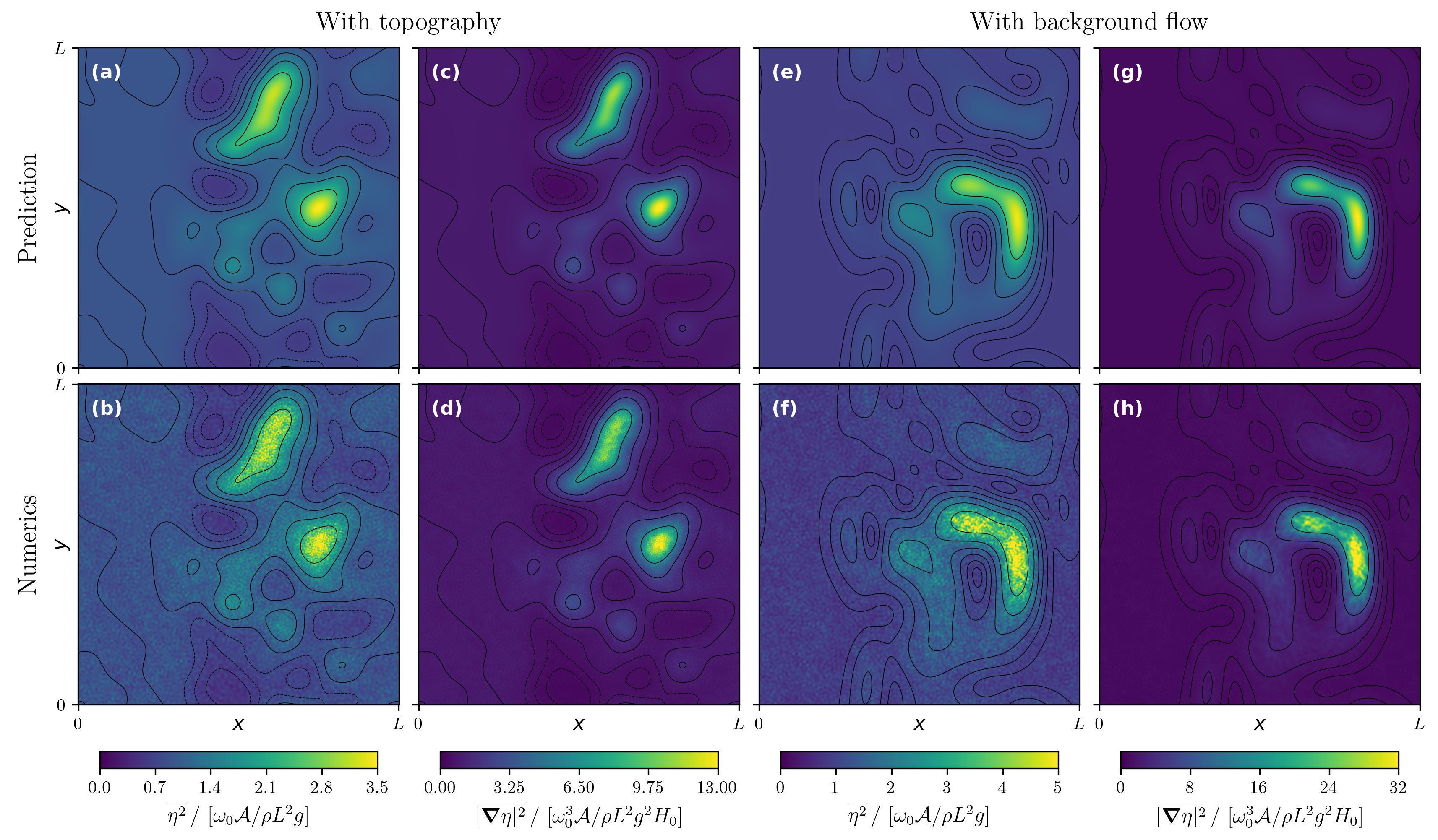
We adapt the microcanonical framework of equilibrium statistical mechanics to predict the statistics of short waves in inhomogeneous moving media. For steady inhomogeneities and background flow, we compute the wave spectrum at any location in the domain based on an ergodic prescription for the action density in phase space, constrained by conservation of absolute frequency. We illustrate the method for shallow-water waves subject to a background flow or to topographic inhomogeneities, and for deep-water surface capillary waves over a background flow, validating the predicted maps of rms surface elevation and interfacial slope against numerical simulations.
Deep Dive into Equilibrium statistical mechanics of waves in inhomogeneous moving media.
We adapt the microcanonical framework of equilibrium statistical mechanics to predict the statistics of short waves in inhomogeneous moving media. For steady inhomogeneities and background flow, we compute the wave spectrum at any location in the domain based on an ergodic prescription for the action density in phase space, constrained by conservation of absolute frequency. We illustrate the method for shallow-water waves subject to a background flow or to topographic inhomogeneities, and for deep-water surface capillary waves over a background flow, validating the predicted maps of rms surface elevation and interfacial slope against numerical simulations.
The interplay between waves and mean flows is a fascinating topic with applications ranging from metrology in experimental fluid mechanics -sound-vorticity or surface-wave-vorticity interaction [1][2][3][4][5][6][7] -to the dynamics of oceanic and atmospheric flows [8]. In the tropical atmosphere, internal gravity waves interacting with the zonal mean-flow induce the quasi-biennial oscillation [9][10][11][12][13][14]. At the Ocean surface, background mean flows deflect surface waves [15][16][17][18], while strong waves feedback onto the mean flow [19][20][21][22]. Deeper in the Ocean, the mean flow shapes the inertia-gravity waves arising in the rapidly rotating density stratified fluid [23][24][25][26][27][28], with important consequences for vertical mixing [29][30][31].
When the waves are much shorter than the background flow and medium inhomogeneities, ray-tracing is the preferred method to predict wave evolution [22,32,33], in a similar fashion to geometric optics. When it comes to predicting wave statistics, however, simulating a largenumber of rays soon becomes computationally intensive and seems to be missing any overarching large-scale organizing principle. In a recent study, we showed that short near-inertial Ocean waves over a background flow behave in an analogous fashion to charged particles in an electromagnetic field, providing a way to predict the wave statistics based on the statistical mechanics of particle systems [34]. For arbitrary waves propagating in an inhomogeneous moving medium, however, no such exact analogy to a particle system is available. The question thus remains whether equilibrium statistical mechanics can be leveraged in this more general context. In the present Letter we answer in the positive, unveiling an organizing principle based on a parallel with the microcanonical ensemble of statistical mechanics. Namely, combining energy and wave-action conservation for waves in moving media [22,35] with an ergodic hypothesis motivated by chaotic motion in phase space and mathematical results on quantum chaos [36][37][38][39][40][41][42][43], we predict the time-averaged statistics of the wave field at any location in space. We illustrate the approach for shallow-water gravity waves and deep-water capillary waves in inhomogeneous or moving media.
Micro-canonical statistical mechanics -Consider linear waves in an inhomogeneous moving medium. Both the properties of the medium and its velocity are assumed to be time-independent and to vary on a scale much greater than the wavelength. Denoting as ω and k the frequency and wavevector, the wavefield locally satisfies the dispersion relation:
where U(x) denotes the velocity of the background medium. Above, ω and Ω(x, k) are the absolute frequency and dispersion relation, corresponding to the wave frequency as measured by a steady motionless observer in a fixed reference frame. By contrast, Ω denotes the intrinsic wave frequency, as measured by an observer moving with the local speed of the background medium. For a motionless medium, Ω(x, k) = Ω(x, k), where the x-dependence of Ω encodes possible spatial inhomogeneities of the properties of the medium. The scale separation calls for a description of the wave field in terms of wave packets obeying the ray-tracing equations.
For a narrow wave-packet located at position X(t) with wavevector K(t), the latter equations take the Hamiltonian form:
where the partial derivatives are to be understood component-wise and are evaluated at (X, K). As a wave packet follows the path given by (2), it conserves its wave action, defined as the ratio of the intrinsic wave energy -energy functional for waves above a motionless background state -divided by the intrinsic wave frequency [35]. For an ensemble of wave packets with various initial positions and wave numbers, one defines the action density a(x, k, t) of the ensemble of wave packets in the phase space (x, k). The Hamiltonian ray-tracing equations (2) correspond to a divergence-free flow in phase space, such that the conservation equation for a(x, k, t) reduces to the Liouville equation:
Because the medium is time-independent, the wave field is governed by partial differential equations with timeindependent coefficients. This invariance to time translations results in the conservation of the absolute wave frequency ω of a given wave packet. We are thus in a position to apply the micro-canonical formulation of equilibrium statistical mechanics, where the action is equivalent to the number of particles, while the frequency plays the role of the energy. Namely, consider an ensemble of wave packets of same absolute frequency ω 0 . In phase space, this cloud of wave packets only has access to the hypersurface Ω(x, k) = ω 0 as it gets distorted by the phase-space flow (right-hand side of ( 2)). The latter being typically chaotic, it tends to homogenize the action density over the hypersurface. The ergodic hypothesis consists in assuming perfect homog
…(Full text truncated)…
This content is AI-processed based on ArXiv data.