📝 Original Info
- Title: The COHERENT Experiment: 2026 Update
- ArXiv ID: 2602.15652
- Date: 2026-02-17
- Authors: Researchers from original ArXiv paper
📝 Abstract
The COHERENT experiment measures neutrino-induced recoils from coherent elastic neutrino-nucleus scattering (CEvNS) with multiple nuclear targets at the Spallation Neutron Source (SNS) at the Oak Ridge National Laboratory (ORNL), USA. Several successful CEvNS measurements have been achieved in recent years with tens-of-kg detector masses, with a CsI scintillating crystal, a liquid argon single-phase detector, and high-purity germanium spectrometers. For the next phase, COHERENT aims at high-statistics detection of CEvNS events for precision tests of the standard model of particle physics, and to probe new physics beyond-the-standard model. Percent-level precision can be achieved by lowering thresholds, reducing backgrounds, and by scaling up the detector masses. It goes hand in hand with benchmarking the neutrino flux from the SNS. Further detectors will measure CEvNS in additional nuclei, including lighter target nuclei such as sodium and neon, to continue to test the expected neutron-number-squared dependence of the cross section. COHERENT can furthermore study charged-current and neutral-current inelastic neutrino-nucleus cross sections on various nuclei at neutrino energies below $\sim$50 MeV. Many of these cross sections have never been measured before, but are critical input for the interpretation of core-collapse supernova detection in large-scale neutrino experiments such as DUNE, Super-K, Hyper-K, and HALO.
💡 Deep Analysis
Deep Dive into The COHERENT Experiment: 2026 Update.
The COHERENT experiment measures neutrino-induced recoils from coherent elastic neutrino-nucleus scattering (CEvNS) with multiple nuclear targets at the Spallation Neutron Source (SNS) at the Oak Ridge National Laboratory (ORNL), USA. Several successful CEvNS measurements have been achieved in recent years with tens-of-kg detector masses, with a CsI scintillating crystal, a liquid argon single-phase detector, and high-purity germanium spectrometers. For the next phase, COHERENT aims at high-statistics detection of CEvNS events for precision tests of the standard model of particle physics, and to probe new physics beyond-the-standard model. Percent-level precision can be achieved by lowering thresholds, reducing backgrounds, and by scaling up the detector masses. It goes hand in hand with benchmarking the neutrino flux from the SNS. Further detectors will measure CEvNS in additional nuclei, including lighter target nuclei such as sodium and neon, to continue to test the expected neutron
📄 Full Content
masses. It goes hand in hand with benchmarking the neutrino flux from the SNS. Further detectors will measure CEvNS in additional nuclei, including lighter target nuclei such as sodium and neon, to continue to test the expected neutron-number-squared dependence of the cross section. COHER-ENT can furthermore study charged-current and neutral-current inelastic neutrino-nucleus cross sections on various nuclei at neutrino energies below ∼50 MeV. Many of these cross sections have never been measured before, but are critical input for the interpretation of core-collapse supernova detection in large-scale neutrino experiments such as DUNE, Super-K, Hyper-K, and HALO.
This document was first prepared in response to a request from the Neutrinos & Cosmic Messengers section of the Update of the European Strategy for Particle Physics and then updated at the beginning of 2026. The COHERENT experiment is sited at the Spallation Neutron Source (SNS) of Oak Ridge National Laboratory (ORNL) in Tennessee, USA. The COHERENT collaboration includes approximately 120 members from institutions in six countries.
Coherent elastic neutrino-nucleus scattering (CEvNS) describes the interaction of the neutrino with the nucleus as a whole [1]. The coherence condition holds if the wavelength of the momentum transfer is of the order of or larger than the size of the target nucleus. For medium-sized nuclei, the neutrino energy must be smaller than ∼50 MeV. For coherent interactions, the cross section is enhanced by the number of neutrons in the target nucleus squared (see Fig. 1); it is large in comparison to other neutrino interactions such as inverse beta decay [2]. The high interaction rate and intrinsically small nuclear uncertainties make CEvNS an excellent interaction channel for precision tests of the standard model in modest-scale experiments.
The signature of CEvNS in a detector is the recoil of the scattered nucleus. The detection of these low energy signals results in stringent limits on the noise level of the detector. The maximum recoil energy scales as ∼
, where E ν is the neutrino energy and M is the mass of the target nucleus. For neutrinos in the tens-of-MeV range, as available at stopped-pion (pion decay-at-rest) sources, nuclear recoil sensitivity in the few tens-of-keV range is required. Depending on the target material, the recoils result in ionization, scintillation, phonon signals, or a combination of these. It is important to understand the detector energy response; and dedicated measurements of the “quenching” of observable recoil energy are needed to reduce systematic uncertainties (e.g., [3], [4], [5]).
The first detection of CEvNS was achieved at the SNS in 2017 by the COHERENT collaboration with CsI scintillating crystals at room temperature [2]. COHERENT subsequently detected CEvNS on two more targets with a single-phase liquid argon detector [6] and high-purity germanium spectrometers (HPGe) [7].
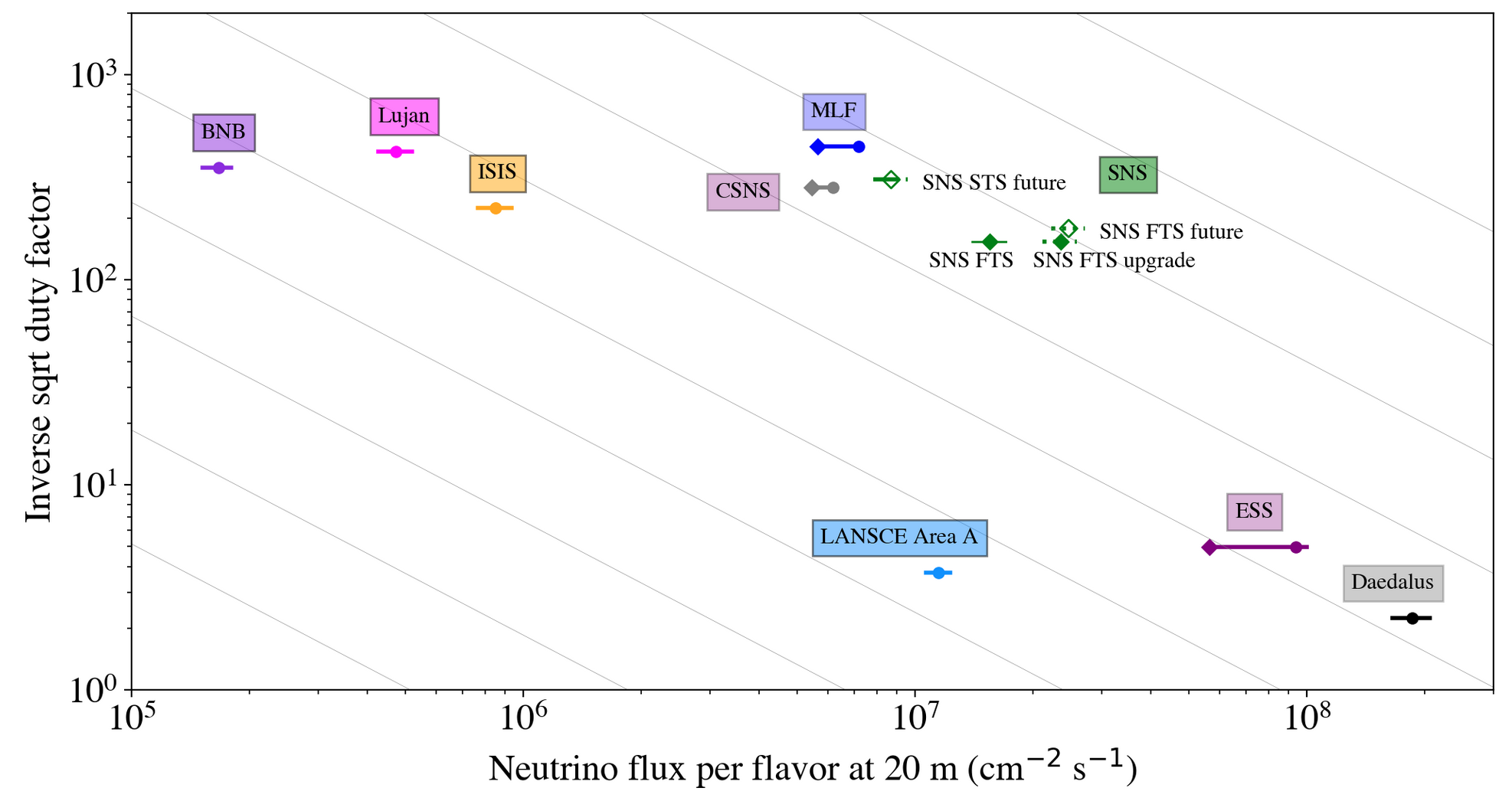
The SNS provides a pulsed beam of stopped-pion neutrinos, as detailed in Section III.
Beyond the efforts at the SNS, CEvNS was very recently also observed at a reactor site. As power reactors are steady-state neutrino sources, much more effort is required to reduce and understand the background that can only be evaluated during the sparse reactor outages. Reactor neutrinos have energies below 11 MeV [8]. The lower energies in comparison to the SNS result in respectively lower recoil energies and consequently detectors with even lower noise threshold by one to two orders of magnitude are required for a successful detection. The first detection of reactor-neutrino CEvNS at 3.7 σ [9] was achieved by the CONUS+ experiment in 2024 with HPGe detectors. Many reactor experiments employ HPGe detectors, which have excellent energy resolution and low thresholds [10][11][12][13]. Additional efforts are underway including charged-coupled devices [14,15] and cryogenic calorimeters [16,17], which are able to detect recoils at even lower energies, as well as cryogenic liquids [18] and NaI scintillating crystals [19]. Complementary detections of CEvNS at reactors and with stopped-pion neutrinos is highly desirable to study the impact of nuclear effects at different momentum transfers (nuclear form-factor (FF) effects are responsible for the difference between the black and green curves in Fig. 1).
Furthermore, very recently first evidence on CEvNS from solar 8 B neutrinos was observed by the XENONnT [20], Panda-X [21] experiments, and now LUX-ZEPLIN [22]. These experiments look for recoils of WIMP dark matter with dual-phase liquid xenon time projection chambers and tonne-scale detector masses. The CEvNS interaction of solar neutrinos is an inevitable background in these searches. Excesses have now been seen with significances of 2.7 σ, 2.6 σ and 4.5 σ respectively and with several tonne-years of exposure. As dark matter experiments become more sensitive, precise independent CEvNS measurements by COHERENT will enable correc
…(Full text truncated)…
📸 Image Gallery
Reference
This content is AI-processed based on ArXiv data.