Evolutionary Systems Thinking -- From Equilibrium Models to Open-Ended Adaptive Dynamics
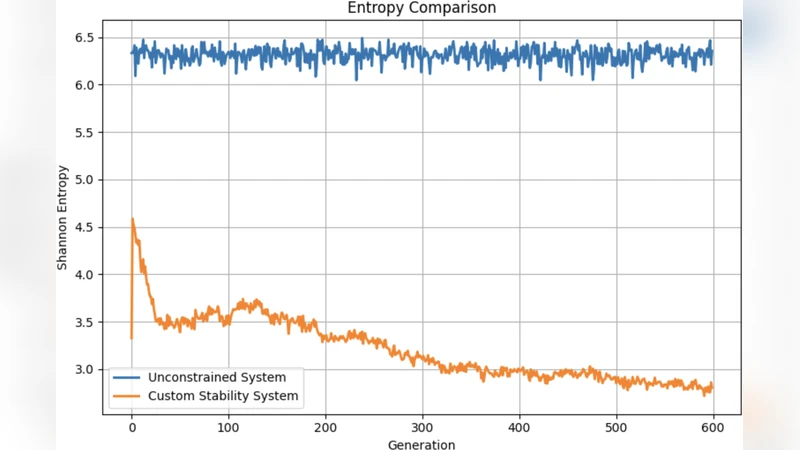
Complex change is often described as “evolutionary” in economics, policy, and technology, yet most system dynamics models remain constrained to fixed state spaces and equilibrium-seeking behavior. This paper argues that evolutionary dynamics should be treated as a core system-thinking problem rather than as a biological metaphor. We introduce Stability-Driven Assembly (SDA) as a minimal, non-equilibrium framework in which stochastic interactions combined with differential persistence generate endogenous selection without genes, replication, or predefined fitness functions. In SDA, longer-lived patterns accumulate in the population, biasing future interactions and creating feedback between population composition and system dynamics. This feedback yields fitness-proportional sampling as an emergent property, realizing a natural genetic algorithm driven solely by stability. Using SDA, we demonstrate why equilibrium-constrained models, even when simulated numerically, cannot exhibit open-ended evolution: evolutionary systems require population-dependent, non-stationary dynamics in which structure and dynamics co-evolve. We conclude by discussing implications for system dynamics, economics, and policy modeling, and outline how agent-based and AI-enabled approaches may support evolutionary models capable of sustained novelty and structural emergence.
💡 Research Summary
The paper opens by observing that the term “evolutionary” is widely used in economics, technology policy, and innovation studies, yet the dominant system‑dynamics and differential‑equation models remain locked into fixed state spaces and equilibrium‑seeking behavior. The authors argue that this mismatch is not merely a metaphorical shortfall; it is a methodological blind spot that prevents models from capturing the open‑ended novelty and structural emergence that characterize real‑world change.
To address this gap, the authors introduce a minimal, non‑equilibrium framework called Stability‑Driven Assembly (SDA). SDA is built on two simple ingredients: (1) stochastic pairwise interactions among agents (or patterns) and (2) a differential persistence property that assigns each pattern a characteristic lifetime. Persistence is not a fitness function defined a priori; instead it emerges from the dynamics themselves—patterns that happen to survive longer simply appear more often in subsequent interactions. Because interaction partners are drawn proportionally to their current abundance, longer‑lived patterns are sampled more frequently, creating a feedback loop in which the population composition influences the very rules that generate it.
Mathematically, the model can be expressed as a birth‑death‑mutation process where the birth probability of pattern i at time t is proportional to its average survival time τ_i. The stochastic interaction step selects two patterns at random, combines or modifies them according to a simple rule set, and then updates the population. Over time, this process yields an emergent “fitness‑proportional sampling” without ever defining a fitness landscape, replicators, or genetic operators. In effect, the system implements a natural genetic algorithm driven solely by stability.
Through a series of computational experiments, the authors compare SDA to classic equilibrium models such as Lotka‑Volterra and standard system‑dynamics formulations. The equilibrium models quickly converge to fixed points or limit cycles and are incapable of generating novel structures after the initial conditions are set. By contrast, SDA exhibits continual structural diversification, co‑evolution of dynamics and topology, and the spontaneous emergence of higher‑order patterns. The authors demonstrate that open‑ended evolution requires population‑dependent, non‑stationary dynamics: the rule set itself must evolve as the composition of the population changes.
The discussion extends these findings to three applied domains. In economics, policy levers are traditionally modeled as exogenous parameters that steer the system toward a desired equilibrium. SDA suggests a paradigm where policies are themselves subject to selection—more “stable” policy configurations survive and shape future interactions, offering a richer representation of institutional evolution. In technology studies, the model replaces static patent trees or pre‑defined technology roadmaps with a process where durable technological components self‑assemble into increasingly complex artifacts. Finally, the authors outline how modern agent‑based platforms and AI techniques (e.g., generative models, reinforcement learning) can instantiate SDA at scale, allowing researchers to observe long‑term novelty emergence in silico.
In conclusion, the paper positions evolutionary systems thinking as a core methodological shift rather than a decorative metaphor. By foregrounding stability‑driven selection and endogenous feedback, SDA provides a tractable yet powerful alternative to equilibrium‑centric modeling. The authors call for a new generation of simulation tools that integrate SDA principles with AI‑enhanced agents, arguing that such tools will be essential for studying sustained innovation, structural emergence, and adaptive policy design in complex socio‑technical systems.
Comments & Academic Discussion
Loading comments...
Leave a Comment