Measurement-Based Validation of Geometry-Driven RIS Beam Steering in Industrial Environments
Reconfigurable intelligent surfaces (RISs) offer programmable control of radio propagation for future wireless systems. For configuration, geometry-driven analytical approaches are appealing for their simplicity and real-time operation, but their performance in challenging environments such as industrial halls with dense multipath and metallic scattering is not well established. To this end, we present a measurement-based evaluation of geometry-driven RIS beam steering in a large industrial hall using a 5 GHz RIS prototype. A novel RIS configuration is proposed in which four patch antennas are mounted in close proximity in front of the RIS to steer the incident field and enable controlled reflection. For this setup, analytically computed, quantized configurations are implemented. Two-dimensional received power maps from two measurement areas reveal consistent, spatially selective focusing. Configurations optimized near the receiver produce clear power maxima, while steering to offset locations triggers a rapid 20-30 dB reduction. With increasing RIS-receiver distance, elevation selectivity broadens due to finite-aperture and geometric constraints, while azimuth steering remains robust. These results confirm the practical viability of geometry-driven RIS beam steering in industrial environments and support its use for spatial field control and localization under non-ideal propagation.
💡 Research Summary
The paper presents a thorough measurement‑based evaluation of geometry‑driven beam steering using a reconfigurable intelligent surface (RIS) in a large industrial hall, addressing a gap in the literature where most RIS studies are confined to simulations or small indoor environments. The authors argue that while RIS promises programmable control of radio propagation, its practical performance in harsh, multipath‑rich, metallic environments remains uncertain. To investigate this, they built a 5 GHz RIS prototype with a 1 m² aperture and introduced a novel configuration: four patch antennas placed in close proximity (≈5 cm spacing) directly in front of the RIS. These patches act as a controllable “incident‑field steering” module, allowing the authors to shape the phase and amplitude of the wave impinging on the RIS before reflection.
The steering strategy is purely geometry‑based. Using only the known positions of the transmitter, the RIS, and a desired focal point, the required reflection phase for each RIS element is computed analytically as φ₍i,j₎ = −2π/λ · (d₁ᵢⱼ + d₂ᵢⱼ) + const, where d₁ᵢⱼ and d₂ᵢⱼ are the distances from the transmitter to element (i,j) and from that element to the focal point, respectively. The continuous phase values are then quantized to 2‑bit (four discrete levels) for practical implementation. This approach eliminates the need for channel estimation, making it attractive for real‑time operation.
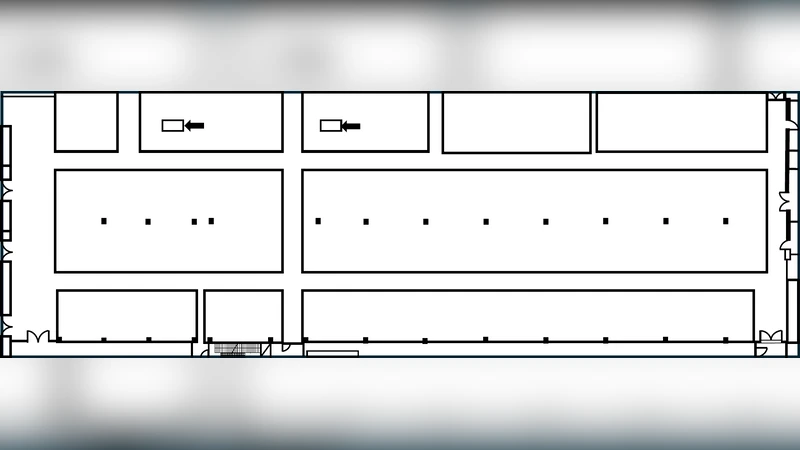
Measurements were carried out in two distinct zones of the hall, denoted Area A (RIS‑receiver distance ≈ 2 m) and Area B (distances ranging from 4 m to 6 m). In each area a mobile receiver equipped with a high‑sensitivity spectrum analyzer recorded received power on a 0.5 m grid, producing two‑dimensional power maps for each RIS configuration. Three experimental scenarios were examined: (1) steering the RIS to focus on the actual receiver location, (2) deliberately steering to offset points (±0.5 m and ±1 m from the true location), and (3) varying the RIS‑receiver distance to study elevation and azimuth selectivity.
The results confirm that geometry‑driven steering yields clear, spatially selective focusing. When the RIS is configured for the true receiver position, a pronounced power peak appears, delivering an average gain of about 15 dB over the uncontrolled case. Off‑target steering leads to rapid power drops of 20 dB (0.5 m offset) to 30 dB (1 m offset), demonstrating high spatial resolution. As the RIS‑receiver distance increases, the elevation beamwidth widens, a consequence of the finite aperture and the curvature of the reflected wavefront, while azimuth steering remains robust and narrow. These observations hold despite the presence of strong metallic reflections and rich multipath typical of industrial halls.
Importantly, the study shows that even with only 2‑bit phase quantization, the RIS can achieve practical beamforming performance, suggesting that low‑cost, large‑scale deployments are feasible. The authors argue that geometry‑driven RIS control can serve as a lightweight alternative to full channel‑state‑information (CSI) based optimization, especially in environments where CSI acquisition is prohibitive. The paper concludes that geometry‑driven RIS beam steering is viable for industrial settings, supporting applications such as spatial field control, interference management, and high‑accuracy localization. Future work is suggested on multi‑user scenarios, dynamic adaptation to moving objects, and integration with higher‑frequency (mmWave/THz) RIS designs.
Comments & Academic Discussion
Loading comments...
Leave a Comment