Passive Imaging with Ambient Noise Under Wave Speed Mismatch: Mathematical Analysis and Wave Speed Estimation
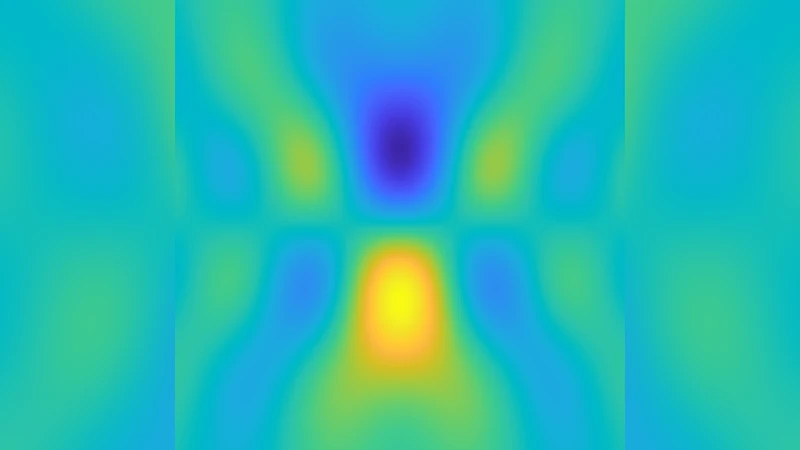
It is known that waves generated by ambient noise sources and recorded by passive receivers can be used to image the reflectivities of an unknown medium. However, reconstructing the reflectivity of the medium from partial boundary measurements remains a challenging problem, particularly when the background wave speed is unknown. In this paper, we investigate passive correlation-based imaging in the daylight configuration, where uncontrolled noise sources illuminate the medium and only ambient fields are recorded by a sensor array. We first analyze daylight migration for a point reflector embedded in a homogeneous background. By introducing a searching wave speed into the migration functional, we derive an explicit characterization of the deterministic shift and defocusing effects induced by wave-speed mismatch. We show that the maximum of the envelope of the resulting functional provides a reliable estimator of the true wave speed. We then extend the analysis to a random medium with correlation length smaller than the wavelength. Leveraging the shift formula obtained in the homogeneous case, we introduce a virtual guide star that remains fixed under migration with different searching speeds. This property enables an effective wave-speed estimation strategy based on spatial averaging around the virtual guide star. For both homogeneous and random media, we establish resolution analyses for the proposed wave-speed estimators. Numerical experiments are conducted to validate the theoretical result.
💡 Research Summary
This paper addresses a fundamental challenge in passive seismic (or acoustic) imaging: how to reconstruct reflectivity from ambient‑noise cross‑correlations when the background wave speed is unknown. The authors focus on the “daylight” configuration, where uncontrolled noise sources illuminate the medium and only the ambient fields recorded by a sensor array are available.
First, they formulate the standard daylight migration functional. Given the cross‑correlation (C(t,\mathbf{x},\mathbf{y})) between recordings at sensors (\mathbf{x}) and (\mathbf{y}), the migration operator with a searching wave speed (c) is defined as
\
Comments & Academic Discussion
Loading comments...
Leave a Comment