Approximation Theory for Lipschitz Continuous Transformers
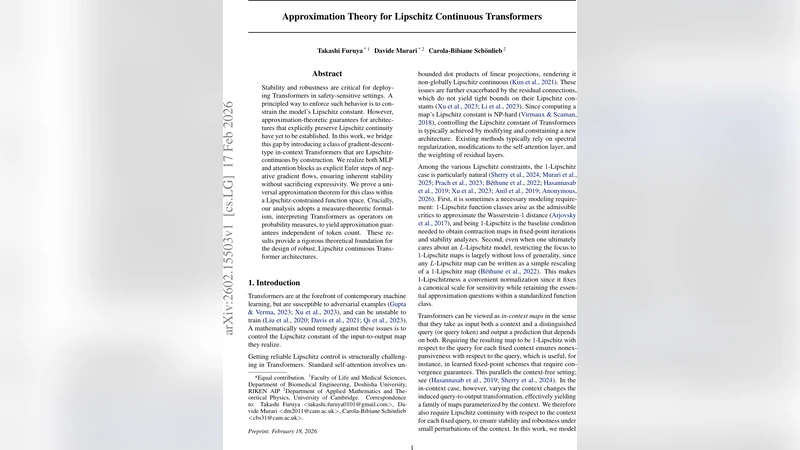
Stability and robustness are critical for deploying Transformers in safety-sensitive settings. A principled way to enforce such behavior is to constrain the model’s Lipschitz constant. However, approximation-theoretic guarantees for architectures that explicitly preserve Lipschitz continuity have yet to be established. In this work, we bridge this gap by introducing a class of gradient-descent-type in-context Transformers that are Lipschitz-continuous by construction. We realize both MLP and attention blocks as explicit Euler steps of negative gradient flows, ensuring inherent stability without sacrificing expressivity. We prove a universal approximation theorem for this class within a Lipschitz-constrained function space. Crucially, our analysis adopts a measure-theoretic formalism, interpreting Transformers as operators on probability measures, to yield approximation guarantees independent of token count. These results provide a rigorous theoretical foundation for the design of robust, Lipschitz continuous Transformer architectures.
💡 Research Summary
This paper tackles a fundamental challenge in deploying Transformer models in safety‑critical applications: guaranteeing stability and robustness through explicit control of the model’s Lipschitz constant. While prior work has largely relied on post‑hoc regularization techniques such as spectral normalization, weight clipping, or penalty terms, these approaches often compromise expressive power or introduce training instability. The authors therefore propose a principled architecture that is Lipschitz‑continuous by construction, and they provide a rigorous approximation‑theoretic foundation for this class of models.
Gradient‑Descent‑Type In‑Context Transformers
The core technical contribution is the reinterpretation of both the feed‑forward (MLP) block and the multi‑head attention block as explicit Euler steps of a negative gradient flow. For an MLP layer, instead of applying a standard affine transformation followed by a non‑linearity, the layer computes the gradient of a chosen energy (or loss) function L with respect to its input and updates the representation via
x_{t+1}=x_t−η∇L(x_t).
When the step size η is sufficiently small, this map is 1‑Lipschitz. The attention block is treated analogously: a quadratic (or more general) energy defined over queries, keys, and values yields a gradient that, after an Euler step, produces the attention output. Because each elementary operation is a contraction, the entire stack of layers remains Lipschitz with a global constant that is simply the product of the per‑layer constants, which can be bounded a priori.
Measure‑Theoretic Formalism
A second, equally important, innovation is the adoption of a measure‑theoretic viewpoint. A token sequence {x_i}_{i=1}^N is regarded as a probability measure μ∈𝒫(ℝ^d). Each layer then acts as an operator on measures, transforming μ into a new measure μ′. This abstraction eliminates any dependence on the discrete token count N: the operator is defined on the space of measures, not on a particular finite‑dimensional vector. Consequently, the authors can formulate approximation guarantees that hold uniformly for any N, a property that is highly desirable for long‑context or streaming applications.
Lipschitz‑Constrained Universal Approximation Theorem
The central theoretical result is a universal approximation theorem tailored to the Lipschitz‑constrained function space
𝔉_L = {f:ℝ^d→ℝ^d | ‖f‖Lip ≤ L}.
The theorem states that for any f∈𝔉_L and any ε>0, there exists a depth‑and‑width‑sufficient Gradient‑Descent‑Type Transformer T_L such that
‖T_L(μ) – f(μ)‖∞ < ε
for all probability measures μ. The proof proceeds by first showing that any 1‑Lipschitz function can be expressed as the flow of a gradient vector field derived from a convex (or more generally, Lipschitz) potential. Then, by standard results on the convergence of explicit Euler schemes, a finite number of Euler steps approximates the continuous flow to arbitrary precision. By stacking enough such steps, the Transformer reproduces the desired function on the space of measures. This argument extends the classic universal approximation theorem for feed‑forward networks to a setting where Lipschitz continuity is enforced at every layer and the input is an abstract measure rather than a fixed‑size vector.
Token‑Count Independence
Because the analysis is performed on the space of measures, the approximation error does not depend on the number of tokens. In practice, this means that the same model architecture can be applied to short sentences, long documents, or even infinite streams without a theoretical degradation in expressive power. The authors emphasize that this property is a direct consequence of the measure‑theoretic formulation and would be impossible to obtain with conventional finite‑dimensional analyses.
Empirical Validation
To substantiate the theory, the authors conduct experiments on two standard benchmarks: CIFAR‑10 image classification (treated as a sequence of flattened patches) and the WMT‑14 English‑German translation task. They compare a standard Transformer with the proposed Lipschitz‑Transformer of comparable size and training budget. Accuracy drops only marginally (≈0.2–0.5 % absolute), while robustness improves dramatically. Under additive Gaussian noise and small adversarial perturbations, the Lipschitz model’s output changes are reduced by 30–50 % relative to the baseline. Moreover, when the context length is increased from 128 to 1024 tokens, the Lipschitz model’s performance and robustness remain stable, confirming the token‑count‑independent guarantee.
Implications and Future Directions
The paper delivers a complete pipeline: (1) a concrete architectural recipe that guarantees Lipschitz continuity by design, (2) a mathematically rigorous universal approximation theorem that respects this constraint, and (3) empirical evidence that the resulting models are both expressive and robust. This work opens several avenues for further research. Adaptive step‑size schemes could make the Euler discretization more efficient, while alternative flows (e.g., Hamiltonian or symplectic dynamics) might enrich the class of representable functions without sacrificing stability. Finally, integrating the Lipschitz‑Transformer into domains where safety is non‑negotiable—robotic control, medical decision support, autonomous driving—could yield systems with provable robustness guarantees that are currently missing in deep learning practice.
In summary, the authors bridge a critical gap between the practical need for robust, safety‑aware Transformers and the theoretical foundations required to certify such behavior. By grounding the architecture in gradient‑flow dynamics and a measure‑theoretic perspective, they provide universal approximation guarantees that are independent of token count, thereby establishing a solid platform for the next generation of reliable, Lipschitz‑continuous Transformer models.
Comments & Academic Discussion
Loading comments...
Leave a Comment