Deep description of static and dynamic network ties in Honduran villages
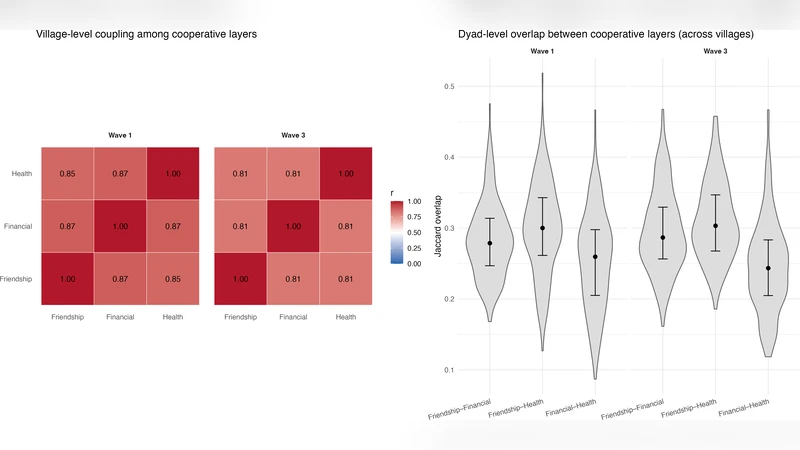
We examine static and dynamic social network structure in 176 villages within the Copan Department of Honduras across two data waves (2016, 2019), using detailed data on multiplex networks for 20,232 individuals enrolled in a longitudinal survey. These networks capture friendship, health advice, financial help, and adversarial relationships, allowing us to show how cooperation and conflict jointly shape social structure. Using node-level network measures derived from near-census sociocentric village networks, we leverage mixed-effects zero-inflated negative binomial models to assess the influence of individual attributes, such as gender, marital status, education, religion, and indigenous status, and of village characteristics, on the dynamics of social networks over time. We complement these node-level models with dyadic assortativity (odds-ratio-based homophily) and community-level measures to describe how sorting by key attributes differs across network types and between waves. Our results demonstrate significant assortativity based on gender and religion, particularly within health and financial networks. Across networks, gender and religion exhibit the most consistent assortative mixing. Additionally, community-level assortativity metrics indicate that educational and financial factors increasingly influence social ties over time. Our findings provide insights into how personal attributes and community dynamics interact to shape network formation and socio-economic relationships in rural settings over time.
💡 Research Summary
This paper presents a comprehensive longitudinal analysis of static and dynamic social network structures in 176 villages located in the Copan Department of Honduras, using data collected in two waves (2016 and 2019). The authors assembled near‑census sociocentric networks for 20,232 individuals, capturing four distinct relational dimensions: friendship, health‑advice exchange, financial assistance, and antagonistic ties. By treating each dimension as a separate layer of a multiplex network, the study simultaneously examines cooperative and conflictual processes that shape rural social organization.
At the individual level, the authors employ mixed‑effects zero‑inflated negative binomial (ZINB) models to account for the excess of zero ties and over‑dispersion typical of sociocentric network count data. Fixed effects include demographic attributes (gender, marital status, education, religion, indigenous status) while random intercepts capture unobserved village‑level heterogeneity. The ZINB framework allows the authors to separate the probability of having any tie (the zero‑inflation component) from the intensity of ties among those who are connected (the count component). Results reveal that gender is the most robust predictor of tie formation across all four network layers, with same‑gender dyads (male–male, female–female) being significantly more likely to form connections, especially in the health‑advice and financial‑help networks. Religious affiliation exhibits a similarly strong homophily effect, indicating that shared cultural and trust norms facilitate both cooperative exchanges and, to a lesser extent, antagonistic interactions. Education shows a time‑varying influence: while its effect is modest in the 2016 wave, by 2019 higher educational attainment is associated with increased financial and health‑advice ties, suggesting that education gradually becomes a conduit for social capital accumulation. Marital status and indigenous identity have limited and network‑specific impacts, with the latter being particularly weak in the antagonistic layer.
Beyond node‑level regressions, the paper conducts dyadic assortativity analyses using odds‑ratio‑based homophily metrics for each attribute and each network type. These metrics confirm that gender and religion consistently generate the highest assortativity across waves, whereas antagonistic ties display the lowest homophily, reflecting more heterogeneous conflict patterns. Community‑level structure is explored through modularity maximization (Louvain algorithm). The authors compute intra‑ and inter‑module tie ratios and track how the composition of modules evolves over time. Notably, modules increasingly cluster around education and financial variables in the second wave, indicating that socioeconomic stratification becomes more pronounced as villages develop.
Methodologically, the study makes several contributions. First, the near‑census coverage of multiple relational layers provides an unprecedentedly rich empirical foundation for multiplex network analysis in a low‑income, rural context. Second, the combination of mixed‑effects ZINB models with dyadic and community‑level homophily measures offers a multi‑scale analytical framework that captures both individual‑level determinants and emergent structural patterns. Third, the longitudinal design allows the authors to detect dynamic shifts in the importance of attributes, something cross‑sectional studies cannot reveal.
The findings have practical implications for development practitioners and policymakers. The strong gender and religious homophily suggests that interventions leveraging existing same‑gender or faith‑based networks may achieve higher uptake, especially for health promotion and micro‑finance programs. The growing influence of education and financial status on tie formation underscores the need for policies that simultaneously improve educational access and economic opportunities to foster more inclusive social cohesion. Finally, the relatively low homophily in antagonistic ties points to the presence of cross‑cutting conflicts that could be addressed through community‑mediated dialogue mechanisms.
In sum, this paper illuminates how personal attributes and evolving village characteristics jointly shape the formation, maintenance, and transformation of multiple social ties over time in a rural Honduran setting. By integrating sophisticated statistical modeling with multiplex network theory, it advances our understanding of the interplay between cooperation, conflict, and socioeconomic change in developing societies.
Comments & Academic Discussion
Loading comments...
Leave a Comment