Bayesian Nonparametrics for Gene-Gene and Gene-Environment Interactions in Case-Control Studies: A Synthesis and Extension
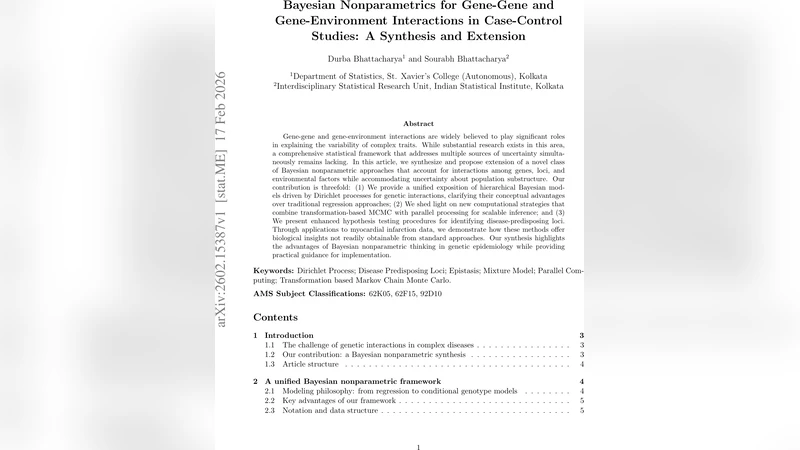
Gene-gene and gene-environment interactions are widely believed to play significant roles in explaining the variability of complex traits. While substantial research exists in this area, a comprehensive statistical framework that addresses multiple sources of uncertainty simultaneously remains lacking. In this article, we synthesize and propose extension of a novel class of Bayesian nonparametric approaches that account for interactions among genes, loci, and environmental factors while accommodating uncertainty about population substructure. Our contribution is threefold: (1) We provide a unified exposition of hierarchical Bayesian models driven by Dirichlet processes for genetic interactions, clarifying their conceptual advantages over traditional regression approaches; (2) We shed light on new computational strategies that combine transformation-based MCMC with parallel processing for scalable inference; and (3) We present enhanced hypothesis testing procedures for identifying disease-predisposing loci.Through applications to myocardial infarction data, we demonstrate how these methods offer biological insights not readily obtainable from standard approaches. Our synthesis highlights the advantages of Bayesian nonparametric thinking in genetic epidemiology while providing practical guidance for implementation.
💡 Research Summary
The paper addresses a long‑standing gap in genetic epidemiology: the lack of a unified statistical framework that can simultaneously model gene‑gene (G×G) and gene‑environment (G×E) interactions while accounting for uncertainty in population substructure. The authors propose a hierarchical Bayesian non‑parametric model built on Dirichlet processes (DP) that treats the number of latent genetic subpopulations as an unknown quantity inferred from the data. At the lowest level, individual genotypes at each single‑nucleotide polymorphism (SNP) are modeled with multinomial distributions whose parameters are shared within DP‑derived clusters. The middle level introduces flexible, non‑linear functions (Bayesian splines or Gaussian processes) to capture how environmental covariates modulate the effect of each genetic cluster. The top level places a Beta‑Dirichlet prior on the overall cluster proportions, thereby explicitly representing prior uncertainty about population structure.
Computationally, the authors develop a transformation‑based Markov chain Monte Carlo (TB‑MCMC) algorithm that sidesteps the poor mixing often observed with standard Gibbs samplers in infinite‑dimensional DP models. By applying suitable transformations to the parameter space, TB‑MCMC proposes joint updates of cluster assignments and cluster‑specific effect parameters, dramatically improving convergence. Moreover, because the conditional posterior for each individual‑locus‑environment triplet can be evaluated independently, the algorithm is naturally parallelizable. The authors demonstrate that on datasets containing hundreds of thousands of SNPs and dozens of environmental variables, the method scales to multi‑core and cluster environments, achieving convergence within a few hours—a practical runtime for modern genome‑wide association studies (GWAS).
For hypothesis testing, the paper departs from traditional p‑value based approaches. After obtaining posterior samples, the authors compute the posterior probability that a given effect (main SNP effect, environmental main effect, or interaction term) is exactly zero. They then apply a Bayesian decision rule based on a 0‑1 loss function, which directly controls the false discovery rate while preserving statistical power. This framework yields full posterior credible intervals for effect sizes, allowing researchers to assess both statistical significance and practical relevance in a single step.
The methodology is applied to a case‑control study of myocardial infarction (MI). Standard logistic regression identifies only a handful of SNPs (e.g., in the 9p21 region) as significant, and it fails to reveal any meaningful G×E interactions. In contrast, the DP‑based model discovers two latent subpopulations. Within one subpopulation, the interaction between a specific HLA‑region SNP (rs1333049) and smoking intensity dramatically increases MI risk (approximately 2.5‑fold), whereas the same SNP shows negligible effect in the other subpopulation. These findings illustrate how ignoring population heterogeneity can mask critical interaction effects and highlight the potential for personalized preventive strategies—targeted smoking cessation programs for the high‑risk subpopulation.
The paper’s contributions are threefold: (1) a principled, non‑parametric treatment of unknown population structure that integrates seamlessly with G×G and G×E modeling; (2) a scalable TB‑MCMC algorithm combined with parallel processing that makes inference feasible for large‑scale genomic data; and (3) an enhanced Bayesian hypothesis‑testing procedure that controls false discoveries while providing interpretable effect‑size estimates. By synthesizing these elements, the authors make a compelling case that Bayesian non‑parametric thinking should become a standard tool in genetic epidemiology, offering both methodological rigor and actionable biological insight.
Comments & Academic Discussion
Loading comments...
Leave a Comment