Noncooperative Coordination for Decentralized Air Traffic Management
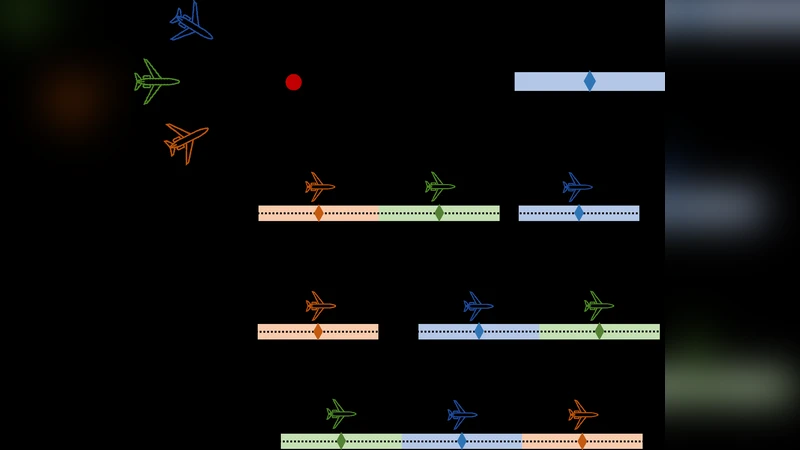
Decentralized air traffic management requires coordination among self-interested stakeholders operating under shared safety and capacity constraints, where conventional centralized or implicitly cooperative models do not adequately capture this setting. We develop a unified perspective on noncooperative coordination, in which system-level outcomes emerge by designing incentives and assigning signals that reshape individual optimality rather than imposing cooperation or enforcement. We advance this framework along three directions: scalable equilibrium engineering via reduced-rank and uncertainty-aware correlated equilibria, decentralized mechanism design for equilibrium selection without enforcement, and structured noncooperative dynamics with convergence guarantees. Beyond these technical contributions, we discuss core design principles that govern incentive-compatible coordination in decentralized systems. Together, these results establish a foundation for scalable, robust coordination in safety-critical air traffic systems.
💡 Research Summary
The paper tackles the problem of coordinating self‑interested agents in a decentralized air‑traffic‑management (DATM) environment where safety and capacity constraints are non‑negotiable. Traditional centralized or implicitly cooperative models fail to capture the reality of multiple independent stakeholders—airlines, airports, and control agencies—each optimizing its own objective with limited information. To address this, the authors introduce a “non‑cooperative coordination” framework that reshapes individual optimality by designing incentives and public signals rather than imposing direct cooperation or enforcement.
Three technical pillars are developed. First, the authors propose a scalable equilibrium‑engineering method based on reduced‑rank correlated equilibria. By projecting high‑dimensional strategy spaces onto low‑dimensional subspaces and incorporating uncertainty as probabilistic constraints, they achieve fast, near‑real‑time computation of approximate equilibria even in large‑scale simulations (hundreds of aircraft and dozens of sectors). Second, they design a decentralized mechanism that selects socially desirable equilibria without any enforcement authority. The mechanism relies on publicly observable signals—prices, quotas, or priority levels—that each agent can condition its strategy upon. Incentive compatibility and individual rationality are proved, and the mechanism is shown to steer the system toward equilibria that improve overall fuel consumption and delay metrics compared to random equilibrium selection. Third, the paper presents structured non‑cooperative dynamics with convergence guarantees. A best‑response plus stochastic‑exploration update rule is coupled with a Laplacian‑matrix structure, allowing the authors to prove global convergence to an ε‑approximate correlated equilibrium within a bounded number of rounds. Empirical results confirm rapid convergence across a wide range of realistic traffic scenarios.
Beyond the technical contributions, the authors distill four design principles for incentive‑compatible coordination in safety‑critical decentralized systems: (1) place incentives at the core of system design rather than relying on punitive enforcement; (2) minimize information asymmetry by using only publicly observable signals; (3) embed uncertainty awareness through probabilistic constraints and sampling‑based approximations; and (4) ensure scalability through low‑rank projections and distributed mechanisms.
The paper concludes by highlighting the broader impact of the framework: it offers a mathematically rigorous, computationally tractable, and policy‑relevant pathway to manage air traffic in a future where autonomy and decentralization are dominant. Future work is outlined in three directions: pilot deployments with real flight data, integration with regulatory policy to formalize incentive structures, and extension of the methodology to other critical infrastructures such as power grids and logistics networks. Overall, the study establishes a solid foundation for robust, scalable, and safety‑preserving coordination in decentralized air‑traffic management.
Comments & Academic Discussion
Loading comments...
Leave a Comment