A Review of Fairness and A Practical Guide to Selecting Context-Appropriate Fairness Metrics in Machine Learning
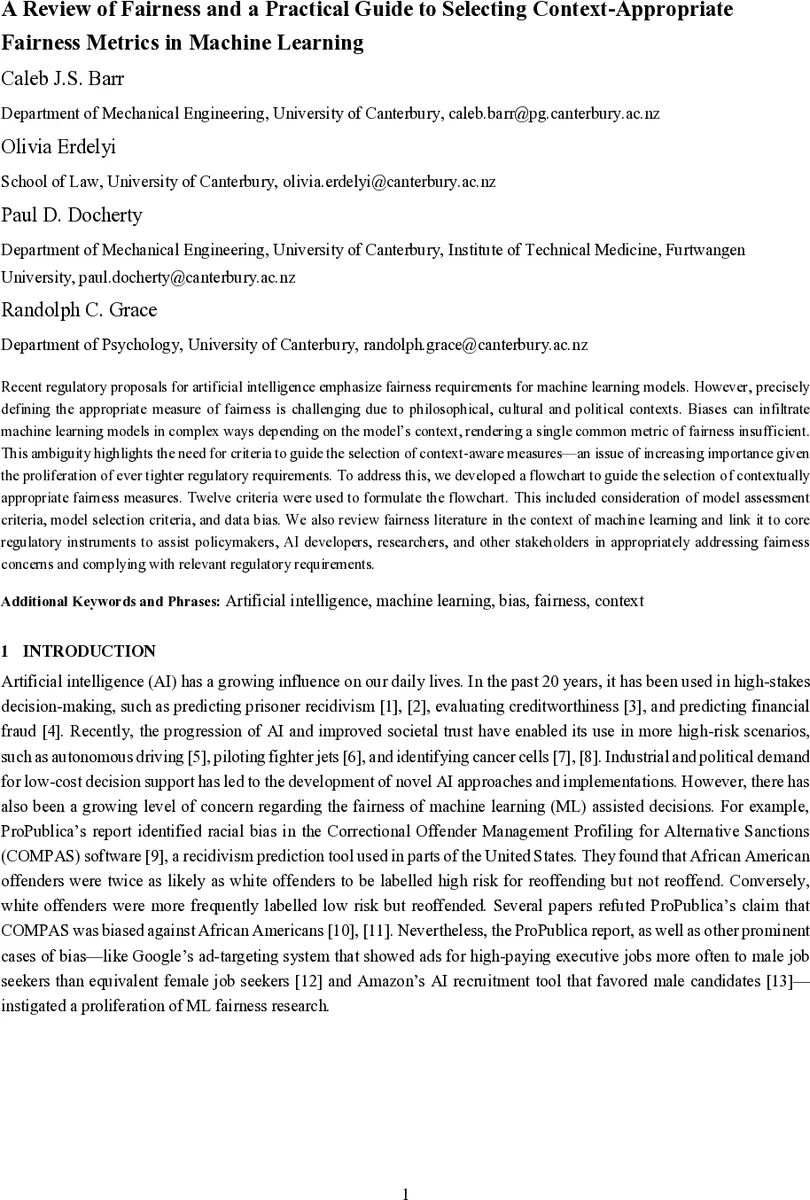
Recent regulatory proposals for artificial intelligence emphasize fairness requirements for machine learning models. However, precisely defining the appropriate measure of fairness is challenging due to philosophical, cultural and political contexts. Biases can infiltrate machine learning models in complex ways depending on the model’s context, rendering a single common metric of fairness insufficient. This ambiguity highlights the need for criteria to guide the selection of context-aware measures, an issue of increasing importance given the proliferation of ever tighter regulatory requirements. To address this, we developed a flowchart to guide the selection of contextually appropriate fairness measures. Twelve criteria were used to formulate the flowchart. This included consideration of model assessment criteria, model selection criteria, and data bias. We also review fairness literature in the context of machine learning and link it to core regulatory instruments to assist policymakers, AI developers, researchers, and other stakeholders in appropriately addressing fairness concerns and complying with relevant regulatory requirements.
💡 Research Summary
The paper tackles the pressing problem of selecting appropriate fairness metrics for machine learning (ML) systems in the face of increasingly stringent AI regulations worldwide. It begins by illustrating how high‑stakes AI applications—recidivism prediction, credit scoring, autonomous driving, advertising, and recruitment—have generated well‑known bias scandals (e.g., COMPAS, Google ad targeting, Amazon hiring tool). These incidents have spurred a surge of fairness research, yet regulators such as the EU AI Act, the U.S. Executive Order, and local statutes (e.g., New York City’s AEDT rules) provide only vague references to “fairness” or “bias” without concrete measurement guidance. Consequently, practitioners are left without clear operational criteria.
To bridge this gap, the authors first harmonize definitions of bias and fairness using ISO/IEC 22989, ISO/IEC TR 24027, and recent scholarly work. Bias is defined as a systematic difference in treatment of individuals or groups; the paper distinguishes between desired bias (necessary for a model to discriminate between classes) and undesired bias (unfair societal impact). Fairness is described as treatment or outcomes that respect established facts, beliefs, and norms without favoritism or unjust discrimination, acknowledging that fairness is culturally and legally contextual.
The authors then present a taxonomy of bias sources. Traditional literature separates bias temporally into data bias, algorithmic bias, and interaction bias. ISO/IEC TR 24027 adds a spatial perspective (development, deployment, operation). By integrating both views, the paper proposes a “bias interaction loop” that visualizes how data collection, measurement selection, omitted variables, sampling, algorithm design, and user feedback can feed into each other, forming a closed feedback system. The loop underscores that mitigating bias at a single stage is insufficient; a holistic lifecycle approach is required.
A comprehensive review of fairness metrics follows. The authors catalog group‑based measures (e.g., demographic parity, equalized odds, predictive parity), individual‑based measures (e.g., individual fairness, counterfactual fairness), and hybrid or utility‑based metrics (e.g., fairness‑aware loss functions, Pareto front analyses). For each metric they discuss applicability conditions (binary vs. multiclass, regression vs. classification, static vs. dynamic models) and typical trade‑offs (accuracy vs. fairness, multiple fairness notions simultaneously).
Recognizing that regulatory compliance demands concrete decision‑making, the core contribution is a decision‑support flowchart built on twelve selection criteria: legal jurisdiction, risk level, protected attributes, model purpose, performance constraints, data availability, stakeholder expectations, interpretability needs, deployment environment, monitoring capabilities, remediation options, and cost considerations. The flowchart guides users through a series of yes/no questions that narrow down the metric space to those that satisfy both regulatory mandates and technical feasibility.
The paper concludes with a discussion of challenges: metric incompatibility, the impossibility of satisfying all fairness notions simultaneously, the need for continuous monitoring, and the difficulty of operationalizing high‑level regulatory language. It calls for future work on quantitative integration of the bias interaction loop (e.g., Bayesian networks) and empirical validation of the flowchart across domains.
Overall, the study makes three valuable contributions: (1) a clear, standards‑aligned terminology bridge between policy and technical communities; (2) an enriched bias interaction model that captures both temporal and spatial dimensions; and (3) a pragmatic, criteria‑driven tool for practitioners to select context‑appropriate fairness metrics, thereby facilitating compliance with emerging AI regulations while maintaining model performance.
Comments & Academic Discussion
Loading comments...
Leave a Comment