Embedding Economic Input-Output Models in Systems of Systems: An MBSE and Hetero-functional Graph Theory Approach
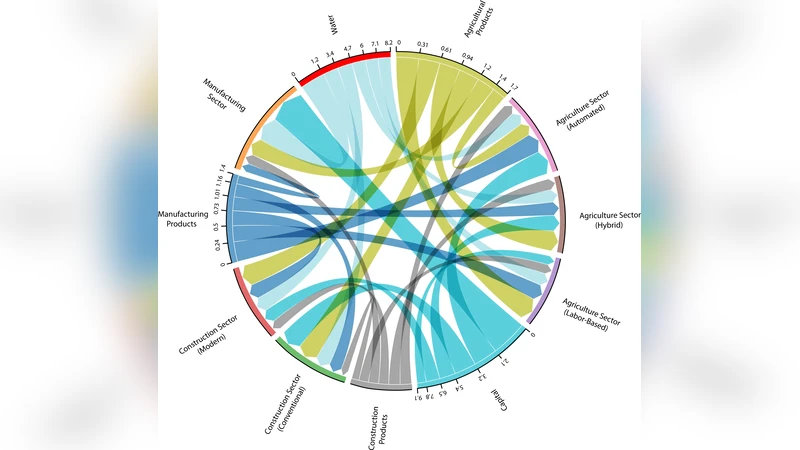
Characterizing the interdependent nature of Anthropocene systems of systems is fundamental to making informed decisions to address challenges across complex ecological, environmental, and coupled human-natural systems. This paper presents the first application of Model-Based Systems Engineering (MBSE) and Hetero-functional Graph Theory (HFGT) to economic systems, establishing a scalable and extensible methodology for integrating economic input-output (EIO) models within a unified system-of-systems modeling framework. Integrating EIO models into the MBSE-HFGT workflow demonstrates how the structural form and function of economic systems can be expressed through SysML’s graphical ontology and subsequently translated into the computational structure of HFGT. Using a synthetic Rectangular Choice of Technology (RCOT) example as a pedagogical foundation, the study confirms that the dynamics captured by basic EIO models, as well as other complex economic models grounded in EIO theory, can be equivalently reproduced within the MBSE-HFGT framework. The integration with MBSE and HFGT thus preserves analytical precision while offering enhanced graphical clarity and system-level insight through a shared ontological structure. By integrating modeling languages and mathematical frameworks, the proposed methodology establishes a foundation for knowledge co-production and integrated decision-making to address the multifaceted sustainability challenges associated with Anthropocene systems of systems.
💡 Research Summary
The paper introduces a novel methodology that embeds traditional Economic Input‑Output (EIO) models within a Systems‑of‑Systems (SoS) framework by leveraging Model‑Based Systems Engineering (MBSE) and Hetero‑functional Graph Theory (HFGT). Recognizing that modern Anthropocene challenges—climate change, resource scarcity, and coupled human‑natural dynamics—require integrated decision‑making across ecological, technological, and economic domains, the authors propose a workflow that translates the algebraic structure of Leontief‑type input‑output analysis into the graphical ontology of SysML and subsequently into the computational formalism of HFGT.
The first step of the workflow maps each economic sector to a SysML Block, while inter‑sectoral flows (the a_ij coefficients of the input‑output matrix) become directed connectors or Flow Ports in Internal Block Diagrams. This visual representation preserves the hierarchical decomposition familiar to systems engineers and enables traceability, version control, and reuse of economic sub‑models within larger engineering projects.
Next, the SysML model is algorithmically transformed into an HFGT representation. In HFGT, nodes are “hetero‑functional” entities that simultaneously embody production and consumption functions, and edges capture the quantitative flow of goods, services, or resources. The authors detail a systematic conversion where the A matrix of the EIO model becomes the adjacency matrix of the hetero‑functional graph. Consequently, the classic equilibrium equation X = (I − A)⁻¹ F (where X is total output, I the identity matrix, A the technical coefficient matrix, and F final demand) is recast as a series of graph‑based linear operations (node‑edge multiplications). This recasting retains exact numerical results while providing a system‑level visual narrative of how each sector’s functional role contributes to the overall economy.
To validate the approach, a synthetic Rectangular Choice of Technology (RCOT) example is constructed. RCOT abstracts a technology selection space into a rectangular lattice; each cell corresponds to a specific input‑output relationship. The authors model this lattice in SysML, translate it into an HFGT graph, and then solve the equilibrium using both the traditional Leontief method and the graph‑based computation. The solutions match perfectly, demonstrating that the MBSE‑HFGT pipeline can reproduce basic EIO dynamics without loss of precision. Moreover, the RCOT case illustrates how the methodology can handle more complex, multi‑technology configurations that are common in modern production systems.
Beyond the pedagogical example, the paper argues for the extensibility of the framework. Dynamic input‑output models (time‑varying A matrices), environmentally‑augmented IO models (including carbon, water, or energy footprints), and multi‑domain SoS models (e.g., energy‑water‑food nexus) can all be incorporated by extending the SysML ontology and the corresponding hetero‑functional graph. This unified representation enables cross‑disciplinary knowledge co‑production: economists, engineers, and sustainability scientists can work on a single, shared model, each contributing domain‑specific extensions while preserving a common analytical backbone.
The authors also discuss practical implications for policy and decision support. By embedding economic structures within a system‑engineered SoS model, stakeholders gain immediate visual insight into feedback loops, bottlenecks, and leverage points that are otherwise hidden in matrix‑only representations. The graphical clarity of SysML combined with the analytical rigor of HFGT supports scenario analysis, sensitivity testing, and the integration of non‑economic constraints (e.g., ecological thresholds).
In conclusion, the study delivers the first systematic integration of EIO modeling into a MBSE‑HFGT workflow, establishing a scalable, extensible, and visually intuitive platform for analyzing Anthropocene‑scale systems of systems. It preserves the quantitative exactness of classic input‑output economics while enriching it with system‑level semantics, thereby laying a foundation for integrated, interdisciplinary decision‑making needed to address the complex sustainability challenges of the 21st century.
Comments & Academic Discussion
Loading comments...
Leave a Comment