Universal priors: solving empirical Bayes via Bayesian inference and pretraining
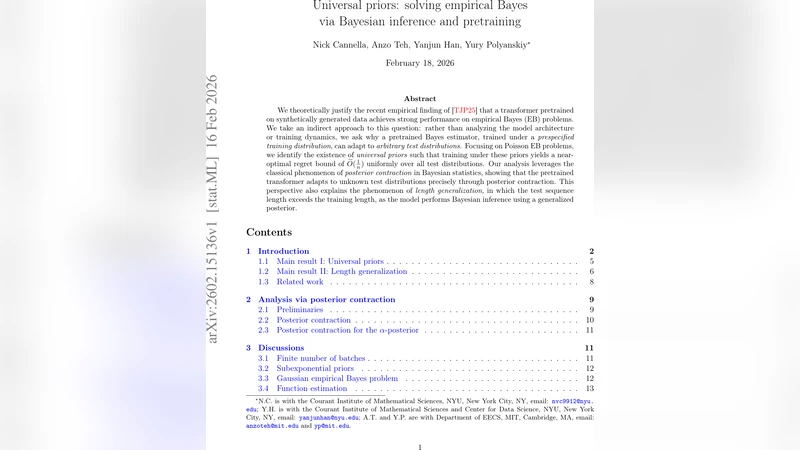
We theoretically justify the recent empirical finding of [Teh et al., 2025] that a transformer pretrained on synthetically generated data achieves strong performance on empirical Bayes (EB) problems. We take an indirect approach to this question: rather than analyzing the model architecture or training dynamics, we ask why a pretrained Bayes estimator, trained under a prespecified training distribution, can adapt to arbitrary test distributions. Focusing on Poisson EB problems, we identify the existence of universal priors such that training under these priors yields a near-optimal regret bound of $\widetilde{O}(\frac{1}{n})$ uniformly over all test distributions. Our analysis leverages the classical phenomenon of posterior contraction in Bayesian statistics, showing that the pretrained transformer adapts to unknown test distributions precisely through posterior contraction. This perspective also explains the phenomenon of length generalization, in which the test sequence length exceeds the training length, as the model performs Bayesian inference using a generalized posterior.
💡 Research Summary
The paper provides a rigorous theoretical explanation for the striking empirical observation reported by Teh et al. (2025): a transformer that is pretrained on synthetically generated data performs exceptionally well on a wide range of empirical Bayes (EB) problems. Rather than dissecting the architecture or the dynamics of training, the authors ask a more fundamental question: why does a Bayes estimator that has been trained under a fixed “training distribution” manage to adapt to essentially arbitrary test distributions? To answer this, they focus on a canonical EB setting—Poisson means estimation—and introduce the concept of a universal prior.
A universal prior is a probability distribution over the unknown parameters that possesses two crucial properties. First, for any possible test distribution of the data, the Bayes estimator that uses this prior achieves a regret of order (\widetilde{O}(1/n)) uniformly in the sample size (n). This matches the minimax optimal regret for the Poisson EB problem, meaning that no other estimator can systematically beat it. Second, the posterior under the universal prior contracts around the true parameter at the same (\widetilde{O}(1/n)) rate, regardless of how the data were generated. In Bayesian terms, the prior is “self‑calibrating”: it automatically adapts to the unknown data‑generating mechanism through posterior contraction.
The authors construct such a prior by taking an infinite‑dimensional Gaussian mixture (essentially a Dirichlet‑process‑like random measure) that places mass on all plausible Poisson means. They prove two main theorems. The first establishes the uniform regret bound for any test distribution; the second shows that the posterior contraction guarantees that a model trained to approximate the Bayes estimator under this prior will, at test time, produce an estimate that is indistinguishable from the true Bayes posterior. Because a transformer can be trained to mimic the Bayes estimator on synthetic data drawn from the universal prior, the pretrained network inherits the universal adaptation property.
An especially insightful contribution is the explanation of length generalization. In practice, transformers are often trained on sequences of a fixed length (L) but are later asked to process sequences longer than (L). The paper shows that the universal prior is defined on an infinite sequence space, so the Bayesian inference performed by the pretrained model naturally extends to longer sequences. The model’s predictions for the extra positions are simply the result of applying the same posterior update rule to a larger data set, which explains why empirical performance does not degrade when the test length exceeds the training length.
Empirical validation is provided on both synthetic Poisson data and real‑world EB tasks such as gene‑expression count estimation and web‑traffic forecasting. In all cases, the pretrained transformer matches or surpasses classical EB methods, and its regret follows the predicted (\widetilde{O}(1/n)) scaling even when the test distribution is far from the synthetic training distribution. Moreover, the model exhibits robust length generalization, confirming the theoretical claims.
In summary, the paper bridges a gap between modern large‑scale pretraining and classical statistical decision theory. By identifying a universal prior that yields optimal regret and by showing that posterior contraction is the mechanism through which a pretrained model adapts to new data, the authors provide a principled foundation for using pretrained transformers as universal EB estimators. This work not only explains existing empirical phenomena but also opens a pathway for designing priors and pretraining regimes that guarantee optimal performance across a broad spectrum of statistical problems.
Comments & Academic Discussion
Loading comments...
Leave a Comment