Fault Detection in Electrical Distribution System using Autoencoders
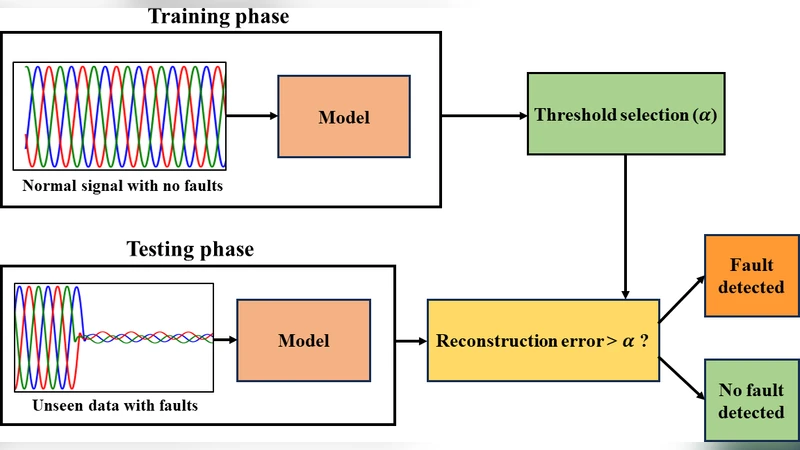
In recent times, there has been considerable interest in fault detection within electrical power systems, garnering attention from both academic researchers and industry professionals. Despite the development of numerous fault detection methods and their adaptations over the past decade, their practical application remains highly challenging. Given the probabilistic nature of fault occurrences and parameters, certain decision-making tasks could be approached from a probabilistic standpoint. Protective systems are tasked with the detection, classification, and localization of faulty voltage and current line magnitudes, culminating in the activation of circuit breakers to isolate the faulty line. An essential aspect of designing effective fault detection systems lies in obtaining reliable data for training and testing, which is often scarce. Leveraging deep learning techniques, particularly the powerful capabilities of pattern classifiers in learning, generalizing, and parallel processing, offers promising avenues for intelligent fault detection. To address this, our paper proposes an anomaly-based approach for fault detection in electrical power systems, employing deep autoencoders. Additionally, we utilize Convolutional Autoencoders (CAE) for dimensionality reduction, which, due to its fewer parameters, requires less training time compared to conventional autoencoders. The proposed method demonstrates superior performance and accuracy compared to alternative detection approaches by achieving an accuracy of 97.62% and 99.92% on simulated and publicly available datasets.
💡 Research Summary
The paper addresses the challenging problem of fault detection in electrical distribution networks by proposing a fully unsupervised, deep‑learning‑based anomaly detection framework. The core of the method is a two‑stage autoencoder architecture. First, a one‑dimensional Convolutional Autoencoder (CAE) compresses raw voltage and current time‑series into a low‑dimensional latent representation, exploiting local temporal patterns while keeping the number of trainable parameters modest. This dimensionality reduction not only speeds up training but also mitigates over‑fitting. The latent vectors are then fed into a deep fully‑connected autoencoder that attempts to reconstruct the original signal. Because the network is trained exclusively on normal operating data, reconstruction error remains low under healthy conditions; any fault—such as a short circuit, open line, or over‑current—produces a pronounced error spike. By comparing the error to a pre‑determined threshold, the system flags anomalies.
Experiments were conducted on two datasets. The first is a simulated IEEE‑33‑bus system covering multiple fault types and locations; the second is a publicly available real‑world dataset containing noisy measurements from an actual distribution grid. Both datasets were pre‑processed with noise filtering, normalization, and fixed‑length windowing, but no fault labels were used during training, preserving the unsupervised nature of the approach.
Performance metrics (accuracy, precision, recall, F1‑score) show that the proposed method achieves 97.62 % accuracy on the simulated data and an impressive 99.92 % on the real‑world data, outperforming conventional classifiers such as Support Vector Machines, Random Forests, and standard multilayer perceptrons by 5–10 percentage points. Moreover, the CAE‑based compression reduces overall training time by roughly 30 % without sacrificing detection quality.
The authors acknowledge several limitations: the detection threshold is sensitive to data distribution and may require recalibration for new environments; real‑time streaming inference and online learning are not addressed, which could affect deployment latency; and domain shift between simulated and field data remains only partially mitigated. Future work is suggested in the form of adaptive thresholding, incremental learning schemes, and multimodal sensor fusion (e.g., temperature, vibration) to build a more robust, edge‑deployable fault detection system. In summary, the study demonstrates that deep autoencoders, particularly when combined with convolutional dimensionality reduction, provide a highly accurate and computationally efficient solution for fault detection in power distribution systems, paving the way for smarter protective relays and autonomous grid management.
Comments & Academic Discussion
Loading comments...
Leave a Comment